

A Humanoid Robot From China Beat The World's Half-Marathon Record
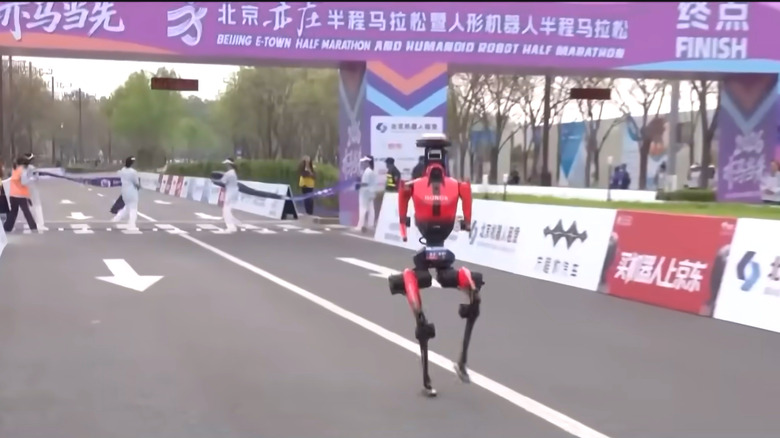
A robotics competition on the outskirts of Beijing may spark a new wave of Asimovian nightmares, as humanoid robots outraced the human competition on their way to record-setting results. The race, in its second iteration, showcased a Chinese robotics industry that is rapidly progressing toward commercial viability.
After an inaugural race riddled with technological snafus, the 2026 half marathon was a resounding success. Pitting autonomous and remote-controlled robots from more than 100 developers against 12,000 human competitors, the race saw massive improvements. Its winner, produced by Chinese phone company Honor, shattered the half marathon world record set by Ugandan runner Jacob Kiplimo earlier this year. Finishing the 13-mile race in an astounding 50 minutes and 26 seconds, the robot beat Kiplimo's record-setting time by almost seven minutes. Honor, an offshoot of Chinese tech giant Huawei, was responsible for the race's top three autonomous finishers.
Observers hail the competition as a showcase for China's runaway robotics industry. Not only did it quintuple its competitors, but it featured major technological leaps. In addition to limiting the slapstick collapses which epitomized the previous year's competition, attendees noted that the horde of robots showcased improved mechanics. To boot, Honor's winning autonomous humanoid finished over three times faster than the previous year's gold medalist.
Experts are quick to point out that the technology powering the robotic runners possesses major industrial applications. China, by far the world's leader in robotics, has begun deploying robots everywhere from the battlefield to fully autonomous farms. However, others note that China's humanoid robots still have a ways to go before they can dominate the economic and security landscape. But after its latest display of robotic dominance, the only question may be, will the rest of the world catch up?
Racing to the finish
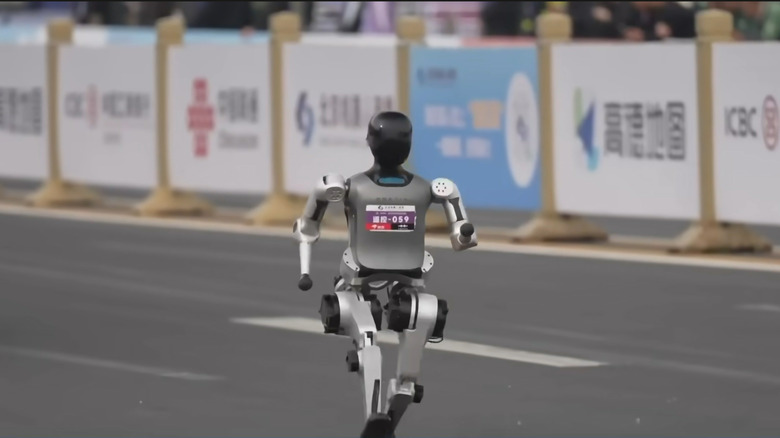
Held by economic development group Beijing Economic-Technological Development Area, the second Humanoid Robot Half-Marathon saw its bipedal runners take major strides from its inaugural competition. Its winner, a 5-foot-5-inch cherry red racer named Lightning, tore through the track, navigating turns, obstacles, and uneven terrain to shatter the world record. Navigating a more difficult course than the previous course, robots vastly outperformed a 2025 cohort that experienced a morass of prominent slapstick fiascos on its way to only 6 of 21 competitors crossing the finish line.
This time around, hundreds of millions of online viewers watched as robot sprinters ran at record-setting speeds. For the most part, this year's crop navigated the course without the catastrophic hiccups that defined last year's race. 2025's champion from Beijing-based lab X-Humanoid, for instance, more than halved its championship time. In all, almost 40% of the racers were fully autonomous.
Of course, the adoration following the event needs a semi hefty dose of salt. While teams dramatically increased the speed and proficiency of their robots, they were also allowed to help their autonomous humanoids on the course, peeling them off the asphalt in the event of a crash, which occurred throughout the competition. One notable entrant from China's largest humanoid robot manufacturer, Unitree, left the half marathon in the same fashion that I would: on a stretcher. Even Lightning, China's lauded speed demon, needed to be resurrected from the pavement after a dramatic collision near the finish line.
The grand robotics race
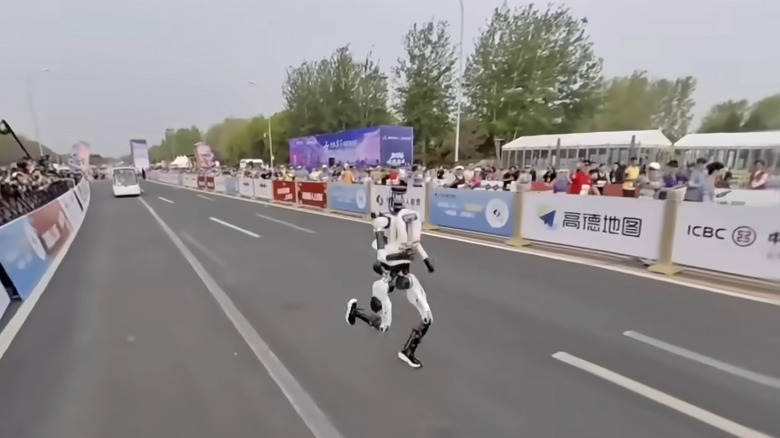
Beijing's cybernetic race was more than a showcase for robotic athletes. As Du Xiaodi, an engineer on the winning robotics team, pointed out, "running faster may not seem meaningful at first, but it enables technology transfer, for example, into structural reliability and cooling, and eventually industrial applications" (via Reuters). In one sense, the race showcases rapid progress toward these functionalities. However, some experts are quick to point out that the processes utilized in the race aren't as economically translatable as some suggest and fail to address the critical hurdles separating the industrial robotics industry from wide-scale usage, lacking the advanced dexterity and perception to accomplish difficult, non-repetitive tasks. As Xue Qingheng, a competitor in the race, described it, "robots today have the body of Mike Tyson but are still missing a brain like Stephen Hawking. Once the brain problem is solved, the scope for imagination here is immense" (via NBC News).
The half-marathon is indicative of a Chinese robotics industry far ahead of its American competitors. Beijing has invested heavily in developing its robotics pipeline, making it a pillar of its 2026 5-year development plan and announcing a $158 billion state-backed capital fund in 2025. Spurred by advantages in manufacturing and component supply chains, China capitalized on its dual-purpose robotics funding, holding an estimated two-thirds of global patents and deploying more industrial robots than every other country combined. One reason for this emphasis is its ability to alleviate the effect of China's declining population on the world's largest manufacturing sector. On balance, China is poised to dominate the impending explosion of dark factories that eliminate the need for vast workforces, accounting for roughly 90% of humanoid robotics exports (via BBC). By broadcasting its humanoid sprint, Beijing showcased its lead in a more consequential race.