

Google Pixel 10a Review: What's New?
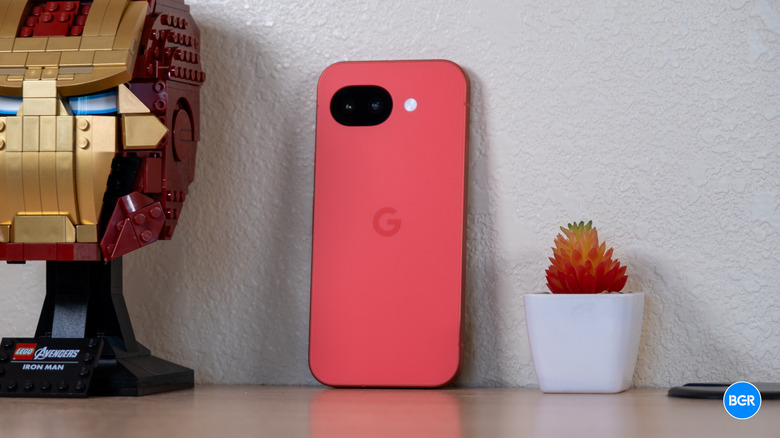
The Pixel 10a is Google's latest budget-friendly phone, landing at the same $500 price point as the previous-generation Pixel 9a. Like the 9a, the Pixel 10a is built to offer access to Google's take on Android, solid camera chops, and more, without breaking the bank.
But the Pixel 10a is an interesting release. At first glance, you'd be hard-pressed to find a single difference between it and the Pixel 9a. There isn't even a new chip — the Pixel 10a still has the Google Tensor G4 chip, the same camera hardware, and more or less the same design as last year's model. So, if all that is the same as before, what exactly is the point of the Google Pixel 10a?
Design
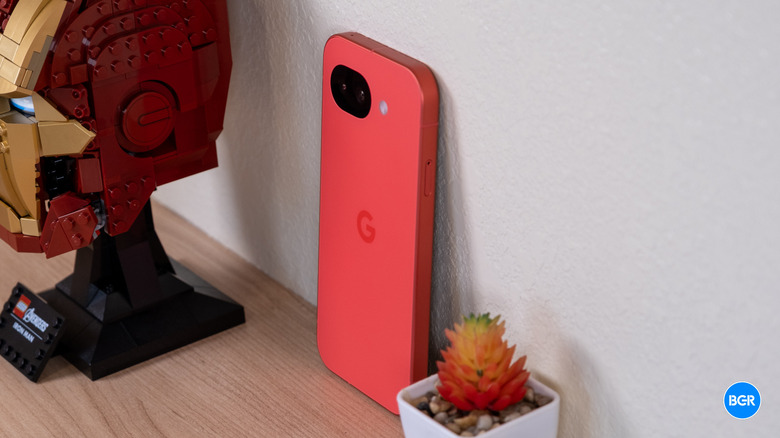
The first thing you'll notice about the Pixel 10a's design, apart from the fact that it's mostly the same as the Pixel 9a, is the fully flat back. The Google Pixel 9a already had what Google called a flush camera on the back of the phone, but in reality, it wasn't actually flush. It was slightly raised, even if only by a tiny amount. On the Pixel 10a, that changes, and the camera sits completely flush with the back of the Pixel 10a.
The body is made from a composite plastic, and it feels solid and durable in the hand. Sure, it's not the glass-and-metal construction you'd get on a flagship, but honestly, it still feels fine. Plastic is lighter, way more resistant to shattering, and arguably more practical at this price.
The rest of the design is solid. The phone comes in a few different colors, including Obsidian, Lavender, Berry, or Fog. I have the Berry model, and I really like the look of it. It's bright and vibrant, and I'm glad brighter colors are becoming more common on phones.
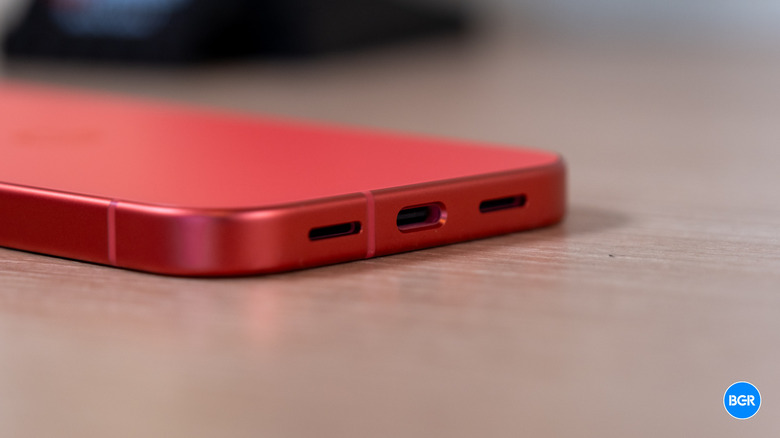
The rest of the design is what you would expect to see. There's the volume rocker and power button on the right edge and a USB-C port on the bottom. There are no additional buttons or controls, so don't expect a dedicated AI button here.
Overall, the Google Pixel 10a looks and feels decently premium despite its lower price. Yes, the plastic build is less durable than metal and less high-end than glass, but it still doesn't feel overly cheap or low-quality.
Display
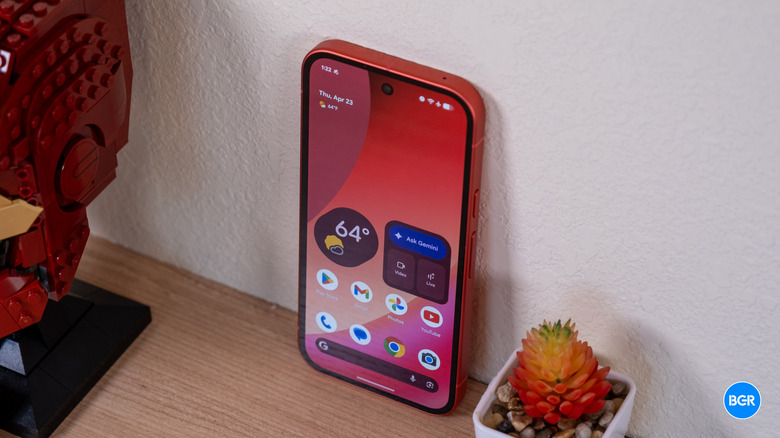
The Pixel 10a sports a 6.3-inch Actua pOLED display at 1080 x 2424 pixels — hitting a 422 pixel-per-inch density. It has a 20:9 aspect ratio and an adaptive refresh rate that scales between 60Hz and 120Hz depending on what's happening on screen. It's sharp, smooth, and it handles everything you need it to easily.
One of its greatest strengths is how bright it is — and display brightness is one of the main differences between the Pixel 9a and the Pixel 10a. The Pixel 10a is supposed to hit 3,000 nits of peak brightness, and I actually measured 3,200 nits. The extra brightness compared to the Pixel 9a is helpful in direct sunlight, but it's not a massive increase over the previous-generation phones, so if you couldn't see content well on the Pixel 9a, don't expect to suddenly be able to see it on the Pixel 10a. Still, more brightness is better, of course.
Brightness aside, the display is responsive and relatively colorful. I found it to be quite color accurate too. Sure, it doesn't have the ability to range all the way down to 1Hz for battery saving, but that doesn't impact the look or feel of the display, just how energy efficient it is.
Performance
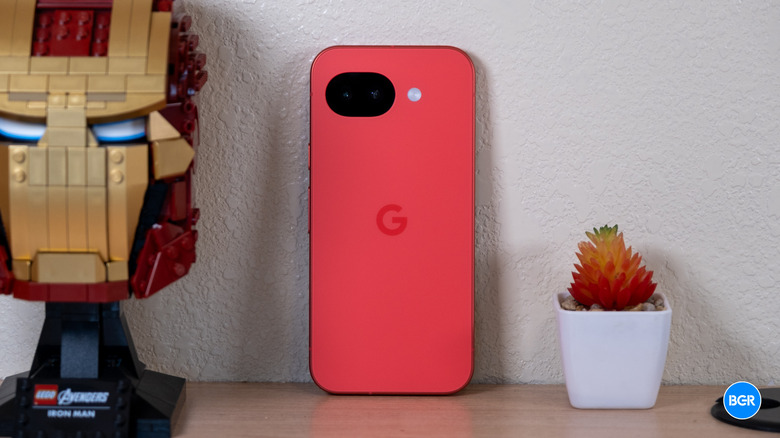
Under the hood, you get the Google Tensor G4 — carried over from the Pixel 9a without any changes. It's paired with 8GB of RAM and either 128GB or 256GB of storage. It's a little strange that Google kept the exact same chip for the Pixel 10a. Even the most minor generational updates usually bring a new processor, at least. The Pixel 10a doesn't even have that.
Day to day, performance is mostly fine though. Productivity apps, social media, multitasking, and general navigation all run without stutters or hang-ups. Google's tight software-hardware integration clearly helps smooth things out. But the Tensor G4 was never a powerhouse for GPU-heavy tasks, and that weakness is harder to ignore now that it's a year-old chip. This isn't specifically a Pixel 10a problem — it's a broader Tensor issue — but running last-generation silicon makes it tougher to look past.
If your typical phone usage revolves around messaging, browsing, media, and photography, you'll be perfectly happy. If you're planning to push the phone with demanding games or resource-heavy apps, though, you'll feel the ceiling.
Battery and charging
The Pixel 10a comes with a 5,100 mAh battery, and real-world battery life lands roughly in line with the Pixel 9a. That's decent but not remarkable. If your usage is average, you should comfortably get through a full day. Power users who are constantly on their phones, running navigation apps, or streaming for hours might need to top up before bed.
Charging speeds got a modest bump. I was able to hit almost 60% in 30 minutes of wired charging, which is a noticeable step up from the roughly 45% I got from the Pixel 9a in the same window. It's not blazing fast by 2026 standards, but it gets the job done.
Wireless charging is a little disappointing. The Pixel 10a tops out at 10W over standard Qi, and there's no Pixel Snap or Qi2 magnetic charging support. This is a real letdown given that the rest of the Pixel 10 family has embraced magnetic charging. It feels like a meaningful omission — especially if you rely on wireless charging or were looking forward to magnetic alignment convenience.
Camera
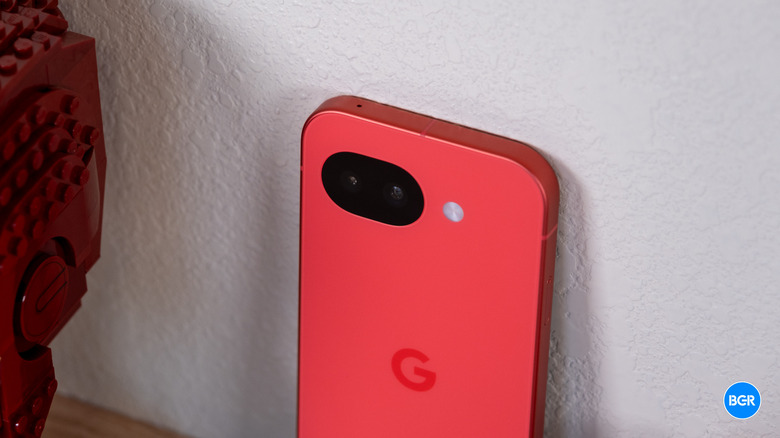
Camera hardware on the Pixel 10a is identical to the Pixel 9a, with a 48MP main sensor, a 13MP ultrawide camera, and a 13MP front camera. There's no telephoto camera, and digital zoom maxes out at 8x.
It's worth pointing out that the budget phone landscape has shifted over the past few years. Competitors like the Nothing Phone (4a) Pro now pack triple rear camera systems with dedicated telephoto lenses at similar prices to the Pixel 10a. The Pixel 10a's dual-camera setup is starting to feel a bit limited from a hardware versatility standpoint.
That said, shots from all three cameras come out sharp and well-exposed in daylight and indoor conditions. Color tuning has been tweaked compared to the 9a — the look still leans vivid rather than strictly accurate, with landscapes and foliage coming out punchy and saturated, but the processing feels slightly more natural overall. The ultrawide also matches the main camera's color output more closely than it did on the 9a, which makes switching between lenses feel more consistent.
Low light images turn out well too. Main-camera detail in dim conditions is cleaner than the Pixel 9a. Digital zoom holds up better too, especially in the 2x to 5x range, with cleaner detail and less aggressive smoothing. Past 6x, though, detail falls apart quickly into the kind of processed mush you'd expect from a phone without an optical telephoto.
The front camera improved as well. Backlit selfies hold up better now when it comes to dynamic range — windows behind you don't blow out as badly, and your face stays more naturally exposed.
As you would expect, the Pixel 10a comes with Google's full computational photography toolkit, including features like Auto Best Take, Top Shot, Magic Eraser, Photo Unblur, Portrait Light, speech enhancement for video, and more. Whether or not you actually use these features is another question, but they are there.
Software
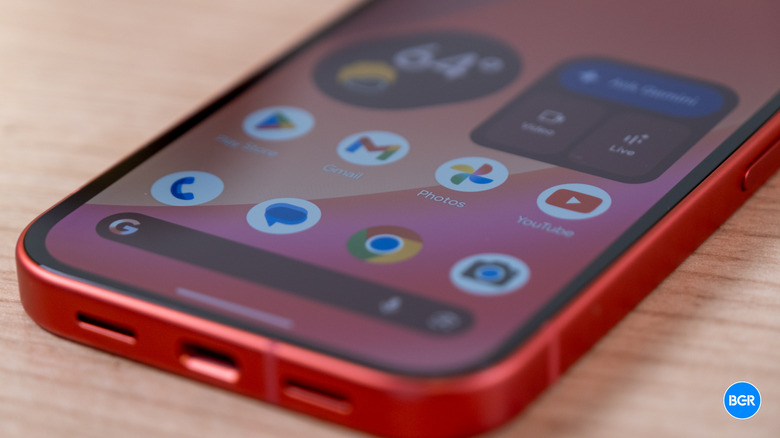
The Pixel 10a ships with Android 16, and the software experience is one of the phone's biggest strengths. Google's version of Android is clean, well-designed, approachable, and responsive. Because Google makes it, you don't have to deal with duplicate apps, bloatware, or the unwanted junk that clutters up phones from so many other Android manufacturers. It's been my favorite approach to Android for years, and that hasn't changed.
Software support is also good. Google has committed to updates through Android 23, meaning the Pixel 10a will get security patches and OS updates until 2033. That's an exceptional support window for a $500 phone — in fact, it's one of the best in the industry at any price.
Conclusions
The Pixel 10a is still a great budget Android phone. The camera is solid and the software experience is excellent. But it's hard to look past just how little has actually changed from the Pixel 9a. With the same chip and same camera hardware, the 10a feels more like a refinement than a proper new generation.
It's an interesting comparison to look at what Apple did with the iPhone 17e versus the iPhone 16e. Apple's iterative update got the basics right, like upgraded silicon and the addition of MagSafe, which was missing on the iPhone 16e. Google didn't do either of those things. It didn't even update the chip. That doesn't make the Pixel 10a a bad phone, but it does make it a boring one, and a somewhat confusing proposition if you're trying to decide between it and the phone it replaced.
The competition
There's no shortage of budget competition, though much of it sits at slightly higher price points. The Samsung Galaxy S25 FE, OnePlus 15R, and iPhone 17e all play in this general space but cost more than the Pixel 10a's $500 asking price.
At this specific price point, I think the Nothing Phone (4a) Pro is the better phone overall. It gives you a more versatile triple-camera system with a telephoto lens, comparable day-to-day performance, slightly better battery life, and reasonably clean software. That said, the Pixel 10a remains a great device — especially if Google's software experience and long-term update commitment are what matter most to you.
Should I buy the Google Pixel 10a?
Yes, but you should also consider the Nothing Phone (4a) Pro.