

NASA Plans To Put A Nuclear Reactor On The Moon By 2030 - Here's Why
While the Artemis II mission captured the public's imagination and revitalized interest in space exploration, it's only the first step. The ultimate goal of the Artemis program is to establish a permanent footprint on the moon by way of a base on the lunar South Pole. However, any such colony will require sustained nuclear power to drive vital systems like life support. Despite slashing the agency's budget, the White House has tasked NASA with providing said lunar nuclear development.
Nuclear power is the only viable solution to power a moon base because of the challenges presented by other fuel sources. Continuously transporting traditional fossil fuels from Earth is unfeasible due to the logistics and expense of such a project, and because the lunar surface alternates between two weeks of sunlight and two weeks of night, solar is out as well. There's also no wind nor flowing water on the moon's surface to drive turbines, leaving nuclear as the only realistic option.
The White House has instructed agencies to begin prototyping nuclear reactors that can be deployed to the lunar orbit as soon as 2028, with surface reactors following by 2030. Here's how Washington envisions the timeline, giving us a better idea of NASA's future of space exploration including an eventual mission to Mars.
The blueprint for lunar nuclear power by 2030
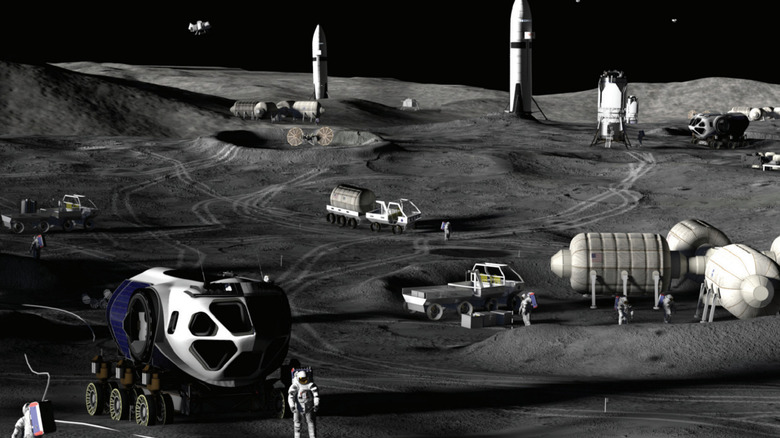
To achieve its goal of deploying nuclear power to the moon for an eventual lunar base, the White House has created a program dubbed the National Initiative for American Space Nuclear Power. As part of the initiative, the White House has instructed NASA to begin prototyping nuclear reactors with the goal of developing a mid-power reactor suitable for the moon's surface by 2030. In the memorandum laying out the mission, NASA defines a mid-power reactor as capable of generating at least 20 kWe (kilowatts electrical) — enough power to run about 10–15 average U.S. homes at once — "during at least 3 years in orbit and at least 5 years on the lunar surface."
As a stepping stone, the memo recommends that NASA consider developing low-power (1 kWe) reactors that can share components or development insights with higher-powered reactors. The ultimate goal of the program is to supply more potent generators, capable of outputting 100 kWe or more, enough power for 60-90 average U.S. homes. Low- to mid-power reactors should all be built, according to the memo, with extensibility to a higher output level in mind.
NASA's long term nuclear ambitions
The initiative was revealed in an executive order issued on December 18, 2025, and it was formalized at an event in April by Office of Science and Technology Policy (OSTP) Director Michael Kratsios and NASA Administrator Jared Isaacman. An early goal is to create nuclear electric propulsion (NEP) systems alongside the reactors, which will pair with "launch vehicles that are or will be readily available by 2029". Part of the NEP side of the program is repurposing the Power and Propulsion Element that was originally developed for the Gateway (a scrapped space station meant to orbit the moon) by 2028.
It will become the Space Reactor 1 Freedom (SR-1), an NEP system featuring a 20-kWe fission reactor at one end that will power ion thrusters at the other. The SR-1 will deposit three robot helicopters on Mars before continuing its journey further into the solar system. The Ingenuity-class helicopters will scout the Marian surface for potential landing sites for future human missions as part of a project called Skyfall.
NASA has released a "user's guide" that lays out three phases of research, development, and deployment all building to an operational moon base. According to the guide, a moon colony will allow researchers to "develop, test, and demonstrate needed technologies, capabilities, systems, and operational paradigms for future human missions to Mars" and "provide experts with data needed to understand the impacts of long-duration spaceflight missions on human explorers."