

The US Company That Wants Samsung's Foldables Banned Might Have A Big Timeline Problem
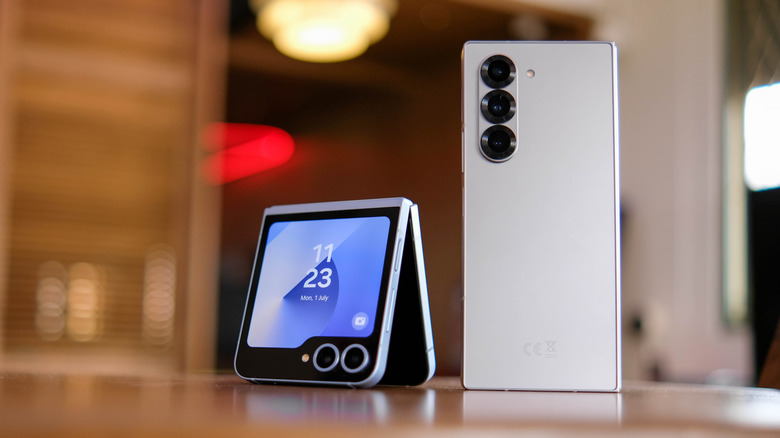
Patents are not a new thing in the world, and companies file them in order to protect their new inventions, as they can be valuable assets that provide a competitive edge. That's why patent infringement, or using a person's or a company's patent without permission, is a serious offense, and companies get fined millions or even billions if found guilty. For instance, Apple paid Nokia $2 billion in 2018 to settle a long-running patent dispute, so being accused of infringing a patent is a grave legal matter. Samsung has just found itself in hot water after a U.S. company, Lepton Computing, sued it over patent infringement.
Lepton Computing has recently filed a lawsuit against the South Korean tech company in the U.S., accusing Samsung of infringing its foldable phone patents. The company claims in the lawsuit that it was "the original developer of foldable phones" and, as a result, it's seeking damages, royalties, and a permanent ban on Samsung's Galaxy Z series of foldable phones. The lawsuit says Samsung infringed upon several core technology patents, nine to be specific, which are key to how foldable smartphones work, according to South Korean news site Seoul News. Lepton says it began researching technologies related to foldables in 2008, long before the first models hit the shelves, and it even released the "first American foldable smartphone prototype" dubbed Lepton Flex.
However, Lepton's lawsuit might face a hurdle in the courts since the nine patents it claims Samsung infringed were filed much later, after Samsung had already released its first foldable phone in September 2019. Among the nine patents, the earliest one was registered on June 29, 2021, and, as a result, the company might have a hard time proving its allegations in court.
Lepton holds patents on how foldable phones work
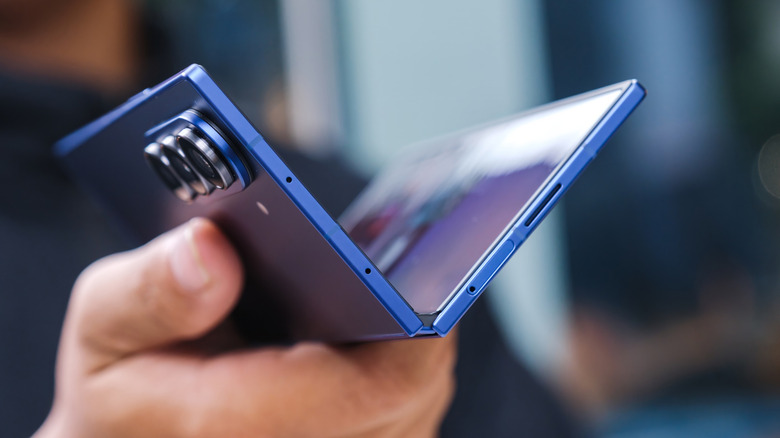
The nine patents that Lepton claims Samsung infringed upon are core to the working mechanism of foldable phones. These patents highlight the basic working mechanism of foldables, from how the hardware is put together to some of the software behaviours. One of the patents touches on app continuation, where opening the foldable switches an app from the outside screen to the internal one. Another one details the folding mechanism, where the screen has to leave some space to avoid damage. It also discusses the structural stability needed to ensure durability, and some also highlight the general structure of a folding phone with a normal rigid screen on the outside and a folding one on the inside.
Its patents also detail how the various necessary parts required for a foldable phone, like the magnets, hinge structure, cameras, and microphones, are integrated into the device. But of course, since the patents were filed after Samsung released its foldable phone, there will likely be a fierce tussle in court over whether they hold any legal weight either in general or specifically against devices that launched after the filings.
Samsung will certainly contest Lepton's patent infringement lawsuit

Lepton Computing's patent infringement lawsuit mentions Samsung's entire lineup of foldable phones, which includes the book-style Galaxy Z Fold, flip-style Galaxy Z Flip series, and even the recently introduced $2,500 Samsung Galaxy Z TriFold that folds twice. While there's a timeline discrepancy between the launch of Samsung's first foldable phone and the registration date of the earliest patent mentioned in the lawsuit, Lepton reveals some interesting details in its court filing. Lepton claims that it held discussions with Samsung regarding cooperation on foldable smartphones as far back as 2013 and says it even shared its prototype and revealed under-the-hood technology details with senior Samsung officials.
As a result, the company claims that Samsung knew about its technology and intentionally infringed on it. Tech giants like Samsung aren't new to lawsuits, and this latest one won't be the company's first rodeo. Samsung even fought with Apple in court back in 2011, where the latter sought to block the sale of the former's tablets, claiming they infringed on the iPad. The current lawsuit by Lepton will likely take time before coming to a conclusion, and how it goes is anyone's guess at this point. However, Samsung will certainly contest it in court with all its might, especially considering that it's the leader in the foldable category and the patents in question are core to how foldables work.