

At 8 Billion Light Years Away, This Laser Just Set Records - And It Was A Lucky Find
Scientists have discovered a microwave laser beam 8 billion light-years away that's the most powerful and distant of its kind. The study's author told New Scientist the signal is roughly 100,000 times the luminosity of a star. It's so bright, researchers created a new category for it: the "gigamaser."
A maser is the radio-wavelength version of a laser. Both are focused, coherent beams of electromagnetic radiation, except a laser emits wavelengths your eyes can see, while a maser emits radio waves you can't see. Hydroxyl masers, like the one discovered, form when two galaxies crash into each other. The collision compresses gas and excites hydroxyl molecules, which then amplify passing radio waves into a concentrated beam. That amplification produces a maser with a 7-inch wavelength, far longer than visible light.
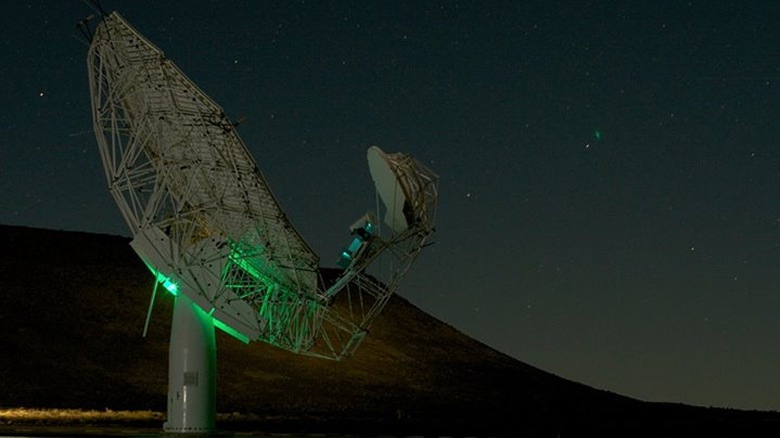
A team of astronomers used the MeerKAT radio telescope in South Africa to discover the maser in the galaxy HATLAS J142935.3–002836. The galaxy is in the middle of a violent merger more than 8 billion light-years away, making it the farthest signal of its kind ever recorded. The Milky Way will face a similar merger one day, though on a much smaller scale. The team made the HATLAS maser discovery thanks to a little luck and a lot of cutting-edge tech.
How a lucky galaxy alignment revealed the record-breaking laser
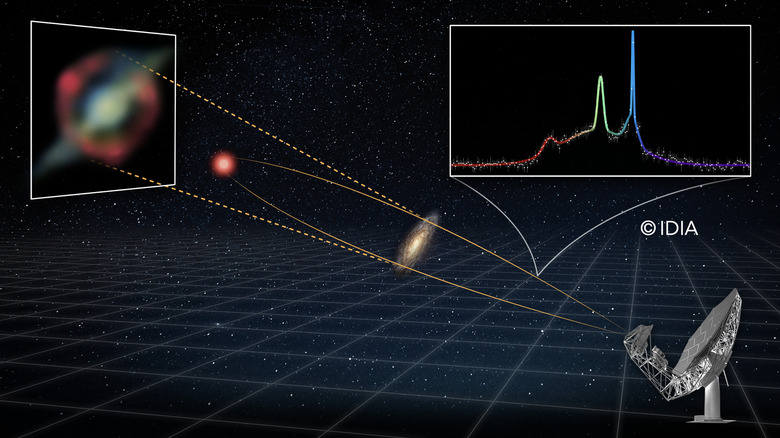
We're seeing the maser and its galaxy as they were more than 3 billion years before Earth existed. Normally, a signal from that distance would be too faint for the MeerKAT to detect. Except researchers got a little bit of luck. In this case, stars were not aligned, but a galaxy was. It happened to be sitting in near-perfect alignment between the Earth and HATLAS J142935.3–002836. The galaxy's sizable mass of stars, gasses, planets, black holes, and dark matter curved local space-time, amplifying the signal as it passed through. The maser's signal rode that curve into the MeerKAT's receivers. Without the alignment and amplification, the record-breaking space laser would have remained hidden.
It took more than luck to make the discovery, though. The MeerKAT is one of the most sensitive radio telescopes in the world, designed to catch faint signals from across the universe. It pulls in about 2.5 terabytes of data per hour. Astronomers use advanced computing and custom-built processing pipelines to sift through the data. It's how they found the gigamaser's signal. The team hopes to find hundreds to thousands more. Masers tend to appear in the most violent galaxy mergers that trigger starbursts and feed supermassive black holes, which are more common than we thought. Studying them could reshape what astronomers know about how galaxies form and evolve.