

Nvidia CEO Jensen Huang Claims The Company Now Has 'Zero Percent' Market Share In China — Here's Why
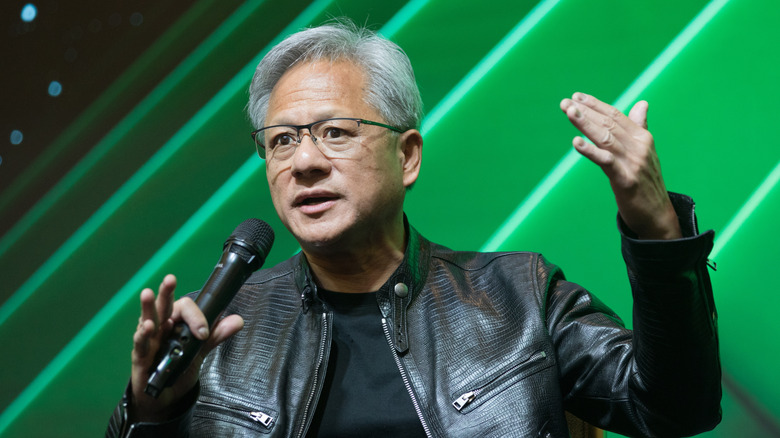
Nvidia CEO Jensen Huang was recently featured on an episode of "Memos to the President" hosted by nonpartisan political group Special Competitive Studies Project. In the interview, Huang said that Nvidia's presence in China's artificial intelligence (AI) industry is practically zero. Once believed to have held around a 70% share, Nvidia has now been kicked to the curb when it comes to AI hardware in China.
This comes after years of restrictions laid out by the Biden administration and reinforced by the subsequent Trump administration. These export restrictions put a total block on graphics processing units (GPUs) above a certain power threshold from being shipped to China. While they focused on powerful chips like the H200, they also collided with consumer-level tech, like the RTX 4090, which was deemed too powerful for export to China. As a result, Nvidia made weaker chips or alternatives, like the H20 and 4090D, but still ran into blocks from both sides of the ocean.
However, Huang's reasoning for this spectacular drop in dominance is due to the government's policies. Critiquing the policies in place that prevent freedom of exporting chips, Huang said, "Conceding an entire market the size of China probably does not make a lot of strategic sense, so I think that has already largely backfired. Maybe it made sense at the time, but I think the policy really needs to be dynamic and needs to stay with the times." The policy led to individuals being arrested for trying to export H200s into China.
Nvidia effectively lost China after export restrictions
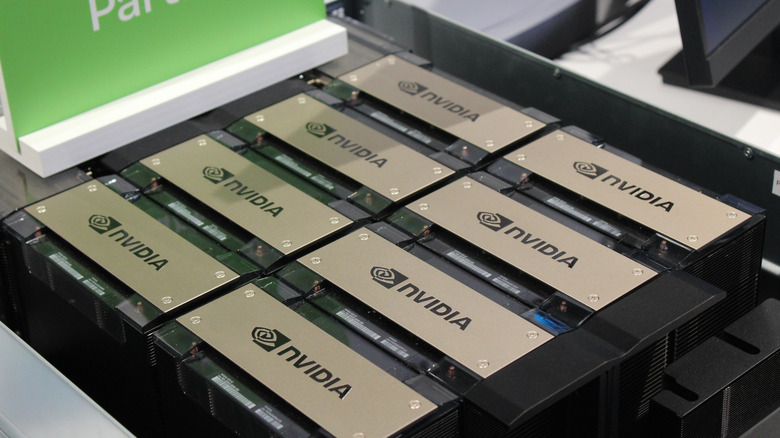
Despite some changes to policy, like the U.S. moving from a total blanket ban to a "case-by-case" situation in 2026 and approving H200 shipments, problems have persisted. Currently, Nvidia's next big hurdle is the Chinese government. In a Financial Times report from December 2025, it was revealed that China had created an approved list of hardware providers for local AI companies. This included Cambricon and Huawei — both Chinese firms — but not Nvidia.
A month later, China reportedly approved the purchase of 400,000 H200 chips for major companies like Alibaba, Tencent, and TikTok owner ByteDance. According to Reuters, this decision by China was backed by officials telling companies to only buy when necessary. In April, U.S. Commerce Secretary Howard Lutnick said that Nvidia had yet to sell any chips to China.
The Reuters report about approving Nvidia purchases claims a source said the contracts are "too restrictive" and haven't been converted into actual purchases. The U.S. also has its own set of regulations on Nvidia's H200 chip exports. However, Lutnick claims the lack of H200 sales is due to Chinese government officials "trying to keep their investment focused on their own domestic industry." This has been shown in another Financial Times report from May 2026, which detailed that Huawei has seen AI chips surge in sales, seemingly correlating with China cracking down on Nvidia chips.
Trade restrictions aside, it's also possible there is less demand for H200 chips in China's AI industry. Despite proving that its large language models, like DeepSeek, can compete with top U.S. models on older hardware, the H200 is now out of style in a sense. NVIDIA introduced successor chips in 2024 and 2026, with new architectures Blackwell and Rubin, making the H200's Hopper architecture outdated by comparison.