

The First Smartwatches Were From The '80s, And They Did More Than You'd Expect
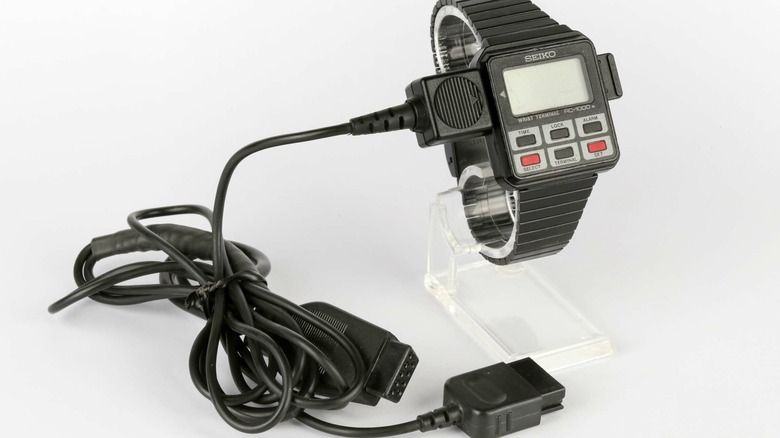
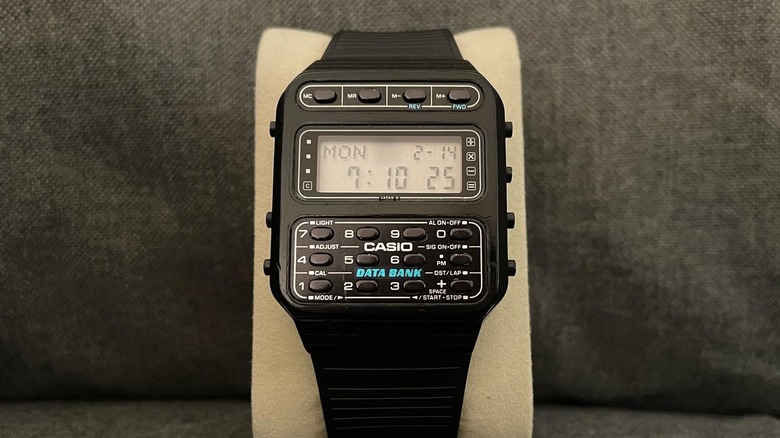
The microchip's invention in 1959 expanded the possibilities of watches beyond science fiction. By the '80s, technology caught up with futurist dreams that envisioned characters like Dick Tracy and James Bond, who used their watches for way more than just telling time. At first, the uses were gimmicky — you could watch TV or play basic video games on your watch. Then, Japanese tech companies Seiko and Casio released two wrist-top computing powerhouses.
In 1983, Casio launched the Databank CD-40, which was considered one of the world's first smartwatches because it was the first to store information. It could hold up to 10 phone numbers and also featured an alarm and a stopwatch. Of course, what stands out is the on-wrist calculator, letting you crunch numbers on the fly. Marty McFly, however, upgraded to the CA-53, which surged in popularity after "Back to the Future." Casio's Databank watches remain popular enough today that Casio released a recent vintage collection.
One year after the CD-40's release, Seiko came out with the RC-1000, also known as the Wrist Terminal. It packed 2KB of memory and came with a cord and software that let it connect to popular '80s computers like the IBM PC, Apple II, and Commodore 64. It could transfer, edit, and store data from your computer in 10 seconds, storing 80 screens of information, each with up to 24 characters. It was essentially a personal organizer on your wrist, able to hold your calendar, contacts, reminders, and notes.
Why some '80s smartwatches didn't take off like today's smartwatches
If you had an '80s smartwatch, you were essentially a beta tester. The frustrations you faced led to design decisions in today's most popular smartwatches. For instance, to use the RC-1000's organization features, you had to load software from a floppy disk to your computer, plug your watch into your computer, and build a structure of menus, notes, and schedules. To access that info on your watch, you had to scroll through entries on a tiny dot matrix LCD display. Compare that to the clean interface of the first Apple Watch, introduced in 2015 and now the most popular smartwatch.
In seconds, you could access weather, messages, health info, Maps, and Apple Pay – which everyone should be using. All the apps are stored on your watch and accessed by easily recognizable icons. The CD-40 had its own issues, especially with its most prominent feature: the keypad. Each name you entered was a tedious task, hitting a number up to three times to type in a single letter. It was slow and error-prone because the keyboard was so small. Once you had a name in your watch, you only had nine spots left. Good luck if you had eleven friends.
The Google Pixel Watch, flawed as it was at release in 2022, had 32GB of memory. That's 16 million times more storage than the powerful (for '80s smartwatches) RC-1000. The most important feature? Software updates. Google continued to improve the Pixel months after release. If you wanted an update in the '80s, you had to buy a new smartwatch.