

China's Fuel Breakthrough Might Be The Solution To The Oil Crisis
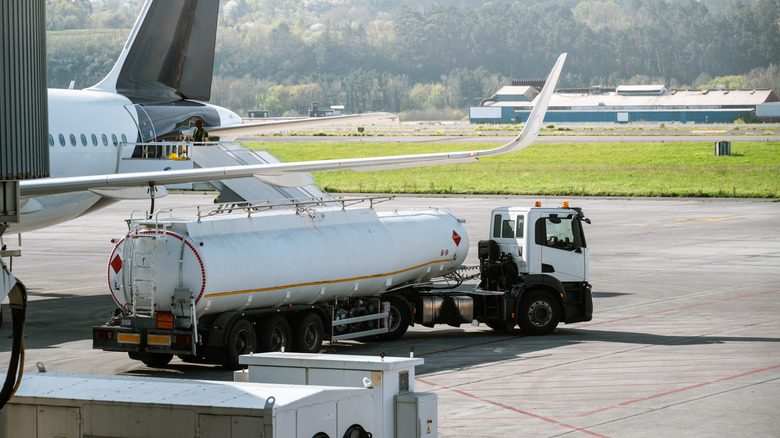
Recently, researchers at the Shanghai Advanced Research Institute of the Chinese Academy of Sciences have found a way to make jet fuel using a technology that can transform carbon dioxide and hydrogen and into long-chain hydrocarbons. The process doesn't actually turn these gases into jet fuel, but instead a primary ingredient for jet fuel, which is the next best thing.
The procedure researchers used is a process known as "reverse combustion," where carbon dioxide merges with hydrogen to form hydrocarbons. The key component of this particular incarnation is an iron-based catalyst, combined with potassium and aluminum additives. The catalyst provided a surface that sped up chemical reactions needed to build the long-chain hydrocarbons. According to a study the researchers published in ACS Catalysis, when exposed to a temperature of 626 degrees Fahrenheit, each gram of catalyst (0.04 ounces) produced 453.7 mL (0.12 gallons) of hydrocarbons, about half of which was deemed sufficient for jet fuel production. Perhaps most important of all, the catalyst showed no signs of deterioration after continuous usage for over 800 hours. That's over a month of round-the-clock production.
Unlike many studies, this downright alchemical technology isn't "new." Although it isn't widespread, scientists are ready to take the process outside of the laboratory setting.
What the technology means for the oil industry
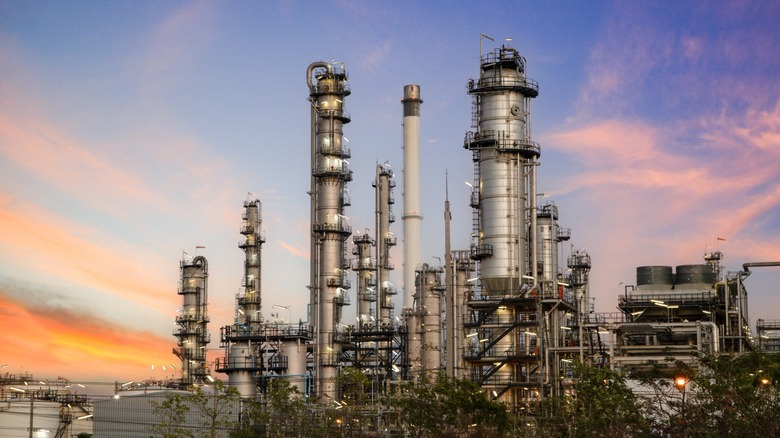
The news regarding this potential source of jet fuel comes at a critical moment in history as we are slowly but surely running out of oil; and as supplies dwindle, supply and demand dictates that prices skyrocket. While we use oil for fuel in our cars and airplanes, it is also a key ingredient in clothes and plastics, as well as countless other commodities.
Like other alternative fuel sources, such as Aircela's air-based system, any synthetic jet fuel formed by these hydrocarbons won't be ready for mass consumption in the near future. These fuels will have to undergo lengthy certification processes to ensure they are safe, both for engines and the environment. Still, if the gas passes these tests, then we could be that much closer to ending the oil crisis ... or at least lowering airplane ticket prices.
Furthermore, this technology could ease some of the strain on industries that rely on oil and free up supplies that would otherwise go to keeping planes in the air. In fact, since most if not all forms of gasoline are made of hydrocarbons, if this technology is properly applied, we could see a future where scientists draw CO2 out of the atmosphere and use it to power our cars. We could solve the fuel crisis and climate change (or at least minimize their effects) at the same time. Heck, if this form of synthetic jet fuel becomes readily available, we might finally get the future full of flying cars and personal jetpacks that shows like "The Jetsons" promised.