

China's Flying Wind Turbine Might Unlock Power Conventional Turbines Can't Reach
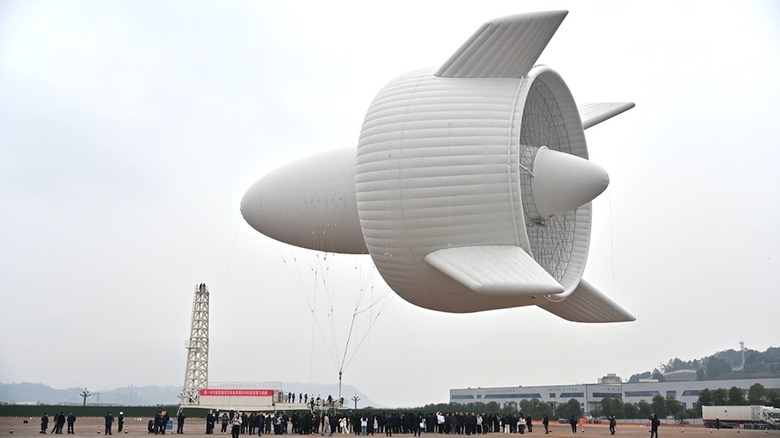
The idea of drawing power from huge machines floating high in the sky may at first sound fanciful, but China is taking the technology seriously and is already making some big claims about its potential. These are giant airborne wind turbines capable of reaching stronger and more consistent winds than the more common ground-based turbines that can take a decade to pay off that people are increasingly seeing on land and in coastal waters.
Hardware for China's Stratospheric Airborne Wind Energy Systems (SAWES) initiative is being developed by Tsinghua University and technology startup SAWES Energy Technology Co., Ltd., both based in Beijing. Touted as a low-impact alternative to conventional wind turbines, engineers unveiled their first design in late 2024. The latest one, the SAWES Type S2000, was announced in early 2026 and is hailed as the first airborne wind power system capable of generating power at the megawatt scale, equal to a million watts of power. SAWES claims the S2000's hourly output "can fully charge approximately 30 electric vehicles from zero to full."
Flying wind turbines could be a game-changer, but there are challenges
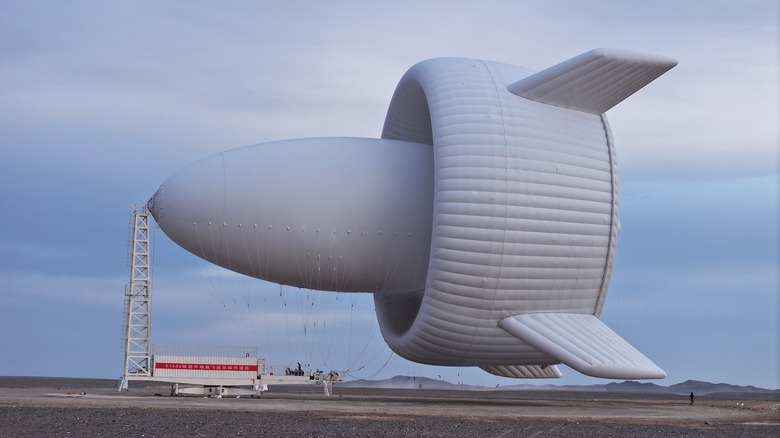
These tethered aerostats are filled with helium and lift wind turbines as high as 2,000 meters (about 6,500 feet). With the elevated winds stronger and steadier than at ground level, the spinning turbines are able to efficiently generate electricity and send it to a ground station via a cable. The S2000 aerostat is 60 meters (197 feet) long and 40 meters (131 feet) in both height and width, and holds 12 turbines with a power capacity of three megawatts. By comparison, the average U.S. turbine has a capacity for 2.75 megawatts.
The aerostat enjoys a major advantage over ground‑based turbines as it can ignore ground-level height restrictions. It also eliminates the need for land use, utilizes stronger and more reliable winds, and offers a far wider range of deployment locations. China's huge size also gives it an edge, as it has vast remote regions with few people, making it perfect for tethered aerostats to do their work.
But the technology also comes with challenges. For example, stormy weather can pose a problem, with severe weather potentially forcing the aerostat to land until calmer conditions prevail. Also, the tether can suffer considerable wear and tear, leading to damage that requires repair work, which can disrupt power generation. Consideration also has to be given to low-flying aircraft, with the tethered high‑altitude aerostats potentially creating hazards for helicopters and emergency-response aircraft that operate at similar altitudes.
China's green-energy push
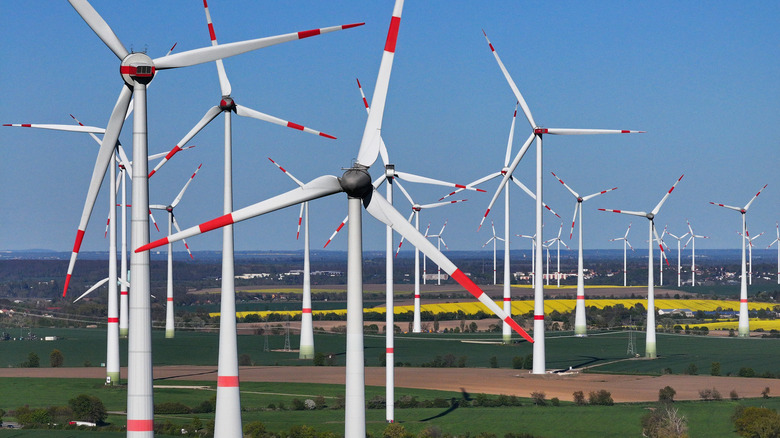
China's growing interest in harvesting energy from high-altitude winds is part of a broader green-energy push that also includes increasing investments in solar power and electric vehicle production. It's the world's dominant battery producer and a global leader in lithium‑ion manufacturing, too, and the government is also pushing renewable hydrogen infrastructure as part of efforts to reduce the nation's reliance on fossil fuels. If China can scale its flying turbines reliably and affordably, it will gain access to high‑altitude winds that conventional ground‑based turbines are physically unable to tap, turning what is still a niche technology into a new pillar of its expanding green‑energy strategy.
In contrast, the U.S. has so far focused its wind‑energy plans on offshore windfarms as well as those onshore, while airborne systems similar to China's remain largely in the R&D phase. President Trump is well known for his hostility toward conventional wind power setups, repeatedly criticizing their appearance and impact on the landscape. Such a viewpoint suggests that aerostats, which are quieter and less obtrusive, might face fewer of the same political objections if they find their way into the U.S. energy debate.