

Scientists Show That Routers Can Be Used To Track Your Movements Through Walls

Researchers from Carnegie Mellon University have developed a unique Wi-Fi configuration that allows them to estimate human movements through walls and dense objects. What's interesting is they don't need expensive equipment, like specialized LiDAR devices or cameras, to make it work. They were able to achieve this with low-cost $30 Wi-Fi routers and receivers, which raises a few privacy concerns.
Leveraging a tool called DensePose from Facebook's AI lab, the system scans the invisible Wi-Fi radio signals that permeate throughout a space and builds a visual model. Radio signals broadcast by a Wi-Fi router naturally bounce off objects and people, and the reflected signals carry information that can be filtered through AI to reconstruct body posture and movements. Similar to how LiDAR or echolocation can be used to build a crude three-dimensional representation of rooms or an area, DensePose can produce images of humans and, over time, could be extrapolated to track and understand someone's movements.
This has been done before. Years ago, MIT researchers built a similar system, using RF-Capture technology, but the presented models were not as high-quality as what you get with the CMU team and DensePose recreations. The key to DensePose is what the researchers describe as a "deep neural network that maps the phase and amplitude of Wi-Fi signals to UV coordinates within 24 human regions." With the Wi-Fi signals as the sole input, that AI model can estimate the pose of multiple subjects.
Could this be used to spy on a family or track private movements?
Although, the CMU study has not been peer-reviewed yet, the scientists demonstrate that their DensePose-driven system can be used to monitor human movements inside a building. But there are a couple of things to keep in mind. For starters, they're using a developed neural network model to make the estimations and empower the data. That includes training the model on room and space layouts. While the DensePose Github is available to anyone, the trained model is not. Bad actors would need to access or develop their own for active monitoring, and extensively train using known spatial layouts.
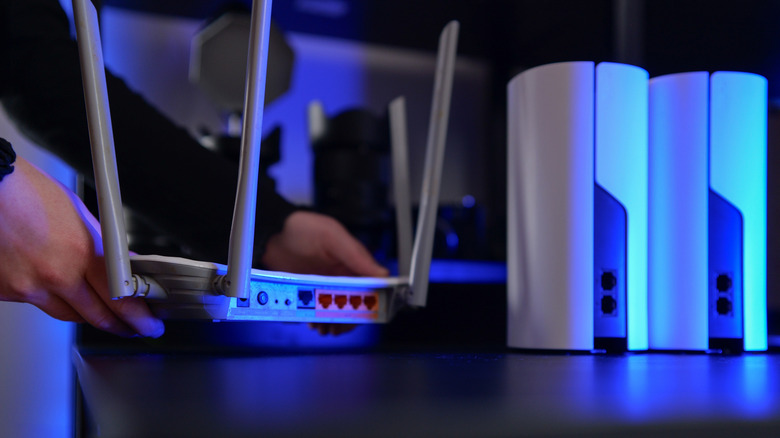
Additionally, the study doesn't address how effective the technology would be within your average residential home. The researchers used relatively inexpensive devices, but they needed multiple access points — the radio waves came from three routers and three receivers. Without a mesh router system, people might only have a single router and an extender or two placed throughout their home. It's not clear how that would impact the models. Moreover, in the average household, many things might interfere with Wi-Fi signal strength, and that could also be a factor for a system so reliant on reliable readings.
However, larger facilities with multiple networking devices (like hospitals, offices, or commercial buildings) and access to higher quality signals may be able to feed enough information. The study also points out that challenges increased when trying to track multiple subjects, so it may be harder to track a whole family or groups of people using something like this.
How might this technology be used?
Regardless, the research demonstrates it's possible to locate and track subjects using only Wi-Fi as an input. In the study, the CMU researchers imagine the technology could be used to monitor the "well-being" of a home's residents or "identify suspicious behaviors." Then question arise such as who is monitoring, what would be considered "suspicious," and what action should be taken when strange behaviors are detected?
Taking that a step further, if the technology were commercialized in some way and used for market research or data harvesting, it doesn't take much to see how many privacy concerns there are. Reports show 80% of U.S. households have a home network router, which means open access to Wi-Fi signals in their homes. Wi-Fi imaging could allow for passive surveillance both in homes and other buildings, without physical access, and without consent. Furthermore, a general difference between Wi-Fi and wireless internet is that Wi-Fi is used to distribute network in a limited space. That's how Wi-Fi networks stay active when the internet is down, and, in this case, such a system could be retooled to work locally without internet access.
For now, the limitations may hold it back until someone comes up with alternative solutions. Though, there's no telling how long that would take. Future network technologies, which are already here and fixing the previous Wi-Fi generations biggest problems, could make consumer-grade routers more powerful and viable for something like this.