

NASA's New 'Space Gas Station' Will Change The Way Astronauts Refuel
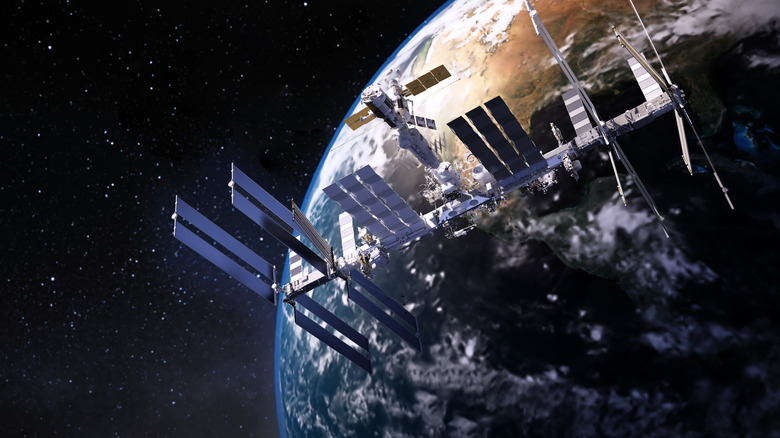
Since 2021, NASA has been working with the cryogenic system engineers at Eta Space on a project known as the Liquid Oxygen Flight Demonstration, or LOXSAT. The goal is to test cryogenic fluid management (CFM) technologies that can be used to build "in-space propellant depots" — in other words, a space gas station. The demonstration is slated to launch by July 17, 2026, and its success could change the way NASA manages fuel during long-range missions.
NASA's previous experiments in propellant transfer technologies made use of remote-controlled refueling robots on Earth and on the International Space Station. The LOXSAT team envisions "gas stations" positioned in deep space, where crafts can refuel while en route to destinations like Mars. However, there is a need for CFM systems that can keep hydrogen and other fluids suitably cold for long periods of time while stored in a deep-space fueling station. NASA uses petaflop-level supercomputers that will likely play a role in coordinating and monitoring the demonstration of 11 CFM technologies throughout the nine-month LOXSAT demonstration.
The LOXSAT project is particularly exciting in the wake of the successful Artemis II mission back in April. NASA's Artemis II mission was special for a variety of reasons, not the least of which is the fact that it set a precedent for long-distance crewed spaceflight in the modern day. Innovating the way astronauts can refuel in space will only help push our species further into space, sooner rather than later.
What will happen during NASA's LOXSAT project?
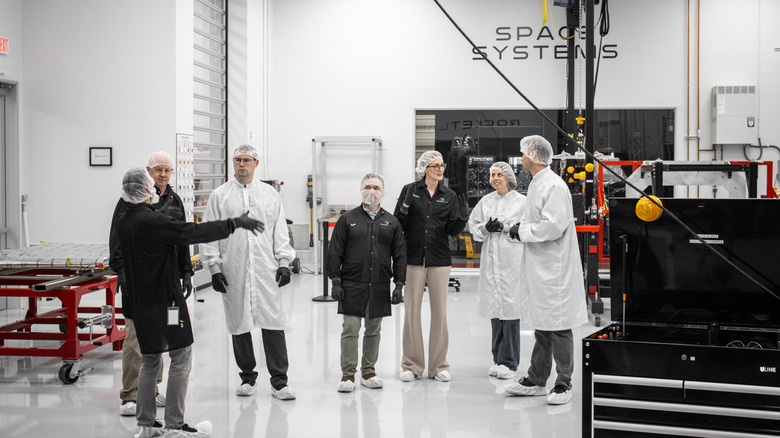
NASA describes the LOXSAT 1 mission as a "small-scale flight demonstration of a complete cryogenic oxygen fluid management system." The CFM technologies being tested in this system will be the primary payload on a Rocket Lab Photon satellite. These are the technologies deemed necessary for creating "practical propellant depots" that astronauts may one day use to procure fuel in deep space.
The satellite will remain in a low-earth orbit to determine if the aforementioned technologies can efficiently store, control, pressurize, and transfer liquid oxygen in just such an environment. If they can, the project would be able to support longer and farther space missions with smaller crafts. The need to expel mass to gain rocket propulsion currently dictates that longer missions require a higher ratio of fuel to spacecraft mass; the ability to refuel in space could overturn that idea.
NASA anticipates that gaining these refueling capabilities is essential to a sustainable space program. But how far could they actually go with these space gas stations in place? Sights are already set on the Moon, Mars, and "other deep space destinations." This ambition, together with NASA's upcoming nuclear-powered mission to Mars in 2028, shows that the agency is very much intent on going the distance this decade.