

Scientists Say Quantum Physics Could Actually Allow Messages To Travel Back In Time

In 2014, Christopher Nolan's "Interstellar" wowed audiences around the world with its emotional and even realistic approach to science fiction. However, there was one part of the movie that left some physicists scratching their heads. A big part of the narrative relies on messages left by otherworldly forces, which audiences later learn are actually messages sent back through time by the movie's protagonist, Joseph Cooper (Matthew McConaughey). "Interstellar" has been praised for featuring the most accurate black hole in cinema, so it might seem strange for it to feature something as unbelievable as sending messages backwards through time.
However, new research says it might be somewhat possible to directly manipulate gravity across time much like Cooper, thanks to time dilation. The findings are part of a new study accepted for publication in Physical Review Letters, and the paper is already available on the preprint server arXiv. The researchers determined that a closed timelike curve (CTC) was the most likely possibility and started there.
This is when an object's trajectory through spacetime takes it both to the past and the future, connecting the two and allowing for time travel. The researchers argue that this phenomenon is completely possible within the idea of general relativity — Albert Einstein's theory that gravity is not simply a force pulling on reality, but instead the actual warping and distortion of the fabric of space and time that is caused by massive objects.
Proving the impossible
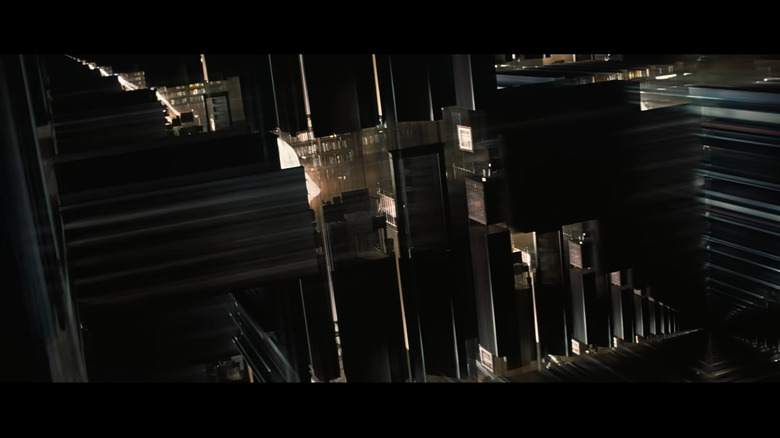
To start proving their theory, the researchers looked at the father-daughter relationship showcased in "Interstellar" and how Cooper was able to send messages back to his daughter. They found that Cooper was able to send messages through what they described as a "noisy mechanism." However, to properly showcase this in their research, they utilized post-selected closed timelike curves (P-CTCs), which could allow time travelers to avoid the dreaded grandfather paradox.
Instead of time looping into an infinite amount of possible timelines, the theory of P-CTCs says that only "post-selected" time loops are available to a timeline. This means that any that would result in a paradox are already ruled out. This could be used as a good way to explain how Cooper is able to communicate with his daughter. Furthermore, because of his memory of the messages, he's able to communicate exactly what they say, despite the researchers' belief that the noise would affect them in some way. This is all just a theory right now, but the team reportedly plans to create a model setup to actually test it using photons.