

China's New Offshore Wind Farm Is A Gamechanger For Clean Energy
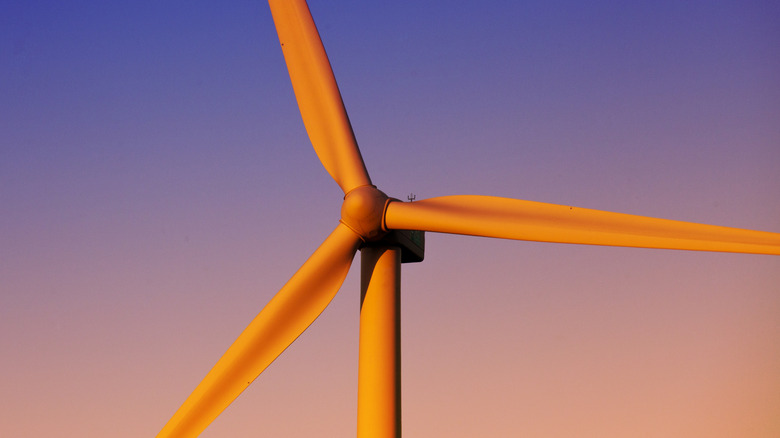
Even though China is still one of the world's major greenhouse gas emitters, it's also making notable progress in its ongoing efforts to shift toward cleaner alternatives like wind and solar energy. In a significant move that further burnishes its green credentials, the country recently installed the Sanxia Linghang, or Three Gorges Pilot, which has been described as the world's largest single-unit operational floating offshore wind turbine, by both capacity and rotor diameter.
Situated in the waters off southern China, the turbine, built by Wuhan-based China Three Gorges Corporation (CTG), is a 16-megawatt unit with a rotor diameter spanning nearly 830 feet and a blade-tip height of more than 885 feet above the water. Unlike conventional seabed-mounted turbines, the huge structure, which began testing last month, floats on a platform in water 164 feet deep and is supposed to be robust enough to withstand 65-foot waves and winds of up to 164 mph, equivalent to a Category 5 hurricane, the most severe rating.
CTG's design is a potential game-changer as it shows that floating wind turbines can be built at a record single-turbine scale. At the same time, it opens up deep-water sites that fixed turbines are unable to use.
Making the massive turbine a reality
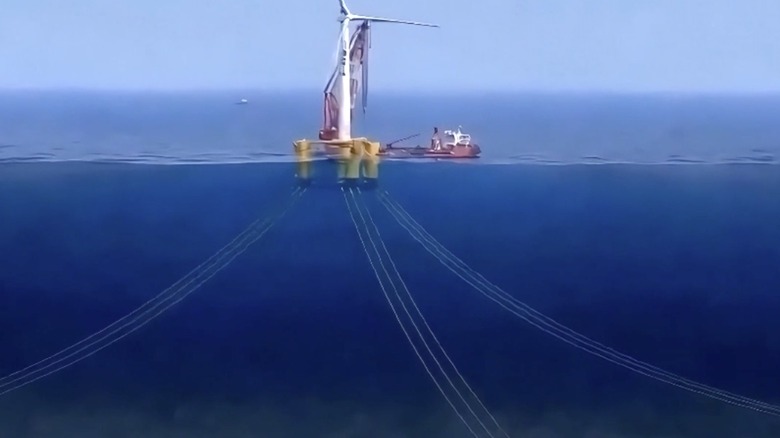
To make its massive turbine a reality, CTG developed a new mooring system, with the 79,000-square-foot floating platform held in place using nine suction anchors and an automatic ballast system for stability. To transfer the generated power to land, the setup uses a 66-kilovolt dynamic cable that's designed to withstand extreme temperatures, wave movement, saltwater corrosion, and mechanical stress, among other challenges.
With an estimated annual output of 44.65 gigawatt hours, the Three Gorges Pilot could supply enough electricity for roughly 24,000 three-person households for a year. During the testing phase, engineers are likely to be gathering performance data, monitoring the platform to ensure the stability mechanisms are working as designed, and confirming the effectiveness of the power transfer technology.
Beyond its record size, CTG's endeavor is expected to demonstrate how multiple systems can work together to keep a large floating turbine both stable and productive, with the ambitious project offering a blueprint for how future floating wind projects could be deployed in even deeper and more turbulent waters. The company can then decide whether the design can be scaled up for future offshore wind farms out in the ocean.
Big wind technology, even bigger challenges
Deep-water floating wind farms already exist, including Hywind Scotland in the U.K., WindFloat Atlantic in Portugal, Hywind Tampen in Norway, and Provence Grand Large in France. But the turbines in those projects are smaller in both size and capacity than the 16-megawatt turbine that CTG is testing.
CTG's larger unit could help to reduce costs by reducing the number of turbines and associated components needed for an offshore project, which in turn can simplify installation and maintenance. Its bigger rotor sweep also allows a single turbine to capture more wind and generate more electricity, offering another advantage over small setups with more turbines. Large floating turbines could also help countries with limited offshore space. In areas where, for example, shallow water for conventional turbines is scarce, a larger floating unit may deliver more power from a smaller footprint than lots of smaller turbines spread across the same area.
It's important to note, however, that various challenges come with these larger, floating turbines. They are, for example, harder to transport and install, not only because of their size but also because working in deep water is more precarious. Additionally, if one of these turbines fails, a lot of capacity is wiped out in one go. Technical issues with smaller turbines are less likely to disable all of them at once, so electricity can continue be produced. Despite the challenges, it's undoubtedly an exciting time for wind energy, and as the technology advances and reliability improves, it looks set to play an ever-increasing role in the move away from fossil fuels to clean energy sources.