

4 Of The Weirdest Blackberry Devices Ever Made
There was a time when BlackBerry was the hottest phone brand, when QWERTY keyboards were preferred alongside or even instead of touchscreens — a trend that seems to be coming back in 2026. BlackBerry still exists, but its phones are a thing of history, the company ending support for its old devices in 2022. Back in 1999, parent company Research in Motion (RIM) launched the BlackBerry 850, which functioned as a two-way pager that could also send and receive e-mail. Its last piece of phone hardware, the BlackBerry KEY2 LE, was released in 2018. It was made under a licensing agreement with TCL since BlackBerry announced it would stop making hardware itself in 2016. The company shifted its business model exclusively to software, where it remains to this day.
At the height of its popularity, BlackBerry made some incredible devices, many that die-hard fans say, to this day, are better than any touchscreen phone you can buy now. Some of its most popular and best reviewed phones included the BlackBerry Pearl, which was designed to appeal to mainstream customers, the BlackBerry Bold that had an elegant faux leather back and was in the hands of every business executive, and the BlackBerry Curve, an entry-level option. There were several iterations of these that saw tremendous success. But alongside the huge hits, BlackBerry had a few misses, too, with some truly weird devices.
BlackBerry Passport
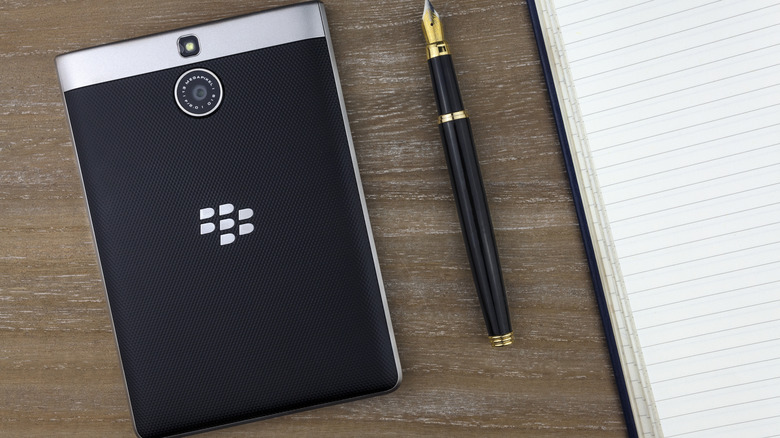
The BlackBerry Passport launched in 2014 as an attempt to capitalize on the growth in bigger-screened phones, but it looked like a big block. It wasn't comfortable to hold in the hand and didn't fit with the other sleeker phones on the market at the time. It had a 4.5-inch HD screen alongside BlackBerry's signature QWERTY keyboard, up to 30 hours of battery life, and a feature called BlackBerry Blend for easily syncing it with your computer or tablet.
With LTE connectivity and BlackBerry Assistant (not AI-powered, of course), it was designed to be a dream device for productivity. Yet it only had 32GB storage and a microSD card slot for adding up to only 128GB more (granted, that was decent at the time). The cameras were rudimentary at just 13MP for the rear and 2MP for the front. You can still find BlackBerry Passports being sold as collector's items. But you may be confused when you see it, wondering if it's supposed to be a phone, a small tablet, or something in between.
BlackBerry Storm
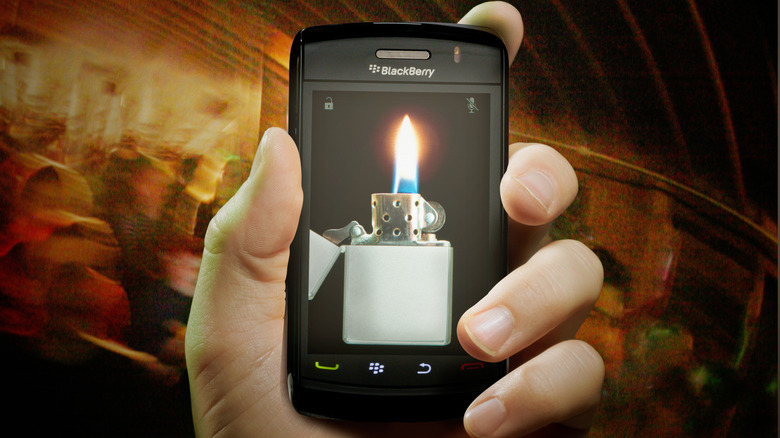
The BlackBerry Storm wasn't so much weird as it was a major miss for the company that, at the time in 2008, was trying to compete with the sleek look of the touchscreen-only Apple iPhone. The Storm was the brand's first attempt at a phone with only a touchscreen. It was a bold move considering that meant abandoning the one feature fans loved about BlackBerry, the physical QWERTY keyboard. It was baffling since the keyboard differentiated BlackBerry and was the reason people sought them out, so why remove it entirely? As a result, the Storm came across as nothing more than a poor attempt at a copycat device to keep up with changing times.
Further, the virtual keyboard wasn't easy to use, the integration of haptic feedback for button press confirmations proving uncomfortable for some. The phone didn't perform well in other aspects either, with slow processing and lag, camera shutter delays, and suboptimal call quality. It was rife with bugs as well, suggesting RIM was out of its depth in trying to divert from its core. The BlackBerry Storm is widely considered to be one of the biggest disasters in smartphone history. The follow-up Storm 2 righted some of the wrongs, but it was still no match for iPhone.
BlackBerry Playbook
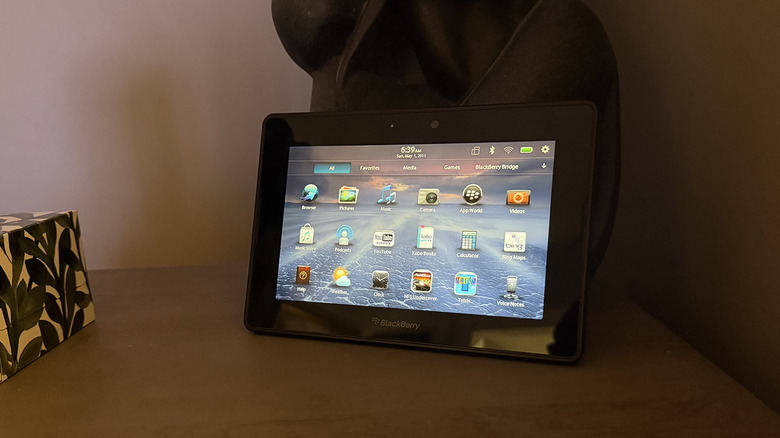
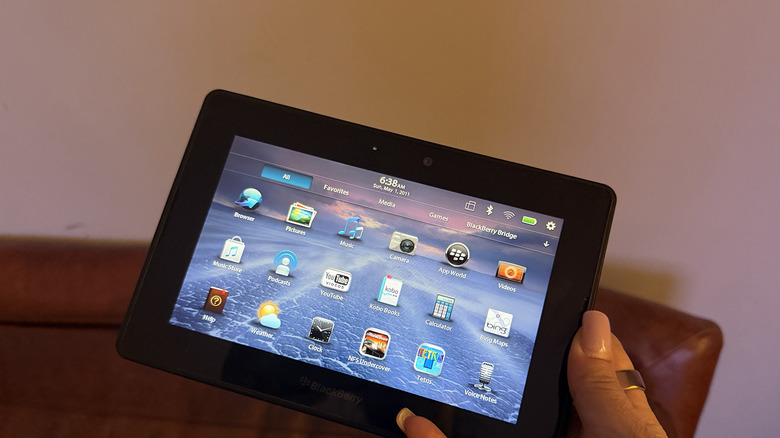
As the tablet market was heating up, BlackBerry launched the Playbook in 2011. But it fell into a weird space of being too big to offer the portability of a phone but too small to offer the advantages users wanted from a tablet. While it introduced RIM's new tablet operating system, the combination of controls, small size, and the fact that you could only use some of the best features when pairing it with a BlackBerry phone, limited its uptake.
Interestingly, today, smaller 7-inch tablets and eReaders with limited mobile app connectivity are available, and pretty popular. Thus, the Playbook might have simply been ahead of its time, putting a cart before the horse, so to speak. The world of apps hadn't yet blown up like it has today when it was introduced, which left it sitting in a weird middle-ground with no purpose. Perhaps the Playbook isn't weird in general, but was just unfitting for its time.
BlackBerry Priv
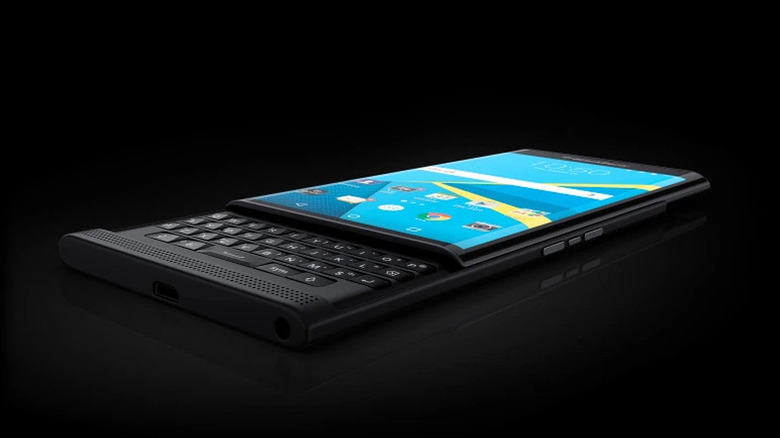
Introduced in 2015, the BlackBerry Priv was BlackBerry's first attempt at launching a phone based on the Android OS, recognizing its dominance as the top competitor against iPhone. It had a full-sized touchscreen that slides up to reveal the QWERTY keyboard fans were not willing to part with. The best of both worlds! However, to fit it into a compact package, the keys were crammed pretty tightly, making it challenging to compose legible sentences on your first try.
It was basically a BlackBerry only in name, but an Android phone in terms of software. Except it didn't even run Android very well. Call quality wasn't great either, and the cameras were passable at best, even for the time. Overall, the BlackBerry Priv was a pretty rudimentary device compared to competitor devices on the market at the time, like the Samsung Galaxy Note 5 and iPhone 6s. Despite the fact that this device and others did not turn out to be huge successes, putting a small stain on the brand's reputation, BlackBerry is still an icon in the mobile tech space. Its iconic, game-changing phones kicked off what eventually became the smartphone as we know it today. That would not have been possible without the best of BlackBerry's line-up, regardless of the worst.