

One Of The First Classic Sci-Fi Movies Was Adapted From A Shakespeare Play
It is impossible to escape William Shakespeare. Turn to any piece of modern film or literature, and you are bound to trace its textual lineages to The Bard. Of course, some connections are more obvious than others, as Denzel Washington's reincarnation of Macbeth is more easily recognizable than Gus Van Sant's River-Phoenix-Keanu-Reeves-coming-of-age-drama "My Own Private Idaho". But many of the most compelling adaptations are those that see Shakespeare translated into a genre flick, as they provide a compelling conduit to reimagine history's most indelible storyteller.
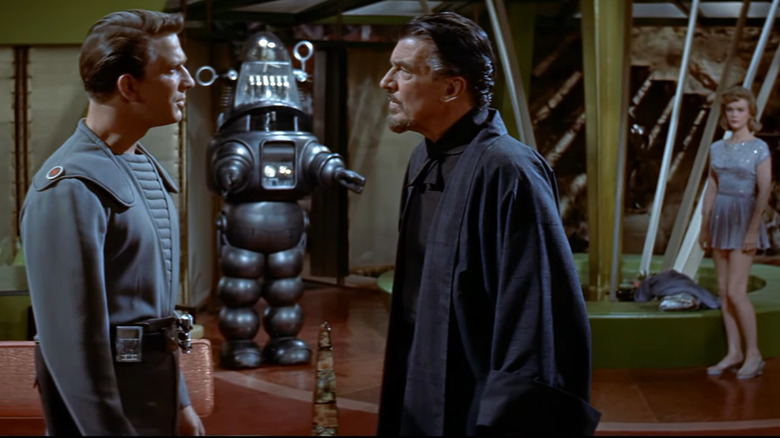
In the realms of sci-fi, 1956's "Forbidden Planet" deftly reconjures "The Tempest," serving as a window into Bill Shakespeare's outsized influence on the genre at large. Released in 1956, Fred Wilcox's galactic caper retells one of Shakespeare's most compelling comedies. It follows the crew of the United Planets Cruiser C-57-D, helmed by Commander J.J. Adams (Leslie Nielsen), as it searches for the remnants of a spaceship lost to the distant planet Altair IV. While there, the crew encounters the ship's lone survivors: a misanthropic Dr. Morbius (Walter Pidgeon), his sheltered daughter Altaira (Anne Francis), and their robot servant Robby.
And while the Tempest analogs are obvious, with the trio serving as the vengeful warlock Prospero, his daughter Miranda, and their ethereal sprite-turned-servant Ariel, respectively, the film rises above mere imitation. Instead, it creates a wholly unique experience that, seven decades later, still stands as a foundational pillar of cinema's most adventurous genre. So if you're still looking for a film to satisfy your "Project Hail Mary" induced sci-fi high, consider "Forbidden Planet" as your conduit to another world.
The Tempest goes to space
"Forbidden Planet's" Shakespearean connection is wholly speculative, as neither Wilcox nor screenwriter Cyril Hume have confirmed its connection. Instead, the similarities have been drawn by seven decades of fans and critics. However, the parallels are too clear to ignore. The wickedly gifted Dr. Morbius and the implied Electra-complex with his daughter Altaira are conjured straight from the play's leads.
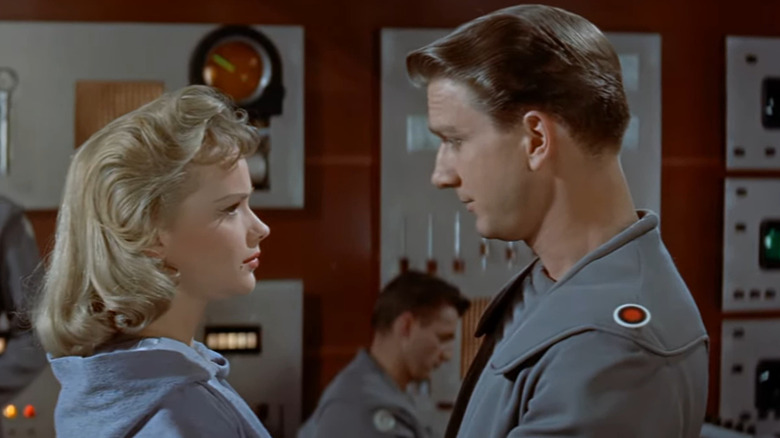
Moreover, Dr. Morbius carries the same presentment of cosmic doom as his wizardly counterpart, as both of their shadowy pasts spur the narrative towards their respective climaxes. Similarly, his daughter's naivete and her dalliance with Commander Adams is a near one-to-one Miranda-Ferdinand love story. A magical servant and a mysterious, destructive force rampaging through the stranded crew round out the film-play correlatives, setting the scene for two twisting fables. What makes "Forbidden Planet" a compelling adaptation, however, is its departures from its unacknowledged source material.
While Prospero's tale is explicitly one of revenge unleashed upon his traitorous brother, Antonio, the doctor is compelled by a more ethereal, but no less sinister, force. As Adams' crew attempts to hunt down the invisible monster that slaughtered Morbius' shipmates, the film unexpectedly probes the inner workings of the doctor's psychology, applying a Freudian lens that threatens to unearth the inner demons lurking therein. And while both the play and film force its antagonists to reckon with the consequences of their own foiled ambitions, their differing approaches reflect a deep philosophical rift between the film and its source material. By the end, you'll be left wondering whether the film's villain was Dr. Morbius, the planet's invisible creature, or the untamed monster within humanity.
A grand precursor
"Forbidden Planet" holds up shockingly well, although it functions better as a cinematic timepiece than a compelling story. With a comedic bent that too often devolves into the corny chauvinism typical of its time, modern viewers may have difficulty emotionally investing in the plight of Commander Adams and his ragtag crew. One laughs at Nielsen's condescension toward Altaira more out of embarrassment than humor. Despite its dated humor, the film remains a visual delight.
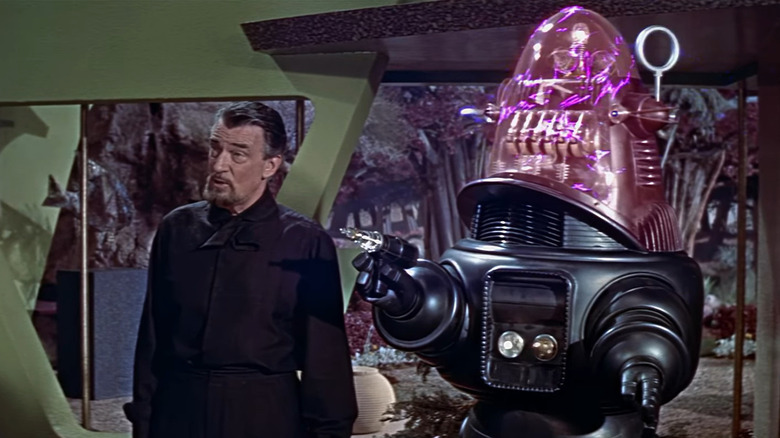
A cornucopia of colorful backdrops, practical effects, and strategic lighting, "Forbidden Planet" was revolutionary in its set design and prop work, earning an Academy Award nomination. Many of the images that have become mainstays of sci-fi films harken back to "Forbidden Planet." Its loveable robot Robby exemplifies its prescience. According to the film's cinematographer, George Folsey (via ASC), Morbius' mechanical robot was a "self-operating" robot made of 2,600 feet of electrical wiring. Other ingenious props included an atomic cannon, an electromagnetic tractor, and a space jeep. Although not the most scientifically accurate sci-fi film, "Forbidden Planet" is as visually compelling as any of its era.
Overall, watching "Forbidden Planet" is more eerie than enjoyable. One cannot help but trace its influence, viewing it more as a precursor to grander cinematic projects than a standalone masterpiece. Even in watching Leslie Nielsen, one sifts through his stoic demeanor for traces of his infamous Naked Gun tomfoolery. This critical parsing occurs immediately at the opening credits, where a voice announces that man landed on the moon "in the final decade of the 21st century," a reminder of both its alternating moments of prescience and miscalculation.