

Your Google Pixel Is Getting Smarter At Detecting Scam Calls

Phone scams are a big business these days, with impersonation scams alone accounting for $2.95 billion worth of lost revenue in 2024, according to the Federal Trade Commission (FTC). In an attempt to combat this fraudulent activity, Google has introduced fake call detection – a new technology to better protect Google Pixel users from such scams. It's a new security layer that will display a warning when the system detects a fraudulent call or impersonator, and it's coming to Android phones starting this month.
How these impersonation scams work is something you'd expect to see in a sci-fi movie: Your phone rings. It's your mom on the other end. There's been a terrible accident, and she's badly hurt. Even worse, the hospital she's at doesn't take her insurance, so they're refusing to treat her until the bill is paid. She urgently needs you to wire money directly to the hospital. Except that bank account doesn't belong to a hospital, and that's not your mom. It's a scammer using Deepfake technology and other malware to spoof not only her phone number and contact information, but also her voice — so convincingly that it's impossible to tell the AI clone from your real mom.
How Google's fake call detection works
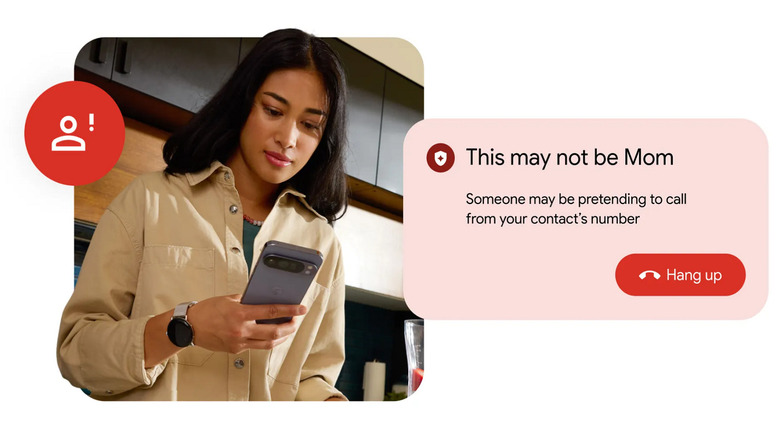
Fake call detection will be available on any Android phone running Android 12 (released in 2021) or newer, and it will work if both you and the contact the scammer is impersonating are using Phone by Google. It will roll out this feature starting on Pixel devices, but the information doesn't specify when or if other Android devices will add fake call detection. Here's how it works: Anytime a legitimate contact calls you, their phone sends your phone a silent signal verifying the correct identity. If your phone doesn't detect this signal, it will automatically ping your contact's phone. If your contact's phone indicates that it's not currently making a phone call, you'll get a popup indicating that the call is likely an impersonator, and it will prompt you to immediately hang up.
It will be enabled by default when it rolls out in an update, but users can choose to manually disable it in settings at any time. Fake call detection joins the "verified financial calls" feature announced in May, which alerts users when a scammer posing as a financial institute is trying to contact you, and should also help combat a rise in scams where criminals call you impersonating Google itself.
Google's focus on security updates

Google's increasingly acute focus on user-protection and security measures comes in response to the growing global threat of scams. Interpol's Global Financial Fraud Threat Assessment report, released in March 2026, estimates the global losses from fraud at $442 billion in 2025. The report describes apps available on Dark Web black markets that use AI to impersonate celebrities or acquaintances of victims. For those too lazy to build AI clones themselves, enterprising criminals are even offering "Deepfake-as-a-Service" products, which can create convincing fakes using just ten recorded seconds of a victim's voice.
According to the report, impersonation fraud was third on the agency's list of top global financial fraud threats facing law enforcement in 2024 and 2025. Fake call detection is just the latest in a number of Google releases created to combat this and other tech-driven security threats, including Scam Detection in text messages and Live Threat Detection, which monitors apps in real time for suspicious behavior. Google also filed a lawsuit in 2025 against Lighthouse, a large company it alleged provides tools for users to create phishing scams responsible for the theft of between 12.7 million and 115 million credit cards. Google's Android marketplace has been a frequent target of scammers and malware, including a scheme that deployed over 200 fake apps to steal money from users' phone bills.