

What Does 5G+ Mean On Your Phone And How Is It Different From 5G?
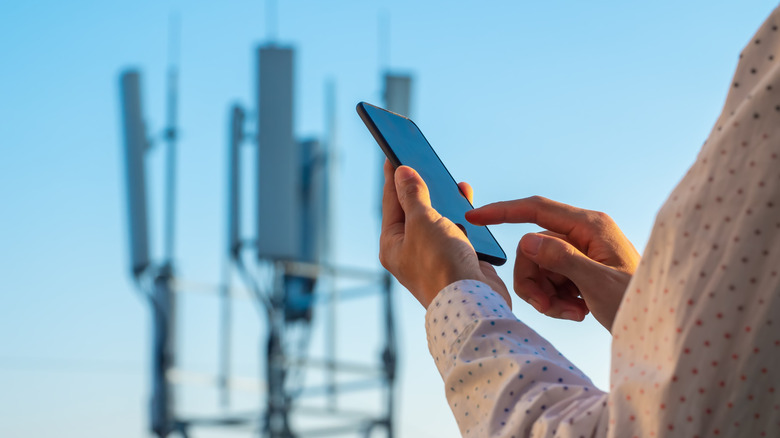
So you're out and about, browsing on your phone, when you spot a peculiar 5G+ icon on your phone's status bar. What gives? Well, you should be happy because you just got a significant connection speed boost. This 5G+ phone icon indicates you're connected to a much faster iteration of 5G that operates on a 5G standalone infrastructure.
In the US specifically, seeing the 5G+ icon flash means you're in an area where AT&T's mmWave is available, which provides significantly better connections than regular 5G. For instance, while the download speed with the "vanilla" variety tops out at 1 Gbps, 5G+ bumps it up to 3 Gbps. The "plus" is also much more stable, even in peak hours.
Though major carriers are phasing out 4G LTE, 5G deployment initially relied on the readily available 4G network infrastructure. This worked in a pinch, so to speak, but it did significantly cap the performance of the more modern network tech. Things have changed since, and AT&T claims the mid-band 5G+ is serving over 300 million citizens. Yet, you actually need to be in specific locations to get a taste.
Is 5G+ better than 5G?

In short, yes. 5G+ is much faster and more reliable. In fact, it's the best mobile connection around, at least until 6G networks become available. Because it relies on a standalone architecture, 5G+ offers higher throughput than regular 5G, which helps ensure network stability and predictability. While connection ultimately depends on coverage and the load (5G+ fares better during network congestion), the newer 5G+ can be two or even three times faster than the older iteration. Whereas 5G is barely capable of 1 Gbps download speeds, 5G+ can top out at 3 Gbps. A similar thing happens with upload speed and latency.
If your phone supports mmWave (for instance, the strip at the top of the iPhone 17 Pro hides the mmWave antenna) and you're in an area with 5G+ coverage, you'll see the plus icon on your status bar. However, you should remember that the newer variety is a mid-band network, so while it can deliver faster connection speeds, its range is quite short. Meaning, you need to be much closer to the tower for it to work. Ultimately, the standard 5G may be much slower, yet, as a low-band network, it offers superior range. In other words, it still has a place in ensuring the best possible coverage. But if you notice 5G+ on your phone, it doesn't hurt to note down the location.