

PLB Vs. Satellite Messengers: Which Life-Saving Camping Gadget Is Best For You?

We may receive a commission on purchases made from links.
If you enjoy hiking, camping, and being outdoors in the great wilderness, a smartphone is handy to bring with you to make calls, send texts, and track your location. That is if the one you're using can connect out in the middle of nowhere. Even though phone services are getting stronger, if you're really off the grid, a phone may not always do the trick. There are a few options you can turn to if you're planning a camping trip that can make all the difference when it comes to emergencies.
Two such gadgets are personal locator beacons (PLBs) and satellite messengers. PLBs are handheld devices that can transmit a distress signal to a satellite that is then sent to search and rescue agencies. Whereas satellite messengers offer the same functionality but also include the option to send texts and your GPS location — much like it can on your smartphone. If you want an emergency device with a stronger signal in case you get lost, a PLB may be best, while a satellite messenger comes with more features.
Both offer the ability to track you if you become lost or injured on a trail or can't find your way back to your tent or car, for example. If you are at the campsite and your car breaks down without phone service, you can activate the device.
When you should use a PLB
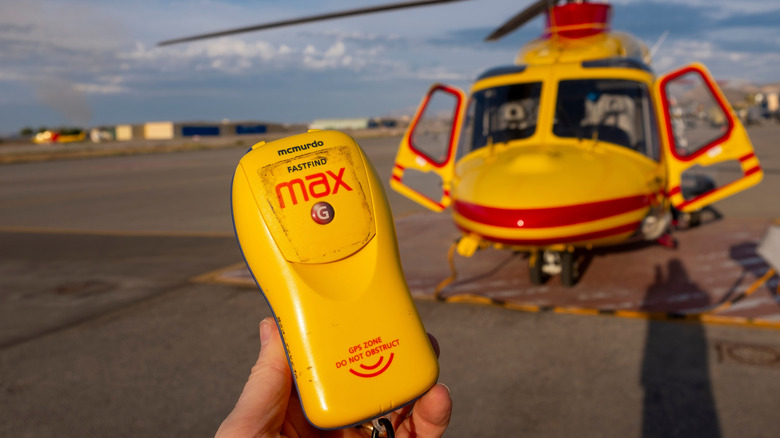
When you're planning a camping or hiking trip, whether it's a local spot or one deep in the forest, a PLB is a great tool to have with you. It's best suited for life-threatening emergencies, such as if you were to injure yourself while hiking. You can carry it with you in a pocket or bag, and it has a feature just to find your location. They offer peace of mind to you and those who care about your safety if you travel alone.
PLBs act as a one-way communication device that sends your location to rescue teams. Once you activate it, an emergency signal is broadcast for up to 24 hours. If you're in the U.S., this signal goes to the National Oceanic and Atmospheric Administration (NOAA), but any 406 MHz PLB can broadcast over the world in the 36 participating nations. Rescue services are called to your last pinged location and sent to find you. You do not have to subscribe to a service to use it, but PLBs do need to be registered beforehand. You will need to replace the battery if you activate the PLB in an emergency.
A good example of a PLB is the ResQLink 400 Personal Locator Beacon, priced between $400 and $460. It is built for outdoor adventurists, with GPS support, a five-year battery life, and 24 hours of operational life. That means once it's activated, it will send out your location for up to a full day. If you're able to wait at your campsite, you may be able to use the internet using Starlink Mini as a satellite internet dish.
When you should use satellite messengers
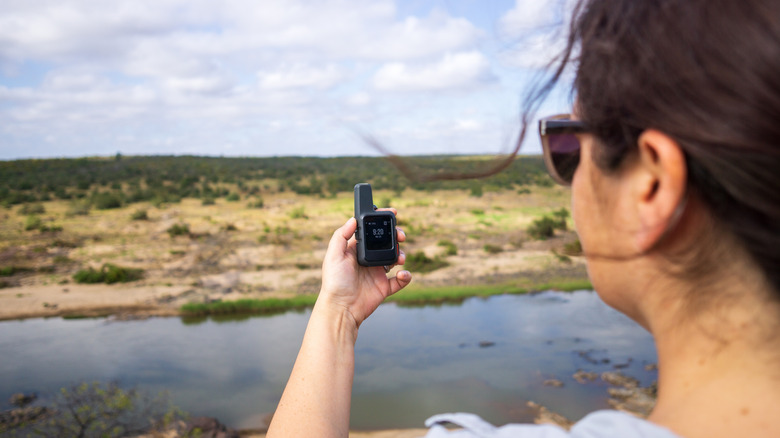
Satellite messengers are lightweight devices that track your location through GPS. You can mark various locations as you travel, so search and rescue teams or your family and friends can see what direction you were traveling and where you were last located. They are best designed for longer cross-country or multi-day tours for hiking, backpacking, and camping where cell service is limited or not accessible at all. Or if you want to update your friends and family about your location and trip, a satellite messenger is the best option.
Like PLBs, once activated, a signal is broadcast that can be picked up by an emergency dispatch center. However, unlike PLBs, satellite messengers offer two-way communication between the user and the dispatch team. Once a team is sent to your location, they can communicate with the user, letting them know vital details. They work similarly to how iPhone satellite messaging helped during the North Carolina floods.
One good satellite messenger is the Garmin inReach. Priced at around $300, it is a cheaper option than a PLB. But it, and other satellite messengers, do require a subscription to use, with prices ranging by product. It is always best to do in-depth research for the best brand for your personal needs.