

Why Are Night Vision Goggles Green?
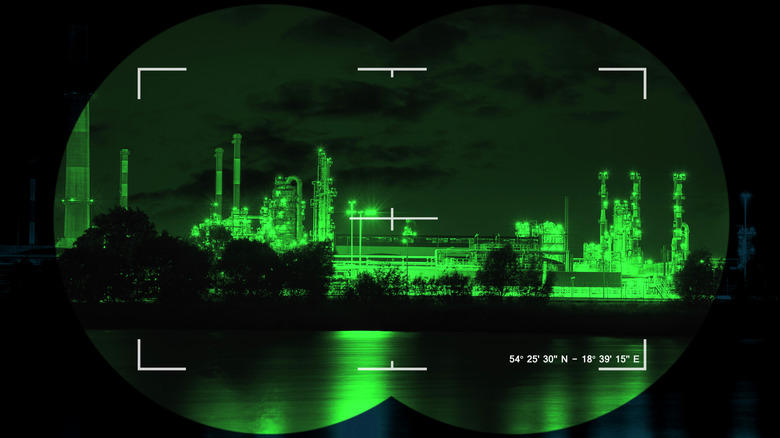
We've all witnessed the scene before. A war movie hero is stepping into dangerous territory when everything suddenly goes dark, and the next thing you see is their view through a pair of glowing green night vision goggles. When the lights make that switch, you know it's about to go down... but why does it always happen in green? Night vision would seemingly be more effective if it boasted the full spectrum of color. However, if they did that, they wouldn't be night vision goggles. The technology works because it amplifies the part of the visual light spectrum that human eyes are most sensitive to, and that just so happens to be the color green.
If you paid attention in school, you may remember the rainbow acronym ROYGBIV (red, orange, yellow, green, blue, indigo, violet), which represents the color spectrum of visible light. It's no coincidence that G is in the middle there; green is where our vision peaks. In fact, humans can perceive more shades of green than any other color, which some scientists attribute to the abundance of green on our planet. However, that doesn't explain why most non-primate mammals, like dogs and cats, can't see green. Whatever the case, understanding green's special position in the spectrum of visual light is essential to understanding how night vision goggles work. They target the human eye's natural strength by displaying in green, but now the question is, how do those goggles do that?
How night vision technology actually works
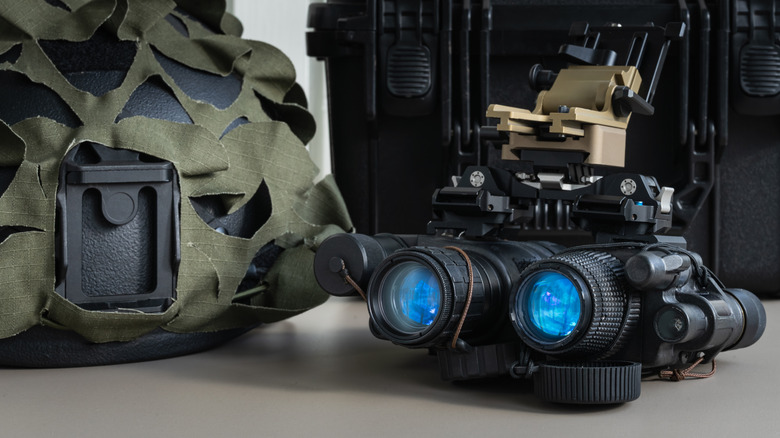
On a basic level, night vision goggles work by amplifying available light. Some systems can also detect near-infrared light, but they do not convert infrared light into visible light. Infrared is right next to visible light on the electromagnetic spectrum, close enough that scientists have even been able to give mice infrared vision (which they also perceive as green). The procedure could make it to humans one day, but until then, we have to rely on night vision goggles and cameras, most of which are based on a technology called image enhancement.
Image enhancement devices are equipped with a high voltage, battery-powered tube called an image-intensifier, which collects all of the available light—including visible light and some near-infrared wavelengths—captured by the device's lens. The light hits a photocathode, which emits electrons in response. The electrons then pass through a perforated glass plate called a microchannel plate, where they are hit with thousands of volts of electricity. The process multiplies the electrons thousands of times before they reach the end of the image-intensifier. At the end of the tube, there is a screen coated with phosphors, which release photons when the mass of electrons collide with it. These phosphors are what you ultimately see glowing green through night vision goggles because green is easier for the human eye to distinguish in low-light conditions.
That's an awfully complex process, so here's the simple gist: a small amount of visible light gets collected, converted into electrons, multiplied thousands of times, and finally converted back into visible light. The fact that night vision lenses keep getting thinner while doing all that is a stunning technological achievement.
Could you make night vision goggles in any other colors?
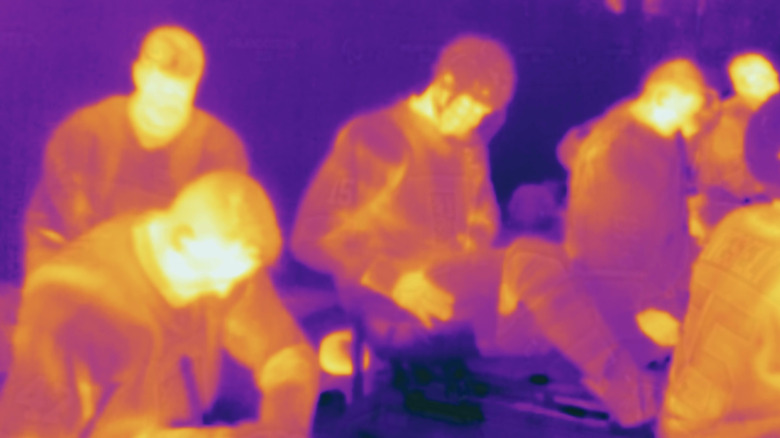
Most night vision devices use the same image enhancement technology, which renders everything green. However, there is another, less common night vision technology that can see through the dark in other colors. It's called thermal imaging, and it relies on the fact that infrared light is emitted from objects in the form of heat. If you've ever seen the Predator movies, you know this technology. The mask that the titular monster wears is a thermal imaging device, and its point of view is just like what you'd see though a typical pair of night vision goggles built with that technology.
Thermal imaging devices have special lenses designed to collect infrared light, as well as infrared detector arrays built into them. The lens focuses the infrared radiation, and the detector array scans it and records the heat radiating from everything in its field of view. It then generates a heat map, technically known as a thermogram, and passes it along to a circuit board with a chip that converts the data into a visual display.
Thermal imaging can be used to see in the dark, and the images appear in different colors depending on the amount of heat they release. However, this doesn't create nearly as sharp of an image as the alternative, image-enhancement technology, which is why the vast majority of night vision devices do, and will continue to, display images in green.