

Boeing's Flying Aircraft Carrier Plan Was Real – So What Went Wrong?

A flying aircraft carrier sounds like the type of vehicle you and your friends would dream up during a particularly interesting LEGO session. The idea is so fantastical that it's easy to forget how such a vehicle could actually serve a practical purpose. In fact, recently declassified documents indicate that none other than Boeing once developed plans to turn its 747 into an aircraft carrier of the skies.
In 1973, the U.S. Air Force coordinated with Boeing on a study meant to determine the viability of using the 747 as a sort of flying base for smaller aircraft, like small fighter planes. What's interesting is that the study concluded the idea was technically feasible. If executed properly, a flying aircraft carrier would theoretically allow the U.S. to respond to the military needs of its allies throughout the globe efficiently and effectively without relying on much slower water transportation.
Of course, unless the Air Force is flying around certain secret vehicles the general public doesn't know about, the idea of a flying aircraft carrier never became a reality. There's actually one key reason the plans didn't evolve into a working prototype (as cool as that would have been).
Why the Air Force didn't develop Boeing's flying aircraft carrier
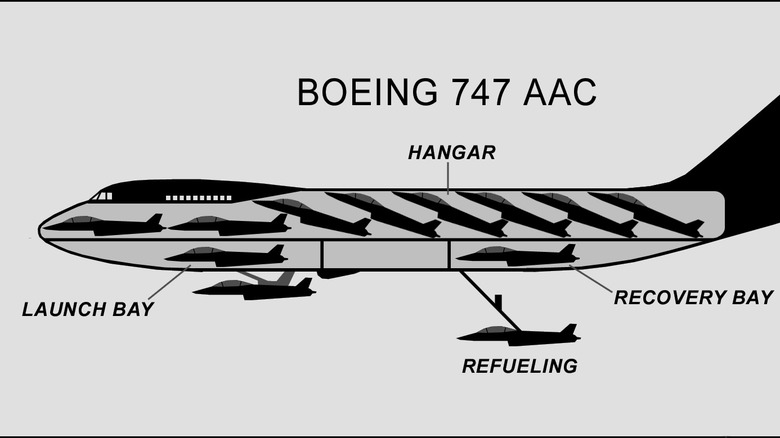
Per Boeing's report, it may have been possible to design the pressurized fuselage of a Boeing 747 so that it could comfortably house up to 10 microfighters. An 80-second process could supposedly launch a single microfighter from the fuselage into the sky. In theory, these planes would also be able to actually land inside of (or essentially dock with) the 747 once again, where it would potentially take a team about 10 minutes to rearm and refuel a microfighter.
The report suggests Boeing's team was confident in the designs and plans for this unique military vehicle. However, the Air Force ultimately decided not to implement the plans in the real world. Although other factors likely played a role in this decision, it appears the Air Force determined the small fighters the theoretical airborne aircraft carrier would house and transport wouldn't offer the combat capabilities necessary for success in modern warfare. They basically decided that the benefits the concept might offer didn't justify the resources necessary to make it a reality.
That's not to suggest that the U.S. military hasn't taken other sci-fi ideas and turned them into actual, functioning weapons and equipment. For instance, laser weapons already exist, with more advanced versions on the way. In a story out of "The Terminator," the Air Force has also used AI to pilot a fighter plane. As long as DARPA exists, it looks like science fiction will always have a shot of becoming science reality. That said, as the flying aircraft carrier proves, sometimes, a crazy idea just isn't worth the investment.