

Roger Ebert Compared This Angelina Jolie Sci-Fi Movie Flop To Indiana Jones

In 2004 a sci-fi movie about giant robots, a fighter pilot, and an evil mastermind caught Roger Ebert's attention. "Sky Captain and the World of Tomorrow" is a film Ebert called "more fun than it sounds like. In its heedless energy and joy, it reminded me of how I felt the first time I saw 'Raiders of the Lost Ark.'" That's high praise from the legendary critic. Even though the film itself wasn't a box office blockbuster it's an imaginative journey set in an alternate 1939.
"Sky Captain and the World of Tomorrow" may not have been as successful a movie as "Raiders of the Lost Ark," but Ebert still gave it four out of four stars. Ebert called "Raiders" "an out-of-body experience, a movie of glorious imagination and breakneck speed that grabs you in the first shot." The two had vastly different budgets, with "Sky Captain" costing an estimated $70 million and "Raiders" an estimated $18 million. "Sky Captain," which featured Angelina Jolie, only made back around $57 million worldwide, with Indy making more than $389 million.
As fighter pilot Franky Cook in "Sky Captain," Jolie didn't actually spend all that much time on the set of the film. In fact, her role only took three days to shoot. Decades later, Jolie would go on to join another fantastical universe, playing Thena in Marvel's Phase 4 MCU movie "Eternals."
How similar are the two movies?
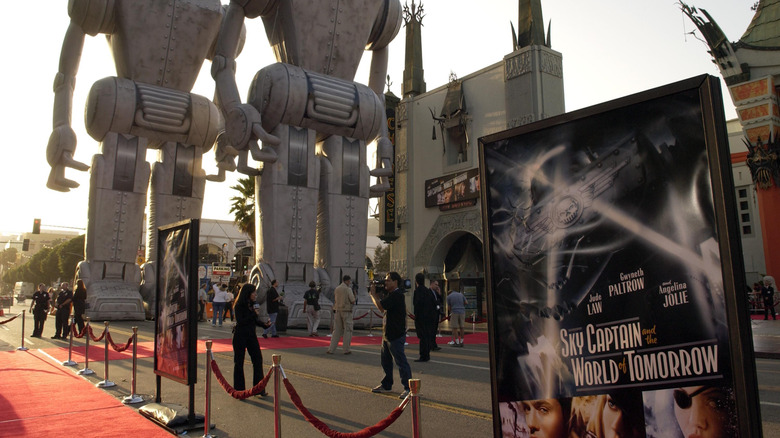
The movies are both set during the late 1930s, with "Sky Captain" set during 1939 and "Raiders" taking place in 1936. They feature World War II-era villains, machinery, and technology, notably including the plane piloted by Jude Law's Sky Captain and Indy's fight around a plane inspired by the German Horten Ho 229.
The plots for the films involve some similar topics, such as the main villain being German scientist Dr. Totenkopf in "Sky Captain" and the Nazis in "Raiders." Both are globe-trotting adventures that feature similar locations, such as Nepal. On the other hand, "Sky Captain" is more sci-fi without magical elements, in contrast to "Raiders'" utilizing the Ark of the Covenant. Both films are reminiscent of pulp adventure magazines, which Ebert mentions in both reviews.
When it comes to the actors, Jude Law and Harrison Ford both appeared in the "Star Wars" universe. There was even a "Star Wars" movie with an Indiana Jones Easter Egg. All three of the main actors in "Sky Captain" would go on to appear in the Marvel Cinematic Universe as well. Gwyneth Paltrow played Pepper Potts in "Iron Man", Jude Law was Yon-Rogg in "Captain Marvel", and (as mentioned above) Angelina Jolie played Thena in "Eternals." Even Harrison Ford joined the MCU as Thaddeus Ross in "Captain America: Brave New World."
The response to both movies

Labeled "an ingenious, idealized sci-fi adventure" by Ebert, "Sky Captain" didn't rise to such heights as Indy. The "Indiana Jones" franchise spawned a total of five films, each, aside from "Indiana Jones and the Dial of Destiny," making more money worldwide at the box office. There hasn't been another "Sky Captain" film to expand on the series.
Fans of "Sky Captain" pointed out, as did Ebert, that nearly the entire movie was shot on a blue screen. The special effects, giant robots, and most of the locations were used as backgrounds for the actors. This allowed more freedom to show and expand the universe, but may have led to its costly budget. One of the more interesting additions to the film is actor Laurence Olivier, who played Dr. Totenkopf. Olivier died in 1989, so each time he's onscreen, you're seeing archival footage.
"Sky Captain" received the 2005 Winner Sierra Award for Best Visual Effects at the Las Vegas Film Critics Society Awards. Meanwhile, Harrison Ford — who once had the perfect answer to who would win a fight between Indy and Han Solo — won the 1982 Saturn Award for Best Actor from the Academy of Science Fiction, Fantasy & Horror Films.