

Panasonic Is Using Smart Tech To Solve The Biggest Problem With Microwaves
We've all been there. Tuck a frozen burrito or Hot Pocket into a microwave, blast it for a couple of minutes, and boom: you've got a tube of molten liquid at the ends with a lump of still frozen gunk bulging in the middle.
Microwaves are incredibly convenient, especially if you're in a hurry. They can heat food or a drink from chilled to nuclear in seconds, and even cook raw food in a fraction of the time it takes in a conventional oven. But they've always been hamstrung by one major issue: regardless of how much the turntable rotates your food, you're almost always going to end up with parts of it that are so hot they're almost inedible, while others seem to have barely been heated at all. It's the major reason microwaves suck: they heat unevenly.
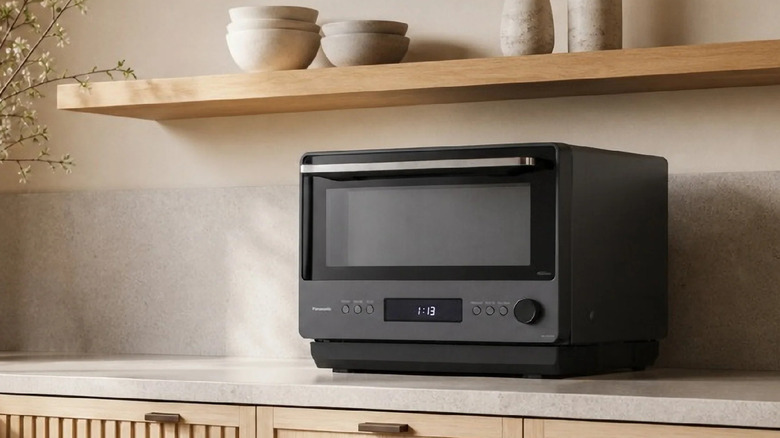
Panasonic aims to change all that with its new Japanese Microwave (also colorfully known as the NN-SF57RM), which uses advanced sensors and Panasonic's long-running Inverter Technology to banish uneven heating to the dustbin of history.
How the Japanese Microwave ensures even heat
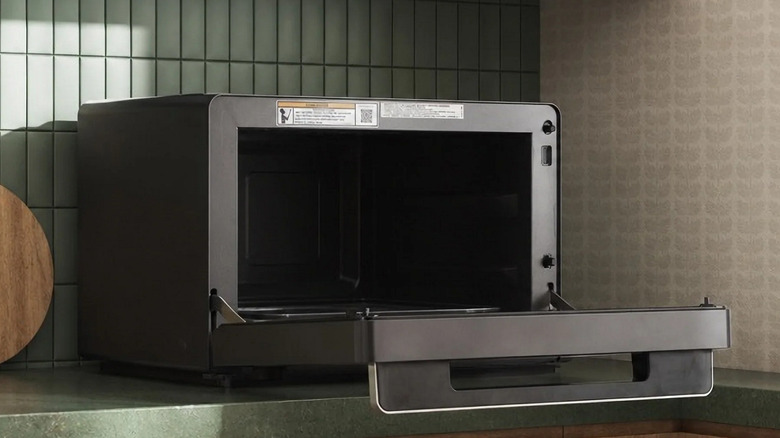
Panasonic's new Japanese Microwave looks the part, borrowing minimalist Japanese aesthetics to deliver a microwave that looks more like a sophisticated air fryer. It's got a pull-down door, and inside is a simple flatbed — no space wasted on the turntables found in traditional microwaves.
While it's a lovely-looking appliance, the headline-grabbing part is the tech working behind the scenes. The Japanese Microwave uses what it calls the Genius Sensor 2.0, a heat sensor that works across 64 discrete points of the microwave, to minutely measure the temperature of whatever you're heating up. It pairs the sensor with its patented Inverter Technology, which Panasonic has used in microwaves for almost 30 years, to deliver steady, consistent heat across the entirety of your food.
Traditional microwaves have no chill: they blast your food at maximum power in short bursts, then turn off completely, before blasting it at peak strength if required. Panasonic's Inverter microwaves can modulate the amount of power they deliver, and apply it steadily and continuously across the entire cook time, leading to more even warming. In combination with the sensor, the inverter allows for precise temperature control, in contrast with a normal microwave that has to blast and then cool food to reach a specific temp. That said, it's still a truly awful idea to heat plastic (and especially to put any kind of metal) in a microwave.