

Hisense UR8 Review: All In On RGB
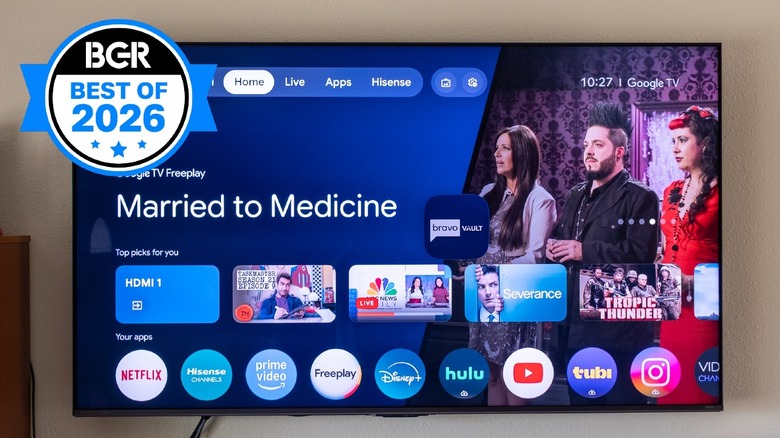
Hisense's U8 series has long offered perhaps the best image quality you can get from a TV in its price range, pushing brightness higher and higher each year, while improving on features and underlying panel technology. The newest model is called the Hisense UR8, which takes the U8 series and adds the next major upgrade in the form of RGB tech.
Basically, the promise is that the UR8 will deliver close to OLED-level performance without OLED-level prices, while maintaining a high level of brightness that OLED TVs can't match. It's also somewhat of a surprising release, given the fact that RGB technology was a hot new technology only a year or two ago. At the time, it seemed like it would be a while before it came to anything under $2,000.
The Hisense UR8 starts at $1,299.99 for the 55-inch model, and it sits underneath another new RGB MiniLED TV, Hisense's top-tier UR9. The good news, however, is that the UR8 largely delivers. You get excellent image quality, a range of features for things like gaming, and plenty of useful features. I've been using the Hisense UR8 for the past few weeks to see how it stacks up against other recent TVs.
Design
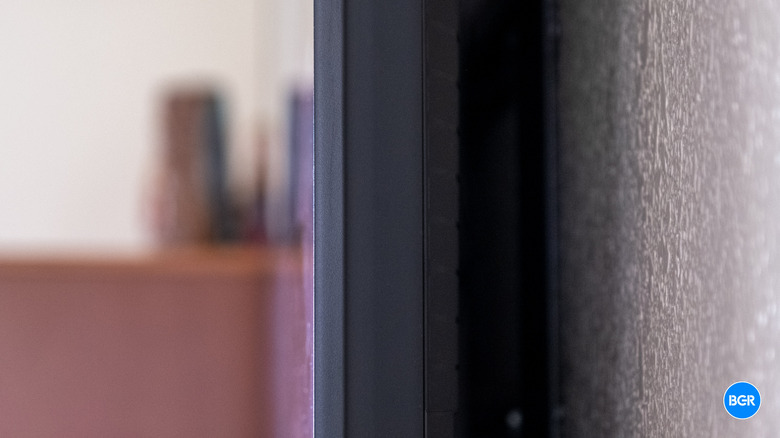
One way in which TVs in this price range have traditionally cut costs is in their designs. You won't find TVs at this price point with the ultra-thin panels that you can find from Samsung or the super-refined finishes that some others offer. That said, the Hisense UR8 looks far from budget.
The TV comes in five sizes, which means there should be a size for most living room environments. The smallest is 55 inches, and sizes range up to a massive 100 inches, though that model costs $4,999. While it's not super slim, the UR8 does still have a decently sleek chassis, and it's thinner than you might expect given how bright the panel gets. It's coupled with decently thin bezels and a relatively premium-looking build, though you might notice the plastic if you get close.
The TV comes with a stand that you can use if you don't want to wall mount it. I quite like the design of the stand. It's sturdy and modern looking, and unlike the feet of many budget and mid-range TVs, it's good at staying out of the way for things like soundbars.
The front of the TV is where perhaps the most consequential design changes come in. Hisense has put an anti-glare coating on the glass to help cut down on reflections, and this worked pretty well. It's not quite the matte finish that you can get on some high-end TVs, but in my usage, it did a pretty good job at handling reflections. When the TV was off, you could still see some of those reflections, but they were dimmed enough to not be distracting when the TV was on.
On the back, you'll find four full-bandwidth HDMI 2.1 ports, one of which doubles as eARC. There's optical audio out and basic USB connectivity, too. Four HDMI 2.1 ports is the right number — plenty of TVs at this price still skimp and give you only one or two. It's also an upgrade from last year's U8, which only had 3 HDMI ports in total.
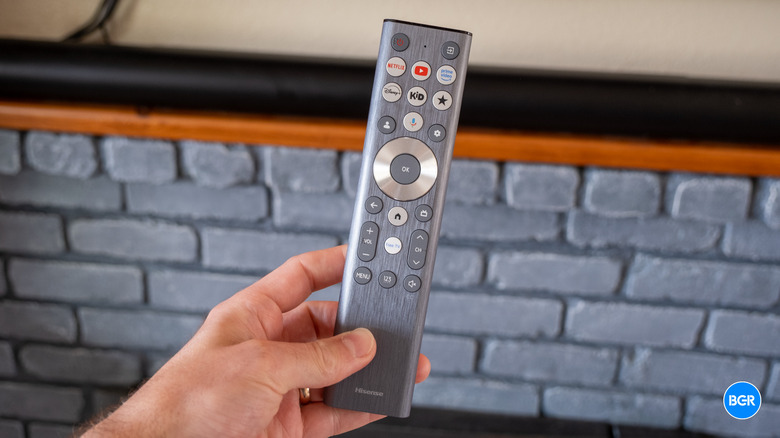
The included remote isn't all that different from previous-generation U8 models, which is to say it works perfectly fine. It has controls for everything you would expect, including software controls for Google TV and quick access buttons for Netflix, YouTube, Prime Video, and Disney+. There's also a programmable shortcut button, which is always nice to see.
As a whole, the design of the Hisense UR8 is perfectly fine. It's far from the sleekest TV out there, but it's also far from cheap-looking. And the changes that Hisense has made to the design are welcome ones.
Software
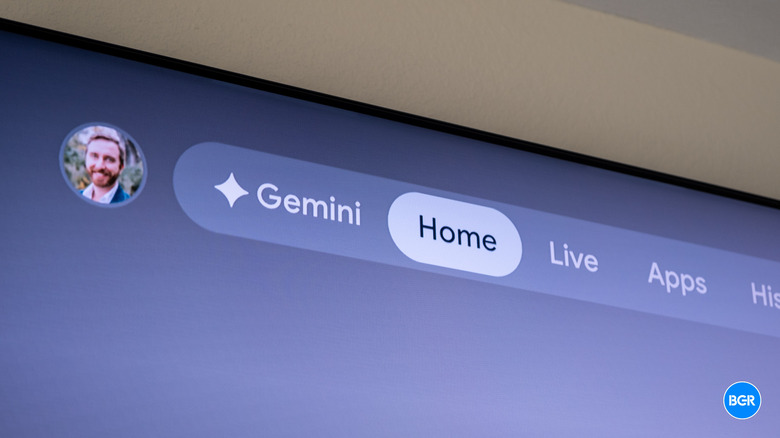
Like most recent Hisense U8 models, the UR8 runs Google TV. At this point, Google TV works well and is easy to navigate, offering quick access to your preferred streaming services, the ability to jump straight into content from the home screen, and extra features like live TV.
Navigation is generally smooth and the system avoids the bloatware that plagues some other smart TV platforms. That said, I did notice lag now and then when transitioning between certain submenus. It's not constant, and it's not bad enough to be frustrating, but it's there.
There are some features specifically for gaming, too. You get Auto Low Latency Mode, VRR, FreeSync Premium Pro, and Dolby Vision. There's even an integrated gaming menu bar that natively displays your active frame rate and HDR status, so you can verify your setup is doing what you think it's doing without leaving the game. For a mid-range set, that's a properly comprehensive gaming feature set.
Google TV, of course, includes integration with Gemini, along with built-in Chromecast support. But Apple users aren't left out. The TV still has AirPlay 2 support, and it can be added to HomeKit — so even if you don't get the full Apple TV experience here, you do get some of the most important integration features.
Performance
Of course, how the TV actually performs is what's really important. And ultimately, it performs very well. As mentioned, the UR8 has an "RGB MiniLED" panel. What does that actually mean? Well, in a traditional Mini-LED TV, there are thousands of backlight LEDs that are usually either white or blue, and are then filtered through color filters to produce the colors you see on the screen. In an RGB MiniLED TV, those thousands of dimming zones can be colored, thanks to the inclusion of red, green, and blue LEDs. This means that the TV can output light that's closer to what it's supposed to be before any filtering happens. The TV does still have color filters, but the idea is that with less reliance on those filters, more light can pass through for a brighter, more vibrant image.
Ultimately, that means that the TV's brightness is one of its top selling points. And, indeed, it does get very bright. Hisense quotes a peak brightness of up to 3,500 nits on a 10% window, which is extremely bright. I didn't test these claims, but I found that the TV was more than bright enough for my living room, which has a decent amount of ambient light thanks to large windows.
The high brightness is complemented with decently deep black levels too. I found that the TV was very good at handling brightness without blooming or light bleed, at least in any meaningful way. Sure, you may notice some blooming in a very dark environment with a keen eye, but again, it's very well controlled, and I suspect most will be able to ignore it altogether, if they even see it in the first place.
Along with the high brightness, I found that colors were vibrant too, and while they could suffer a little off-axis, this TV held up better in off-axis viewing than most I've used, at least when it comes to LCD-based TVs like this. Wide viewing angles are an advantage that OLED TVs have had over LCD TVs for some time now — and that doesn't disappear here, but at least it's a little more manageable.
The Hisense UR8 supports Dolby Vision, HDR10+, HDR10, and HLG, and that's pretty much everything you'll need for most viewing. There is one missing format, though, and that's Dolby Vision 2, which is not supported and is instead reserved for the more expensive Hisense U9. I would have liked to see Dolby Vision 2 support here, but I expect it will come to the U8 series model next year. To be fair, there's very little Dolby Vision 2 content out there right now, so supporting it would be more about future-proofing than anything else.
The image quality isn't perfect, but it's pretty darn close at this price point. I occasionally spotted some stepping artifacts during transitions, which means that you'll see a gradient step rather than a smooth ramp. But that was rare, and again, not distracting by any means.
Upscaling was also pretty good. The TV did a very good job at upscaling 1080p content to look almost 4K, and even 720p video looked a lot sharper than you might expect. The TV also offers a range of gaming features. It has a 180 Hz refresh rate, and when combined with the four HDMI 2.1 ports, you should be able to get the most out of any modern gaming console.
Against the previous Hisense generation, the gains are clear. The RGB LEDs deliver higher color saturation, high-contrast blooming is meaningfully reduced, and the native refresh rate jumps from 165Hz to 180Hz. As has been the case for a while now, against OLED TVs, you'll get a brighter overall picture and no risk of burn-in.
Audio
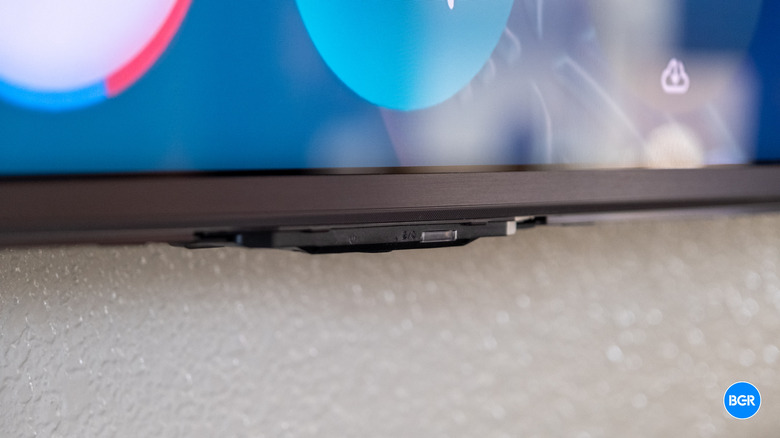
As has long been the case with TVs, you're better off pairing the Hisense UR8 with a soundbar or set of speakers than relying on the built-in audio. But as has also always been the case, the UR8 sounds better than older models. The TV has a 2.1.2 channel speaker setup tuned by Devialet, with two front-firing drivers, an integrated subwoofer, and two upward-firing speakers — with onboard Dolby Atmos decoding and processing. There's also room correction technology that analyzes your space and tunes playback to suit it.
Vocal clarity and mid-range reproduction are impressive, and dialogue stays intelligible even during busier scenes. The catch, obviously, is that you won't get anywhere near the bass response that you would get from a dedicated external subwoofer. Nor will you get the immersion that you can find on many modern soundbars. Audio just isn't as deep, as crisp, or as immersive out of the TV's dedicated speakers, but they'll work in a pinch while you wait for your speaker system to be delivered.
Conclusions
The Hisense UR8 is a nice step forward for the U8 series. The RGB MiniLED tech improves on the image quality even further, and the TV offers huge brightness that you simply can't get on OLED models or plenty of comparable LED models.
That image quality is coupled with a good selection of features, an operating system that's easy to use, and competitive gaming features. If you're looking for a TV in this price range for a room that has a decent amount of ambient light, then the Hisense UR8 is an easy recommendation. If you're looking for a TV for a darker living room, then it might still be worth considering one of the cheaper OLED TVs, but just know that you'll be sacrificing some brightness by doing so.
The competition
There's a fair bit of competition in this price range. Perhaps the most notable competitor comes in the form of the Samsung QN80H. The QN80H isn't as bright as the Hisense UR8, though, and it's more expensive. Another top competitor is the TCL C8K, which also gets incredibly bright. It doesn't have the RGB tech that the Hisense TV has, but it's a solid midrange option.
If you are open to an OLED TV, then it's also worth considering the LG C5. For those looking for a TV for a darker living room, the C5 is actually probably a slightly better buy. It doesn't get anywhere near as bright, but it does have advantages typical of OLED TVs, like those inky deep black levels and a thin, sleek build.
Then there's Hisense's own UR9. It's the significantly pricier flagship sibling, and it adds native Dolby Vision 2 support, higher peak brightness, and an Obsidian panel for deeper foundational black levels. If you want the absolute best of the RGB MiniLED lineup, that's the model to buy — but you'll pay considerably more for it.
Should I buy the Hisense UR8 RGB MiniLED TV?
Yes, if you want the best TV in this price range for environments with decently high levels of ambient light.