

Atomic Nucleus Clocks Are Making History After Decades Of Theorizing
Perfect timekeeping is more complicated than you think. Most clocks slow down over time (not that many people notice), and tiny imperfections in the manufacturing process ensure that no two timepieces are truly in-sync. Atomic clocks are currently the most advanced timekeepers we have conceived. Or at least they were, before nuclear clocks were invented.
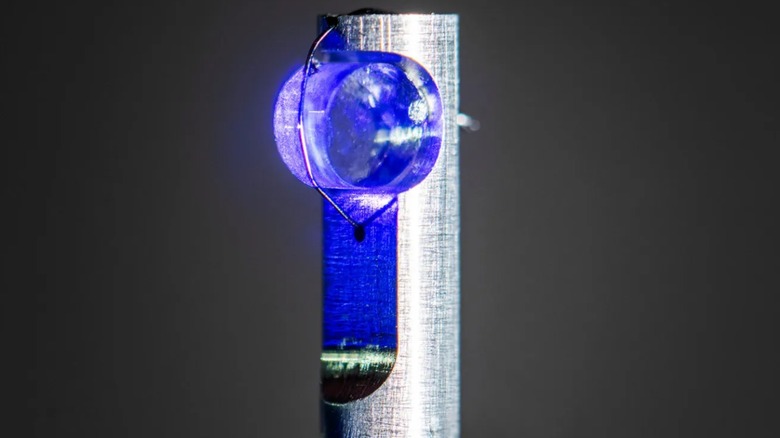
Earlier this month, researchers developed a prototype for an "optical nuclear clock," a timekeeping device that is allegedly even more precise than the standard atomic clocks that NASA uses in its satellites. The researchers detailed the new clock and how it functions, and published their work on arXiv. Basically, nuclear clocks measure time with the oscillations of a laser, tuned to the precise frequency that swaps the nucleus of thorium-229 atoms (stored in a calcium fluoride crystal) between quantum states. If the frequency drifts, fewer atoms change states, and the laser has to be readjusted to maintain precision.
As the device is a prototype, it is nowhere near ready for widespread use. However, it has potential applications in the search for the theoretical, invisible material that binds the universe and its laws together known as dark matter. Think The Force from "Star Wars" but less mystical. However, we can't normally detect dark matter because its interacts with most particles at an almost infinitesimal degree. That being said, a thorium-229 optical nuclear clock is so sensitive and precise, oscillations in its fine structure constant (the electromagnetic force between particles) that don't match those of similar clocks could be taken as proof of dark matter. The fine structure constant is supposed to be, well, constant across all elements. Then again, some scientists claim dark matter doesn't exist, so it's all theoretical at this point.
Timekeeping that was a long time coming

Despite sounding like it sprung from the pages of a "Star Trek" script (or at least like an invention that was inspired by sci-fi novels), atomic clocks were invented in the 1950s. Likewise, nuclear clocks have been around longer than we think. Well, the theory behind them, at least.
The idea for an optical nuclear clock was pitched in 2003 (you can read the paper in Europhysics Letters). The original idea theorized atoms of thorium-229 could be housed in radiofrequency traps. The scientists who wrote the paper believed thorium-229 would make the perfect heart for a nuclear clock because the element isn't affected by external magnetic and electric fields. Not too far off from the current iteration of the optical nuclear clock.
So what took scientists so long to capitalize on the theory? Our technology needed to catch up to our imaginations. Thorium-229 has a very specific energy jump ripe for prodding with a laser, but this laser must be frequently monitored and readjusted, ideally without human interaction or intervention. Without that feedback loop, you'd only have a laser poking at the element without performing any actual timekeeping. But now that we have the requisite technology, not only can we produce prototype nuclear clocks, researchers are confident the field will progress quickly. Our fingers are crossed these advances will revolutionize the search for dark matter.