

Why Does NASA Need To Use Atomic Clocks In Space?
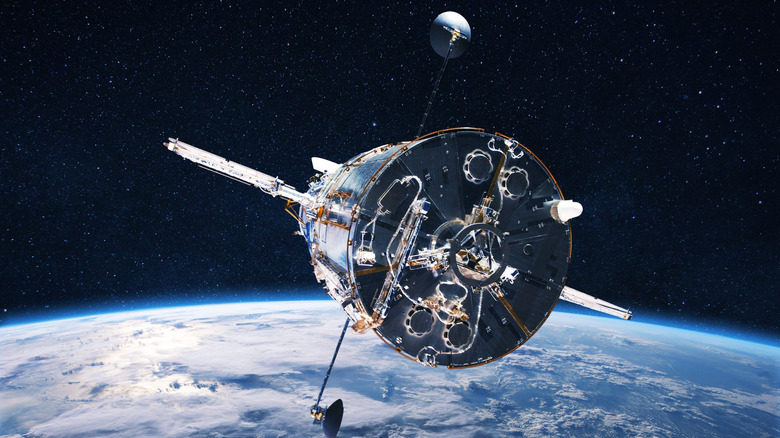
Humanity has used clocks since we became aware of the concept of time. And as technology has improved, so have our time-keeping methods. Today, many people rely on digital clocks to track the hours and tell us when to wake up (although physical alarm clocks are coming back in fashion). But these clocks are too unsophisticated for the rigors of outer space. Or should we say inaccurate?
Whenever NASA launches anything into space or even orbit, it is equipped with an atomic clock. Even GPS satellites use atomic clocks instead of traditional time-keeping methods because the latter is inherently flawed. No two clock mechanisms are exactly the same; miniscule, almost imperceptible imperfections throw off how accurately they keep time. Some clocks are simply faster than others due to uncontrollable side effects of how they are manufactured, which isn't well-suited to traveling in space. The slightest timing error can be all that stands between a satellite maintaining its orbit and hurtling back towards Earth as a flaming artificial comet.
Even in an ideal world where all clocks keep time in sync with one another, most still aren't accurate enough for NASA's standards. Digital clocks track time because their internal quartz crystals oscillate at a specific frequency — 32,768 times a second. Whenever the internal crystal reaches its 32,768th vibration, that counts as a second to the clock. In theory, at least. In reality, quartz crystal clocks slow down over time. After an hour, they're off by a nanosecond. After six weeks, that difference grows to at least a millisecond. This compounding error is why perfect timekeeping is extremely complicated. And why NASA relies on atomic clocks.
What's the big deal with atoms and atomic clocks?
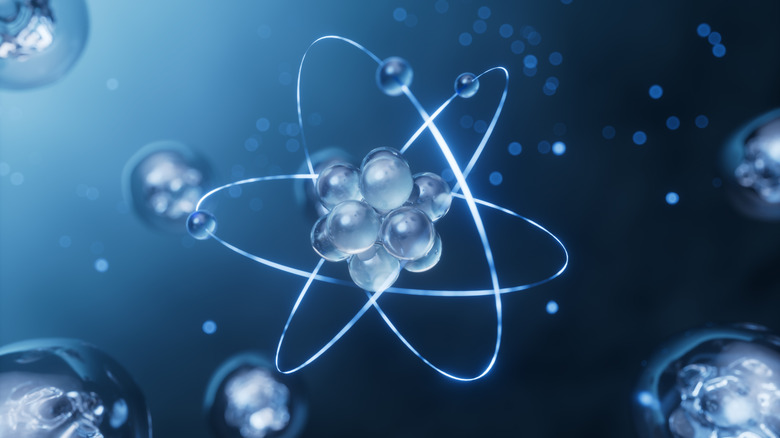
Atoms are the building blocks of reality. The Earth is made up of atoms. You are made up of atoms. Heck, nuclear explosions are made up of atoms. Well, the atoms of nuclear elements splitting and releasing megatons of energy, but same difference. So what makes atoms the perfect little timekeepers? They're 100% natural.
Unlike manufactured parts, all atoms of any given element are identical, and they don't wear or slow down over time. Although, atoms aren't the smallest particles in the universe; each atom is made out of a nucleus, consisting of protons and neutrons, and varying numbers of electrons that orbit around the nucleus. When atoms receive energy of a specific frequency, their electrons swap orbits. Scientists can measure this exact frequency to receive a precise measurement of time. Well, almost precise.
Admittedly, the science behind this timekeeping process is far from reliable. Atomic clocks transfer this energy frequency using quartz crystal oscillators, which as we already established are inaccurate at the best of times. Usually, the quartz's oscillating frequency is correct, which makes most of the electrons jump orbits, but sometimes it isn't, and only a scant few change orbit. Atomic clocks can calculate what changes are needed to get the quartz oscillator back on track. This self-correction makes atomic clocks far more accurate than other manmade clocks.
In space, nobody can hear you ask for an update
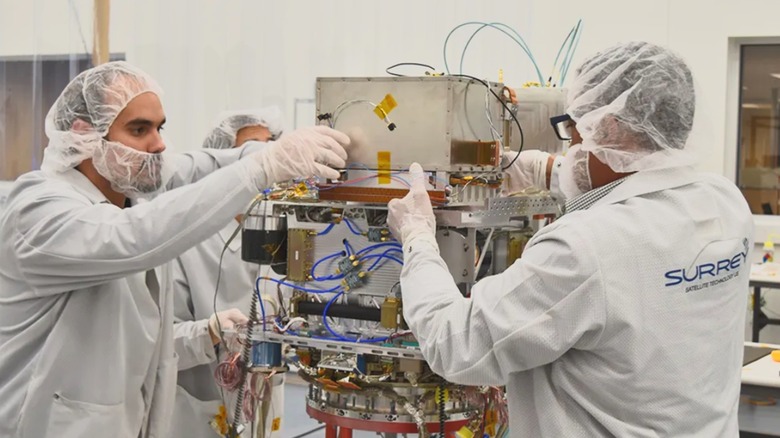
All GPS satellites use atomic clocks for their timing, and these satellites stay in touch with Earth. Not just because plenty of people still use handheld GPS devices that rely on these satellites but to receive timing updates. Turns out while GPS atomic clocks are accurate, they still need corrections from larger, more stable ground-based clocks that can't survive in space. But NASA is designing special atomic clocks that can thrive far from Earth.
The Deep Space Atomic Clock (DSAC) is a relatively new form of atomic clock. First launched in 2019, this space-bound timekeeper miniaturizes the technology used in the aforementioned Earth-based atomic clocks while also reducing the power demands. The secret ingredient to the DSAC and its capabilities is mercury, specifically mercury ions. Normally, atoms are housed within vacuum chambers, and any environmental change can lead to frequency errors. Whereas most atomic clocks use neutral atoms, mercury ions carry a charge, which means it can stay within an "electromagnetic trap" that isn't vulnerable to the ravages of outer space.
When all is said and done, the DSAC could be 50 times more accurate than the atomic clocks in GPS satellites. It's still prone to some natural errors, but the DSAC's drift only totals under a nanosecond every four days. That's a compounding error of one second after 10 million years. Not perfect, but it's not like anyone will live long enough to notice. Odds are when when we finally travel to Mars, our rockets will utilize DSAC timekeeping technology.