

Large Power Bank Vs. Solar Charger - Which Is Better For Camping Trips?

We may receive a commission on purchases made from links.
If you are planning a camping trip and have electronics you want to bring along and keep charged during your excursion, you have a couple of pretty solid choices: large power banks and solar chargers. Both provide a way to top off devices such as your phone, radio, computer, or small appliance. Both are also essentially portable batteries, but one needs to charge through an outlet, and the other harnesses energy from the sun.
Either item will serve you well during a camping trip, but there may be one that is better overall for your needs. While you can use either a large power bank or a solar charger to power up your dead phone or radio, for example, a larger power bank is usually the preferred choice if you need to power small appliances beyond a simple coffee maker or toaster. Solar chargers tend to work fine for smaller devices, but large power banks start to take over as you move toward larger, more power-hungry gadgets. You can find some fast charging power banks, as well, for quicker charging.
Your choice of power source will also depend on where you plan to camp. For campsites with electrical power, you could get by with using the solar panel to charge your phone or other small gadgets, but use the provided outlets to charge (or flat-out power) appliances. If you plan a longer trip in the forest away from power, it may be best to bring a large power bank, especially in areas with dense tree canopies, which can limit your exposure to sunlight.
The pros and cons of large power banks
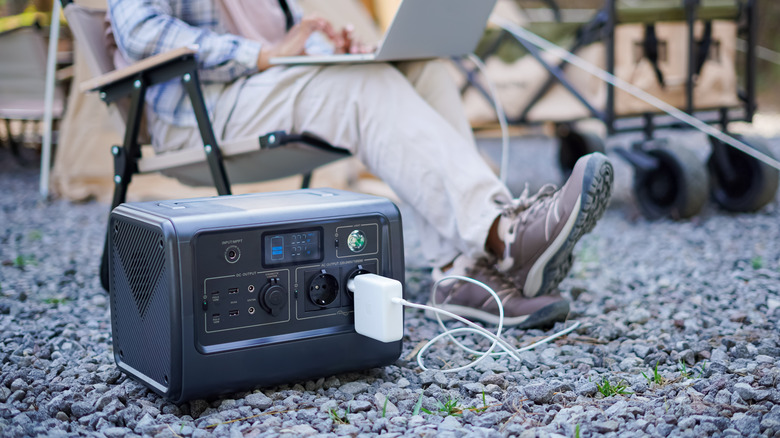
Large power banks are designed to store vast amounts of electrical energy inside an internal battery. Before you set off on your camping trip into the woods, you will need to charge the large power bank by plugging it into an outlet so it's ready to go later, when you need it for your outdoor adventure. Once at the campsite, you can plug just about any portable device into the large power bank to charge it up.
By using the appropriate cable, such as a USB or AC port, you can charge either one device or multiple, depending on the type of large power bank you have. Many come with multiple charging ports so you can boost several items at the same time. However, keep in mind that the more devices you have connected, the more time they may take to charge, and the more electricity they will drain from the power bank.
There are a few other concerns to be wary of with large power banks. The units can be expensive, as they are essentially portable power outlets. For example, the Jackery Explorer 1000 v2 Portable Power Station has a list price of nearly $800 on Amazon. Another drawback to consider is the weight of a large power bank. They can easily weigh 20 pounds or more, making them hefty to lug around, so make sure to bring ultralight camping gadgets to cut down on the overall weight of your expedition.
The pros and cons of solar chargers
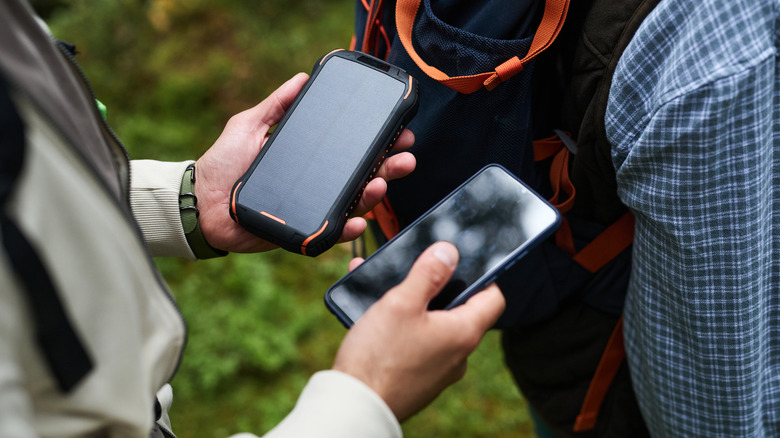
Solar chargers are great tools for charging smaller devices, including your smartphone, radio, or tablet. Phones, of course, are useful on a camping trip for making calls or sending texts, but can also be used for GPS and to monitor the weather. But making sure a phone is charged while on a camping trip is essential for staying safe and keeping in contact with those you left back home. That's where a solar charger comes in handy.
A solar charger offers you peace of mind, no matter what type of camping you're doing. They are compact, making them lighter than large power banks, and they are less expensive. However, solar chargers typically feature only USB ports, meaning you won't be able to charge some appliances you might want to bring with you unless they offer a compatible port, like the ones on the BigBlue 28W Solar Panel Charger. Another drawback to using solar chargers is that they rely on the sun to charge. If you are not in direct sunlight, they may still charge, but not as efficiently. You also won't be able to charge your gadgets at night, so timing and planning are important with the solar option. This generally makes large power banks a better option as portable battery packs that can store energy for long periods of time.
While the choice between solar chargers and power banks will depend on your situation, it's possible you don't have to choose at all. If you bring along both types of devices, you can use the solar charger to top off the power bank during daylight hours, giving you the best of both worlds.