

Alec Baldwin And Anthony Hopkins' '90s Survival Thriller Still Holds Up Magnificently
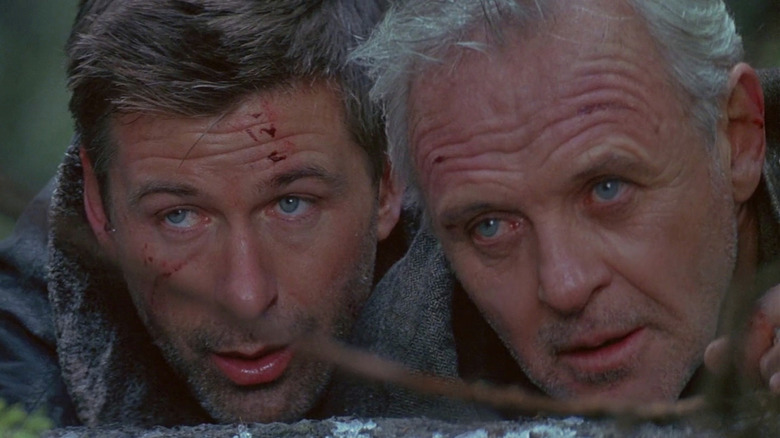
It's difficult to imagine Lee Tamahori's 1997 survival thriller, "The Edge," being made today and having the same visceral and striking effect. We hardly get the kind of straightforward yet razor-sharp script that the great David Mamet penned for this film anymore — let alone a direction that favors practical effects over CGI, and character drama over flashy, adrenaline-fueled action with a wild animal. Yet the biggest contrast between "The Edge" and contemporary survival flicks is that it stars an old rich man not only remarkably intelligent and self-aware but inherently relatable too. No director could (or would) do that in today's eat-the-rich era.
You see, "The Edge's" thick suspense doesn't solely come from its man vs. wilderness premise but the inherent conflict between its two protagonists. On paper, Charles Morse (Anthony Hopkins) is a typical billionaire businessman with a decades-younger supermodel wife (Elle Macpherson), whom he's eager to please to prevent losing her to a younger competitor like arrogant yet charming photographer Bob Green (a smarmy Alec Baldwin).
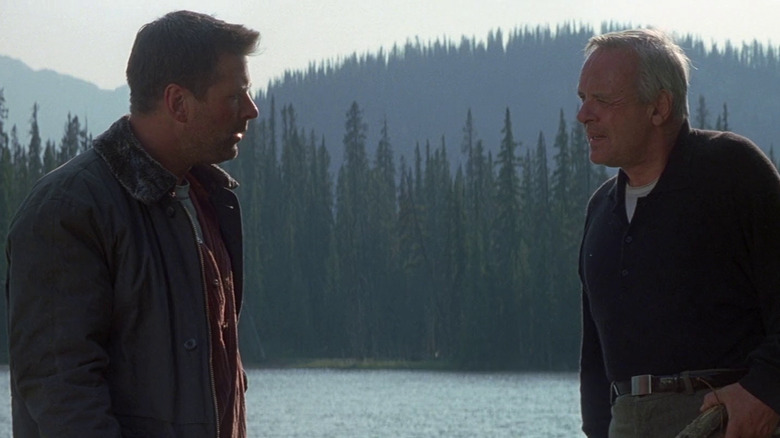
He flies her out to the Alaskan wilderness for a photoshoot, where he quickly deduces that she might be having an affair with Bob. The attraction between the two is obvious, which immediately generates tension before any real action occurs onscreen. By the time Charles slyly confronts Bob on a charter plane that crash-lands right after in a lake in the middle of the Alaskan bush, the suspense is already sky-high and gripping. But their situation turns on a dime: now they have to stick together (initially accompanied by Bob's assistant Stephen, played by future "Lost" star Harold Perrineau) in the wilds to survive the merciless elements and a bloodthirsty Kodiak bear hellbent on hunting them down.
Fighting the elements and each other
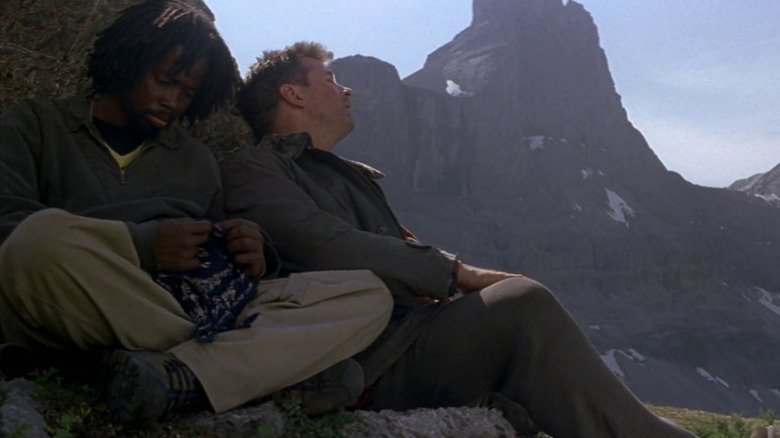
David Mamet's screenplay is filled with tautness, snappy dialogue, and constantly emerging threats. He can maintain and escalate conflicts that are happening on two entirely different levels simultaneously. And thanks to Tamahori's immersive direction, creating a setting replete with lush greenery, breathtaking mountain landscapes, and a sense of omnipotent danger, we feel the devastating weight of being lost in the Alaskan wilderness alongside these men.
It's in this unexpected situation where Charles (and Anthony Hopkins embracing the challenge of it) truly begins to flourish. He's got a vast knowledge of the outdoors, mostly theoretical, that he can finally put to the test. Virtually in an instant, he turns from an enigmatic and contemplative man to the leader of the pack. We can see the power balance between him and Bob shifting like tectonic plates, relying on instinct, smarts, and fear as they navigate this riveting yet unyielding terrain packed with imminent threats. Despite their innate opposition, the need to stay alive briefly develops a necessary bond between them, culminating in those fiercely captivating scenes where the two are forced to defend themselves against a vicious bear breathing down their neck and eventually making a plan to kill it.
Their turbulent, and at times moving, relationship is what drives "The Edge" relentlessly from beginning to end. But it'd be remiss of me to neglect the top-notch action and ravishing, elemental atmosphere that Lee Tamahori paints effortlessly around the sharply-drawn characters, even with a relatively small $30 million budget. Shot on location in British Columbia and other Canadian national parks, Tamahori makes the most out of the genuine surroundings, extracting both raw beauty and potent dread in large portions — not to mention the formidable strength and fierceness of a real Kodiak bear trained by Doug Seus.
They don't make 'em like that anymore
In an age where VFX and CGI (alongside AI) dominate nearly every medium and big Hollywood production, there's something to be said about older films that aimed for authenticity and realism without computer tricks. Whether it's the intriguing practical effects, shooting on location, or using real animals, these movies are sadly pretty much extinct now, and often what we get in place of them comes across as hollow and artificial.
I don't want to be the guy who shakes his fist while saying "everything was better back then," but watching something so vigorous and raw as "The Edge" does make you feel longing for a time when cinema aimed to produce magic rather than content. Don't get me wrong, there are plenty of enjoyable survival movies today, but when you go back to watch classics like "The Edge," "Alive," or even "The Ghost and the Darkness," you rediscover a vital veracity and grit these features had.
"The Edge" is a neat (if somewhat flawed) example of that: enthralling, tight, and endlessly absorbing even in its smaller moments. The wall-to-wall talents involved might make that sound like a sure thing, but we've seen plenty of examples have all those ingredients and still go sideways. Simply put, "The Edge" delivers adrenaline and thrills alongside a satisfying, character-driven story climaxing in a finale that not only leaves no loose ends but makes you ponder the nature of men — rich and poor, moral and amoral — for more than a few minutes. Within this specific genre, that's a rare breed you can encounter a lot more in the past than in the present — so treasure it accordingly.