

Rockets Actually Fly Better Without Air - Here's Why
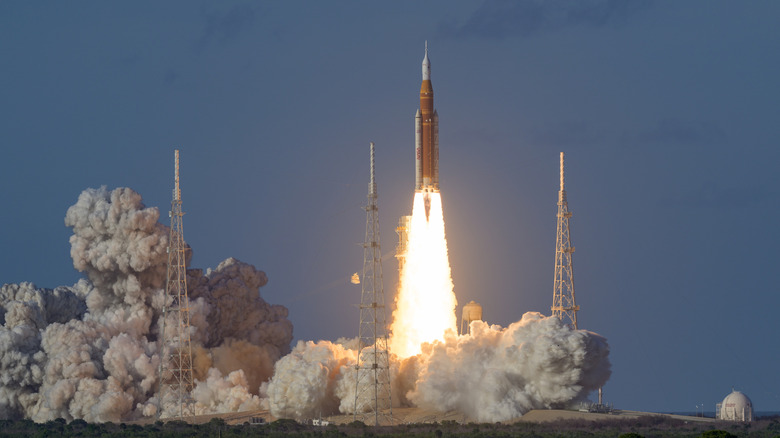
You can be forgiven for assuming that rockets need air to fly through the atmosphere to get to space, much like airplanes need air to keep flying. Rockets actually fly better without air because they are designed to operate best in space, and only deal with the challenges that come with air pressure for a short while after liftoff. Airplanes fly thanks to the air that moves over and under their wings. Rockets fly thanks to the raw power generated by their engines.
Rockets work on a different set of rules because they are designed to fly from the denser parts of the atmosphere right up to space, where there is no air. Because of this, rockets can't rely on air to keep them flying, and usually don't have wings. NASA's Space Shuttle orbiter had wings, but they were only needed for when it glided back to Earth after reentering the atmosphere. While rockets have to fly within the Earth's atmosphere after launch, they don't thrive in this environment, where they have to contend with air resistance that makes it harder to accelerate.
While airplanes rely on air to fly, rockets rely on Newton's third law of motion, stating that for every action, there is an equal and opposite reaction. The rocket's engine produces large amounts of thrust, enough to overcome the weight of the rocket, and to get it accelerating in a vertical direction.
Why rockets thrive in space
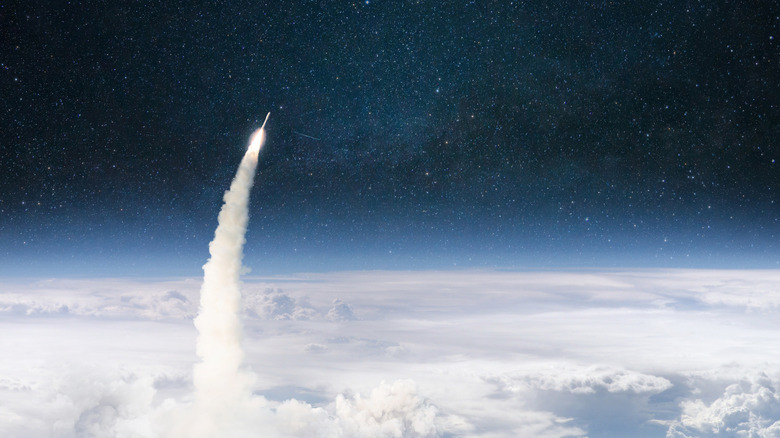
Once a rocket gets off the ground, it will use a combination of thrust from the rocket engines as well as steering mechanisms like gimballing, where rocket engine nozzles rotate to steer themselves. A good example of this is how rockets perform an essential rolling maneuver right after launch to set them on the correct navigational course. Enough thrust is required to not only lift the rocket off the ground, but to keep it accelerating to a speed of 17,500 mph in order to get to a stable orbit.
In the lower parts of the atmosphere, air resistance makes it very difficult for rockets to fly as fast as they need to because of how dense the air is. Aerospace engineers design rockets as aerodynamically as possible to mitigate this. As rockets reach higher altitudes, air becomes thinner, and air resistance decreases significantly until it disappears completely. A rocket can fly in space without atmospheric drag holding it back, and can accelerate much faster.
Rocket engines also perform much better in space because of air pressure. Within the atmosphere, air pressure causes a rocket engine to produce less power. Ambient air pressure resists the expansion of gasses coming out of a rocket engine's nozzle, making it less powerful.
When spaceships like the SpaceX Dragon eventually reach space, they can navigate and change direction by using the thrust produced from a spacecraft's main engine and reaction-control-system (RCS). RCS systems consist of multiple small engines situated all around a spacecraft that can be fired to change a spacecraft's orientation and momentum.