

Rocket Vs. Space Shuttle: What's The Difference?
With SpaceX now launching its reusable Falcon 9 rocket up to several times a week, the U.S. company has quickly become a giant of global spaceflight. It's a far cry from the days of America's Space Shuttle, which launched an average of 4.5 times a year during its lifetime between 1981 and 2011. People sometimes use the terms "rocket" and "Space Shuttle" interchangeably, but there's an important difference between the two.
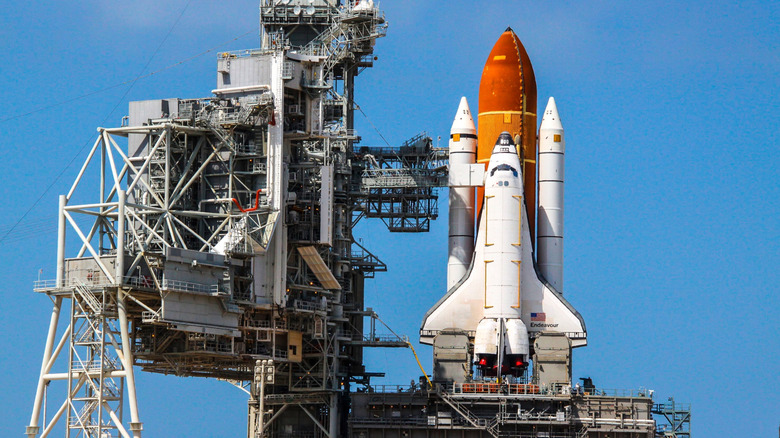
A rocket is the launch vehicle that carries a crew or payload to space, while the Space Shuttle was a specific reusable orbiter that used rockets to get to orbit before returning to land like an airplane. Put simply, the rocket is the delivery system, while the Space Shuttle is the vehicle riding on it. If you watch a Space Shuttle launch, you can clearly see its two side rockets powering the vehicle to space. After a couple of minutes, when the Space Shuttle is well on its way, these two side boosters detach and fall into the ocean before being recovered for reuse.
Meanwhile, the Space Shuttle's three integrated rocket engines continue to propel the vehicle into orbit. Similarly, a Falcon 9 launch involves the first-stage rocket booster powering the upper stage, including the crew or payload, toward space. Like the Space Shuttle, the booster detaches from the rest of the vehicle, but instead of being recovered from the ocean, it lands upright back on Earth.
Breaking down the differences
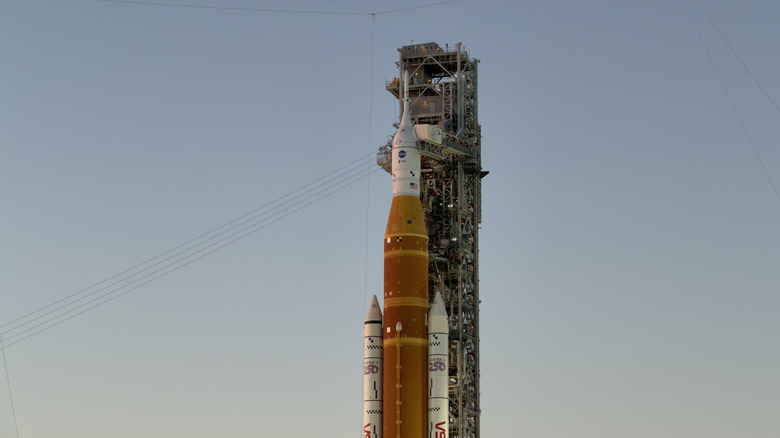
Modern rockets like SpaceX's Falcon 9 comprise a first stage and an upper stage supporting the crew capsule or payload, which sits atop the vehicle. The Space Shuttle had three main components: two side rocket boosters that fell away and were later recovered, an external fuel tank that was discarded, and the plane-like section for the crew. The shuttle launched in a similar way to conventional rockets, using rocket engines to thrust upward to escape Earth's gravity.
But differences emerge once a mission starts. The shuttle, for example, released its two rocket boosters and fuel tank before reaching orbit, whereas Falcon 9's first stage returns to Earth for reuse, and the upper stage delivers the crew capsule to orbit before separating from it. Coming home, the shuttle reentered Earth's atmosphere at high speed, with the underside heat shield resisting the extreme temperatures. It then glided like a plane toward its destination, landing on a runway before deploying brakes and a parachute system to bring it to a stop.
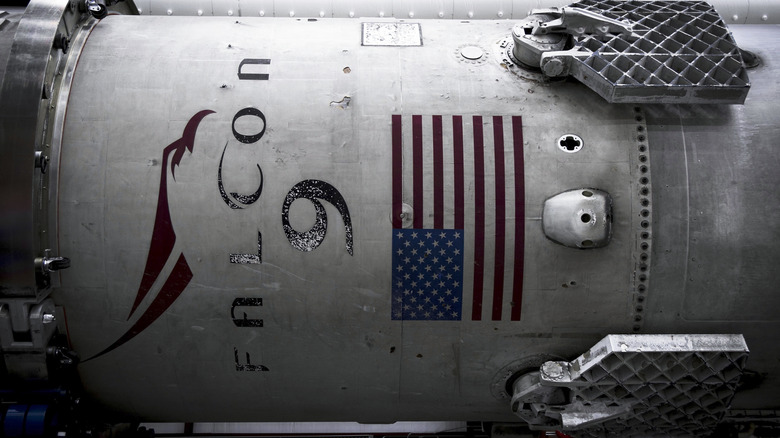
Before the Falcon 9, the first-stage of an orbital rocket fell into the ocean and wasn't recovered. SpaceX developed a way to land and reuse its first stage booster, enabling it to slash launch costs. After deploying a spacecraft or payload, a Falcon 9's first stage performs a series of burns that allow it to land upright on a barge waiting near the launch pad — usually around eight minutes after liftoff. The Falcon 9 is then made ready for relaunch. Rockets are general-purpose launchers, while the Space Shuttle was primarily a crewed spacecraft for orbital operations, including ISS missions as well as satellite deployments and servicing activities.
The Space Shuttle has gone, but rockets keep flying
After 30 years of operations, the U.S space agency's final Space Shuttle mission took place in 2011. Becoming one of NASA's most expensive space projects ever, it found the system too costly to maintain. Safety was also an ongoing concern following two tragic accidents — Challenger in 1986 and Columbia in 2003 — in which all of the crew members perished.
To reduce spending, NASA encouraged private firms to start making commercial rockets to carry crews to orbit in separate capsules — similar to how the space agency sent astronauts to orbit in the Gemini and Apollo programs in the 1960s and 70s. NASA also developed a new rocket called SLS (Space Launch System) and the Orion spacecraft for crewed missions to the moon. SpaceX, founded by the trillionaire entrepreneur Elon Musk in 2002, developed the Falcon 9 rocket and its reusable first-stage booster.
Nine years after the end of the Space Shuttle program, NASA and SpaceX used the Falcon 9 and Crew Dragon capsule to resume human spaceflight missions from U.S. soil in 2020, sending two astronauts to the International Space Station and bringing them safely home again. The historic mission marked a new era for American crewed spaceflight and showed that a reusable rocket paired with a separate capsule could make spaceflight more sustainable than the Space Shuttle's all-in-one design was ever able to achieve.