

Is The Last Of Us Cordyceps Infection Possible In Real Life?

In the HBO series "The Last of Us," which has been renewed for a third season, humanity is locked in perpetual conflict with a zombie scourge brought about by a mutated strain of cordyceps fungus. Said fungus infects humans either directly through bites or exposure to airborne spores, turning its victims into animalistic monsters who only seek to spread the fungus further. As is often the case with fiction loosely rooted in science, and especially the most popular zombie films, it's been a common question since the popularization of "The Last of Us" as to whether or not this kind of fungal zombie pandemic could actually happen.
The good news is that it can't, or at least it can't in the particular terms outlined in the series. Cordyceps is a very real fungus, and it is capable of parasitizing creatures with the intent of propagating itself. However, the creatures it usually parasitizes are ants, and ants are a very different kind of creature from humans. In the first episode of the HBO series, an epidemiologist posits that the only thing preventing cordyceps from taking root in humanity is its high internal body temperature. While that is a factor protecting civilization, it's not insurmountable. Cordyceps can overcome this and many other factors with a random temperature-based mutation.
Ophiocordyceps unilateralis hijacks ant bodies to propagate
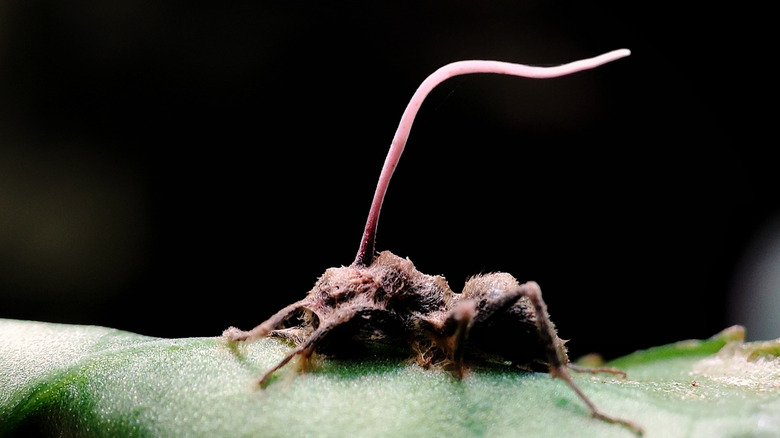
Cordyceps fungi, scientific name Ophiocordyceps unilateralis, grows natively in the high-altitude, low-oxygen regions of Asia, though it can also be found in tropical forests. Fun fact: Cordyceps has been a staple of traditional Chinese medicine for centuries, with some studies suggesting it could even be used to treat cancer. Cordyceps, like most fungi, propagate through airborne spores. These spores land on young insects, most commonly ants, and gradually penetrate the insect's exoskeleton to work its way into its circulatory system.
The cordyceps gradually consume the ant's body from the inside out, while flooding its nervous system with chemical signals that compel it to move out of its burrow and up to higher ground. When the controlled ant finds a good perch, it latches onto an anchor point like a leaf and effectively dies on the spot. The ant's corpse stays in its perch for several days while the cordyceps finishes eating its insides. Once it's had its fill, the cordyceps begin growing up and out of the base of the ant's head as a fruiting body. This fruiting body then jettisons a fresh cloud of spores to infect more ants, and the cycle starts all over.
Cordyceps can't survive in the human body
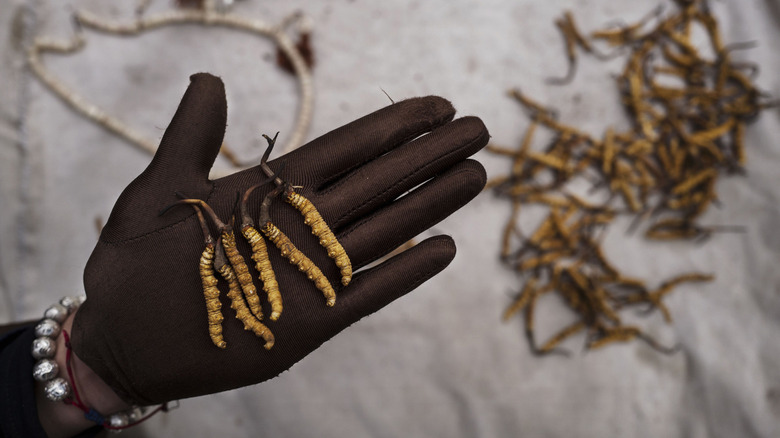
The epidemiologist in the first episode of "The Last of Us" says that cordyceps can't survive in human bodies because we're too hot, and hypothesizes that a mutation brought about by climate change could eliminate that point of protection. However, it's a lot more complicated than that.
For starters, while cordyceps can take hold of an ant easily enough, it's only because cordyceps have specifically evolved to control ants and similar arthropods. Human beings have a completely different physical and chemical makeup, and in all likelihood, whatever chemical signals cordyceps use to compel ants just wouldn't work on people. That's also assuming that cordyceps would even be able to get a foothold in the human body. In addition to their higher body temperatures, humans also have a much more robust immune system. People aren't immune to fungal infections, of course, as evidenced by conditions like athlete's foot or yeast infections, but those ailments don't circulate through your entire body, and they don't affect your brain.
All of this isn't to say it's completely impossible for a fungal-based infection to turn humanity into zombies, but if it was going to happen, it wouldn't happen due to cordyceps. It would have to be an entirely new fungus that's already predisposed toward pulling the precise levers of the human body, and the odds of something like that arising in a vacuum, while not zero, are pretty close to it.