

How Modern Navy Radars Track So Many Threats At Once
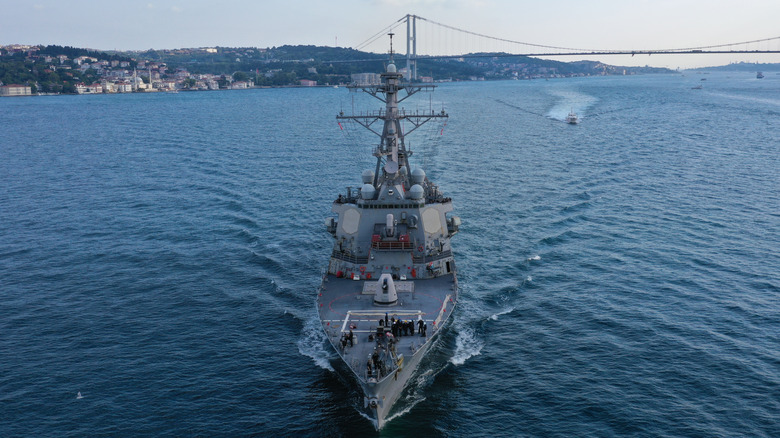
In the modern naval battlespace, naval ships need highly capable radar systems to track targets for multiple purposes. Modern naval vessels can no longer track only singular targets but must scan and track multiple targets and threats on the water and in the air at the same time. The U.S. Navy's modern workhorse radar is the AN/SPY-6 active electronically scanned array (AESA) series, capable of tracking hundreds of targets simultaneously. The radars use digital beamforming to steer radar beams, rather than the mechanically driven methods seen on legacy radars. This enables simultaneous tracking.
The AN/SPY-6 Air and Missile Defense Radar (AMDR) system uses Radar Modular Assembly (RMA) technology, in which multiple self-contained radar antennas are grouped into arrays of varying sizes to fit each mission. The AN/SPY-6 radar system uses gallium nitride semiconductor technology, which enhances power efficiency and delivers up to five times the power of radar systems that use legacy materials. This radar system is in use on various U.S. Navy ships, including destroyers, amphibious ships, and nuclear-powered aircraft carriers like the USS Gerald R. Ford.
While the AN/SPY-6 radar is a cutting-edge antenna system, it cannot form a comprehensive multi-target picture without software support. U.S. Navy destroyers are equipped with the Lockheed Martin Aegis combat weapon system, a dedicated system for managing defensive and offensive operations that require radar-based targeting. Aircraft carriers use a simpler Ship Self-Defense System (SSDS) that focuses primarily on self-protection. The U.S. Navy is also working on a major project called Overmatch, which will use tracking information from these radars and combine them with multiple other sources to form a global picture of enemy naval movements.
AESA radars are the new global benchmark for navies

While the U.S. Navy uses the AN/SPY-6 series of radars built by Raytheon, some European counterparts use three-dimensional multi-function radars built by Leonardo, such as the Kronos Grand Naval radar system. The Kronos system is an AESA radar that features technology similar to that used in the AN/SPY-6 systems and also uses advanced materials such as gallium nitride. It is being phased into active use with the French and Italian navies.
The United Kingdom's Royal Navy uses the SAMPSON multifunctional AESA radar, which is fitted to its Daring-Class destroyers. Like the AN/SPY-6 radar, the SAMPSON radar system can track hundreds of targets simultaneously at ranges of up to 250 miles. China has implemented the Type 346 AESA radar on its Type 052D Luyang III destroyers, and Russia uses the Poliment AESA radar.
Shipborne AESA radar systems are a global standard for navies around the world. In modern warfare, naval ships can expect to track not only incoming ballistic missiles, such as Russia's Avangard hypersonic missile, but also aircraft and drone swarms. Tracking hundreds of targets simultaneously isn't just a nice-to-have, but a defensive and offensive standard without which Navy ships cannot conduct modern combat operations.