

What Is A Black Light Flashlight Actually Used For?
We may receive a commission on purchases made from links.
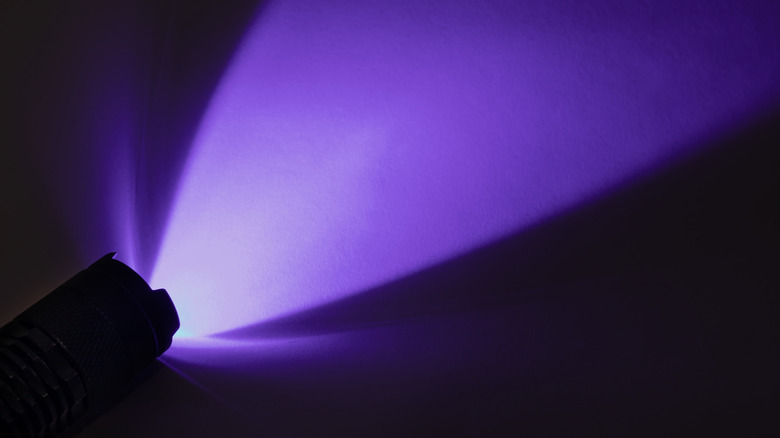
If you grew up in the '90s you probably remember the neon glow of black lights, which were popular at the time. Maybe you had one in your bedroom, a friend had one, or somewhere local basked its halls in the bold hues. You can still find them today, though they're not as prevalent, in indoor minigolf parks, laser tag venues, arcades, and so on. But there's another more practical use for them in the form of a flashlight. Black light flashlights, technically UV flashlights, are nothing more than portable or handheld lights that emit ultraviolet light instead of the warm hues of a traditional bulb. While they have many uses, generally UV flashlights are for detecting traces of materials or elements.
A UV flashlight is merely one equipped with a UV bulb or LED, that emits UV radiation. Scientifically, UV light is an invisible wavelength of the electromagnetic spectrum, between visible light and X-rays. They are shorter than visible light but longer than X-rays in the range of 100 to 400 nanometers. Natural UV comes from the sun and comes in three types, UV-A, UV-B, and UV-C. UV lights or black lights emit UV-A, the longest and most common of the three wavelengths.
How is a UV flashlight used to detect traces of materials?
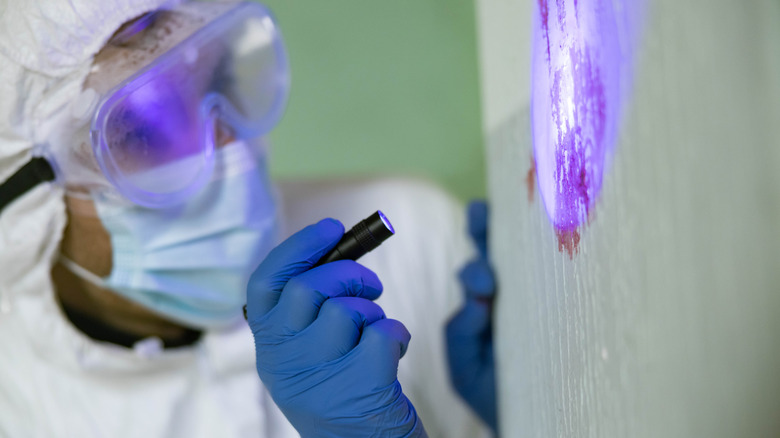
The old-school style of black lights are a fun, whimsical form of decoration excellent for arcades and game rooms alike. But you may have also noticed that the UV light has a way of illuminating various stains, traces of elements, and reactive materials. When something glows under a UV light its considered to be "fluorescent," which means its absorbing the wavelength of light or radiation and then returning it (re-emitting) as a longer wavelength. Humans, animals, and rodents are known to change color under UV light, as well, which is called biofluorescence. These properties would otherwise be invisible to the human eye and undetectable. UV lights make it all observable.
That makes them ideal candidates for investigations in various settings, professional to personal. UV flashlights can help identify otherwise invisible stains, like pet stains, food or chemical spills, blood, and other fluids, the latter of which is highly useful in forensics and at the scene of a crime.
There are many similar, yet auxiliary uses, as well. China has set up farming robots that are a lot more fancy than simple tractors, which use UV light and cameras to detect and flag pests and crop disease. HVAC technicians can use a UV flashlight to detect system leaks, art experts and inspectors might use them to authenticate or treat paintings by studying the fluorescent properties of older paints, and miners or rock collectors use them to discover rare minerals. Additionally, UV lights can help check the cleanliness of spaces like hotel rooms or apartments, find UV-reactive insects, or even to identify counterfeit money and documents — legitimate versions are marked with fluorescent ink to signal they're genuine.
Are UV flashlights dangerous to use?
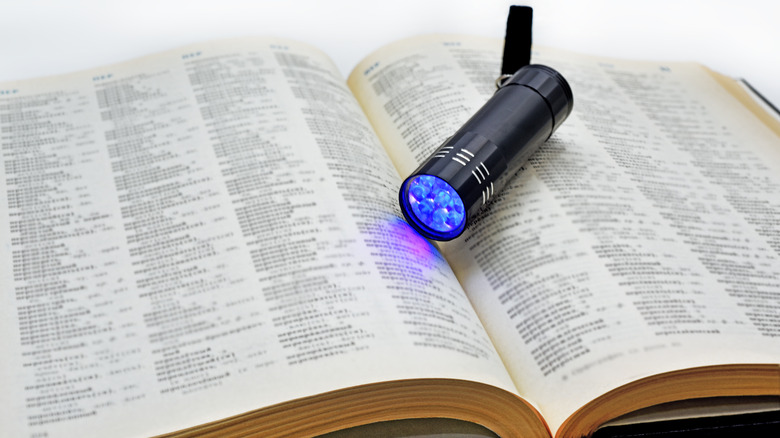
As long as you're not pointing a UV flashlight directly at someone for extended periods, they should be safe to use. Overexposure to UV light is what you know as a sunburn. While the risks are smaller, prolonged exposure to UV-A from manufactured lights can cause sunburns and skin damage, increasing the risk for cancer. You should avoid shining UV lights on bare skin up close especially if they're classified as a high-power light.
You should also avoid shining them into someone's eyes or your own eyes, which means don't look directly at the bulb or light source. That can result in something called photokeratitis which is a painful sunburn on your cornea. It's temporary in most cases but hurts, so it's still not something you want to experience or want anyone else to deal with. Wearing protective glasses or polarized glasses is the ultimate defense. Similarly, modern cameras are sometimes outfitted with a UV protection lens filter to safeguard the camera lens and reduce haze and light adjustments due to the UV rays.
A good practice is to turn on the light only when it's needed, like to detect minerals, stains, or chemicals on specific surfaces, versus leaving it on and walking around with it. Interesting side note: Phone sanitizer machines actually work by using UV-C, another form of ultraviolet light, to kill bacteria and viruses.