

What Does 'GaN' Actually Mean On Your Charger?
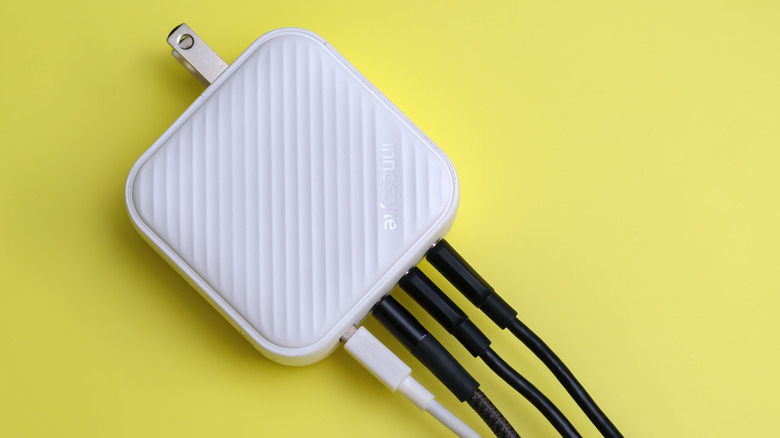
GaN stands for Gallium Nitride, which is a wide-bandgap semiconductor material that is now replacing traditional silicon inside charging bricks. If you have been looking for a new charger in the past few years, you probably realized that many companies have been using the term "GaN," as they show small chargers with impressive power capacities. This is because GaN has a wider bandgap than silicon, which means electricity can pass through the material at much higher voltages and temperature without causing any breakdown.
In practical terms, GaN technology enables chargers that are significantly more efficient than silicon-based options, while handling higher operating temperatures and reducing the need for large internal heatsinks — and this is why whenever you see a very small charger with a high potency, you probably think that it's not safe. Still, it means that more power can be squeezed into a smaller volume. On top of that, GaN loses less energy to heat, as it operates at 95% efficiency compared to silicon's typical 85-90%.
That said, whenever you're looking for a new charger for your smartphone, laptop, or to charge several devices at once, you should look for a GaN charger, as it drastically shrinks the size of the power brick you carry, you can fast-charge several devices at once depending on the device you choose, and it can be the perfect travel companion thanks to its weight and space savings.
What are the disadvantages of GaN chargers?
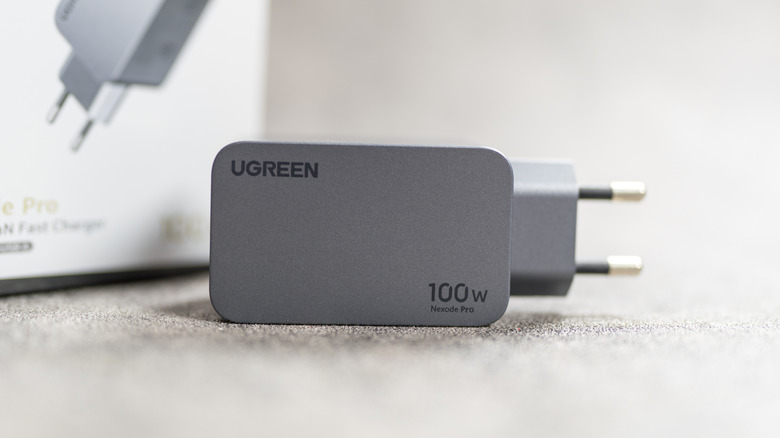
Even though GaN chargers are the tech of the moment to fast charge your devices, and they offer a few technical advantages in comparison to a regular charger, it comes with some drawbacks. For example, GaN substrates are far more complex and expensive to fabricate than standard silicon wafers, as companies need to use sapphire, silicon carbide, or silicon wafers via chemical vapor deposition. If it costs more for a manufacturer to make them, then it will cost more for customers to buy them.
Since GaN passes energy more efficiently and creates less heat, it requires special internal circuit boards with specialized gate drivers, high-frequency transformers, and precise electromagnetic interference shielding to prevent electrical noise. Finally, for basic everyday devices, like those that charge with 5W to 15W of power, there's no benefit of choosing a GaN charger, as you'd be spending a lot of money on a device that can't take advantage of these fast-charging speeds.
For example, a regular 5W to 15W charger can cost around $12, while a GaN charger will be available for at least $30. That said, GaN chargers only make sense when you think about charging more demanding accessories, like some of the latest smartphones, tablets, or a laptop.
Is it worth buying a GaN charger?
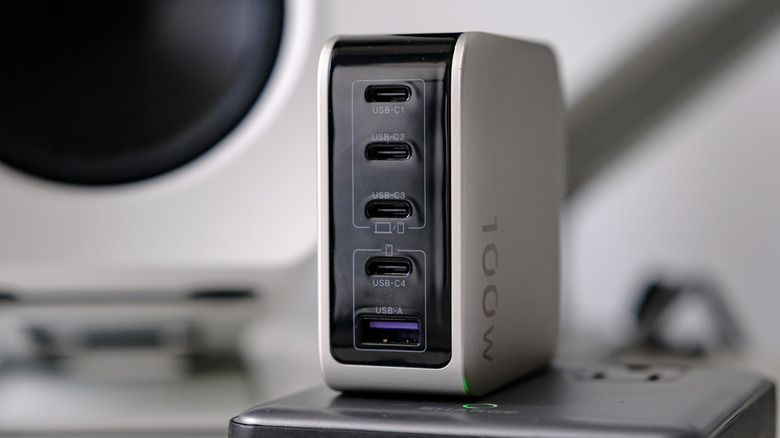
GaN chargers can be a great choice for anyone needing a new charger for their laptops or other devices with bigger batteries. After all, since they usually require 65W or more, GaN chargers can easily top that power while drastically shrinking the size of the power brick you'll need to carry. For example, my current 96W MacBook Pro charger from 2019 looks like a huge brick compared to similar GaN options in 2026.
Besides that, this technology is great for multi-device users. So with a single GaN charger you could theoretically fast-charge at least three devices, like your smartphone, laptop, and tablet. While it depends on the amount of power you'll choose, if you get a 160W GaN charger, you could easily fast charge your MacBook Pro, an iPad Pro, and the latest iPhone 17 Pro series. This is good not only for cable management at home, but also for taking on trips, and the reduced weight of replacing several power bricks with a single one is beneficial.
The only downsides of GaN chargers are if you're not ready for this technology, as it won't disrupt your device's battery, it will save you space when traveling, but it will cost more, and it won't make any differences if you don't have enough devices capable of fast charging, which means you might need to upgrade your devices before getting your hands on the charging technology of the moment.