

Scientists Dressed Up As Batman Had An Unexpected Effect On Local Residents
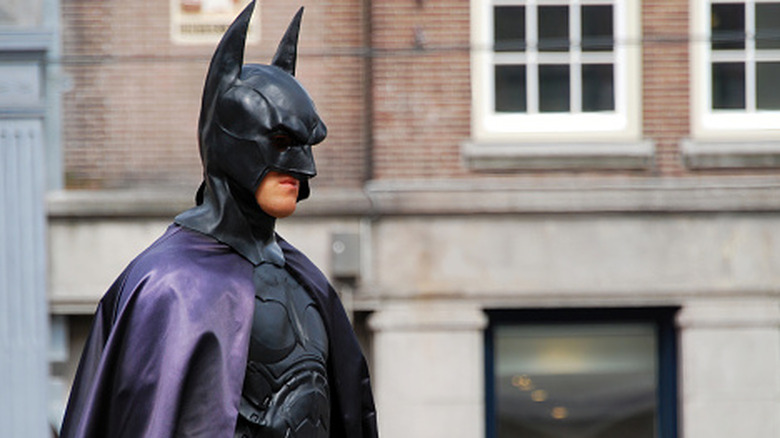
Batman typically is seen fighting crime in Gotham City, but recently he showed up in Milan, Italy as part of a study. The research posed the question of how people would react upon seeing someone dressed up as the Dark Knight and if it impacted their behavior. The scientists donning the cowl and suit weren't stopping the Joker from blowing up a bridge, but the experiment did feel like one the Riddler may set up, and it did change people's behavior.
The field study took place in the Milan Metro and involved observing nearly 140 rides on the train. The research saw a woman, who appeared pregnant, get on the train, while another scientist watched and recorded the situation. During the actual experiment, the pregnant woman would board the train while someone dressed as Batman would enter from another door. Scientists wanted to see who, if anyone, would give up their seat to the pregnant woman when Batman wasn't and was present. When the Caped Crusader was spotted, around 67% of people offered their seat to the pregnant woman. When they didn't see Batman, only 44% of passengers offered their seat.
Scientists concluded that altruism is present whether or not people saw Batman. However, those that reported seeing him showed more altruistic signs by offering their seat to the woman. Batman has a few rules he lives by to protect the citizens he cares for, and this study is one he may be proud of.
This isn't the first psychological study done regarding Batman

Batman has been featured in another study which focused on taking on an alter ego, something that is familiar to the vigilante. In a similar way to Batman's alter ego being Bruce Wayne, the study revealed that adopting our own alter ego can make us more confident and reduce stress. When Wayne puts on the suit and speaks with a deep gravely voice, he's no longer the eccentric billionaire, but Gotham's protector.
Known as the "Batman Effect," the research featured three groups of children, aged between four and six, all working on a boring assignment for ten minutes. Each was told they could take breaks to play a video game. The first group was told to say "Am I working hard?" The second was told to ask the question but replace I with their name. The third was told to pretend to be a favorite character such as Batman and ask "Is Batman working hard?"
The third group who took on the identity of Batman spent the most time on the project. The results seemed to reveal that those who take on a persona, such as Batman, are more likely to show signs of having less stress and increased perseverance. It's a way to have someone get out of their shell and step into a new identity to complete a task, overcome anxiety (which actually rewires your brain), or be happier situation. It's similar to Einstein's note on how to be happy.
How you can implement Batman in your life

The Milan study gained the attention of Reddit where the r/todayilearned subreddit discusses the research and how it plays a role in society. Comments explore the hypothesis that the experiment can be used in everyday life. One commenter proposes that seeing someone dressed as Batman triggers the brain into becoming more present in their surroundings as it breaks the normality of everyday life. Being more aware, therefore, makes people more likely to treat others better.
The concept of the study played out in one of Christian Bale's Batman films. Bringing it full batarang back to Batman, "The Dark Knight" features a scene where two groups, civilians and criminals, are in separate ships. Both are given a trigger to explode the opposite ship, but choose not to. In that moment, they become as heroic as Batman. It was both the idea of Batman and seeing Batman in action that triggered their brains into doing the kind and right thing.
The "Batman Effect" can be used by anyone if they are struggling to overcome a challenge. Examples can be taking on the personality of your favorite character from a show or movie, exploring a character on stage, and using mannerisms of other people you know. Seeing someone do a heroic act, like Batman saving a civilian, or a person helping someone cross the street can prime our brains into becoming more heroic ourselves.