

Einstein's Theories About Time Were Actually Proven True By Commercial Airlines In 1971

Albert Einstein published two papers between 1905 and 1915 theorizing about the relationships between space, time, mass, and energy. His two theories were called general relativity and special relativity. In a nutshell, he theorized that time slows down if you move faster, and runs slower when you are positioned closer to Earth, where gravitational pull is stronger. To prove Einstein's theories, physicist Joseph C. Hafele and astronomer Richard E. Keating set up a simple experiment with commercial airliners in the '70s. They booked flights that circumnavigated the world in an easterly direction, and then in a westerly direction. Their idea was to use the airliners' speed over a great distance to ascertain whether or not time slowed down or sped up in line with what Einstein had theorized. When the two men concluded the experiment, Einstein was proven right.
In order to measure time as accurately as possible, they needed a type of clock that could measure on a much more accurate level than normal clocks, but perfect timekeeping is slightly more complicated than you would expect. The only type of clock that was suitable was an atomic clock, and Hafele and Keating took four of them on the flights. Another atomic clock which remained at the U.S. Naval Observatory (USNO) was used as a control, and would be compared to the readings on the four clocks that travelled with the two men.
The results that proved Einstein's theories right

The clocks were expected to lose about 40±23 nanoseconds during the eastward flights and gain 275±21 nanoseconds during the westward trip, if Einstein's theories were correct. This is slightly counterintuitive, as both trips had the planes travelling over the ground at similar speeds. This is because speed counts only relative to space, rather than speed relative to the ground. Because Earth already rotates at about 1,040 mph, it means that the earth acts like a giant moving walkway for the plane, which ends up moving much faster relative to space than the plane traveling westbound in the opposite direction.
After traveling eastbound around the world, time readings were taken and compared with the control clock that remained at the USNO. The clocks that traveled with the men lost 59 nanoseconds during the eastward trip. The two then set off again in a westerly direction, and arrived back to conduct the same control comparisons. What they found was that the clocks gained 273 nanoseconds during the westbound trip. Although there were variations in the exact amount of time lost or gained versus what was expected, the results proved that Einstein was correct.
How do atomic clocks work?
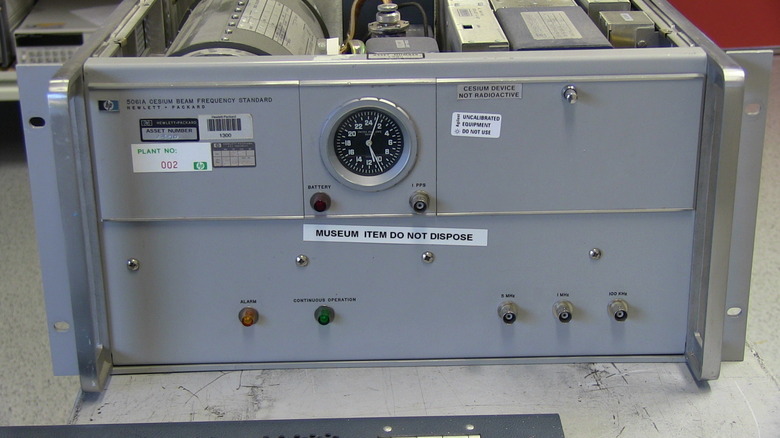
The experiment conducted by Hafele and Keating relied heavily on the accuracy of the clocks they used to measure time differences. They used atomic clocks because of how accurate they are, but how does this actually work? Imagine a pendulum, and how every swing takes the same amount of time to complete. By counting the amount of swings, you're effectively counting time, and that is essentially how normal clocks work. The problem with normal clocks is that they are prone to small accuracy drifts that are caused by differences in temperature, wear, and manufacturing defects. This is where atoms are a much better measure of time. Even NASA relies heavily on atomic clocks for all of its space missions because of how accurate they are.
Every cesium atom is identical, and by exposing them to microwave radiation, electrons orbiting those atoms will switch between two energy states. This switch occurs at its maximum rate when the microwave frequency is a bit over 9 billion hertz. Atomic clocks use this transition as a reference, and tune the frequency of the microwave oscillator until the number of atoms changing states peaks. In a cesium clock, the microwave oscillator serves the same role a pendulum or quartz crystal does in more traditional clocks. Modern atomic clocks are so accurate and consistent that if one had been running since the Big Bang 13.8 billion years ago, it would have drifted by less than a second.