

Why Are ASUS Vivobook Laptops So Much Cheaper Than Zenbooks?
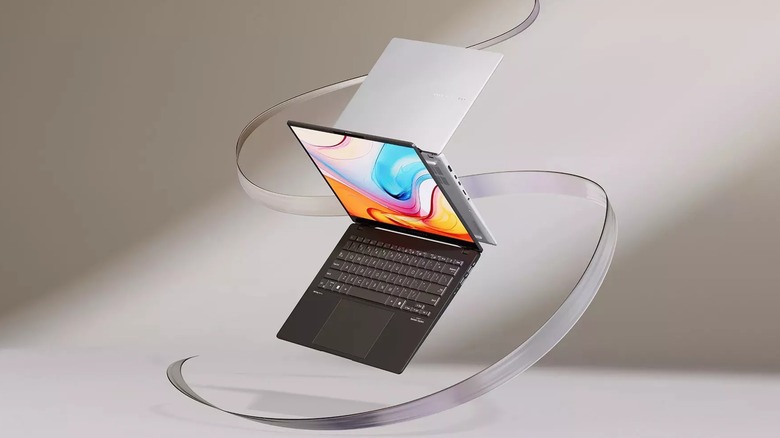
Generally speaking, two kinds of people own ASUS laptops: those who want to game on the go, and those who want to work on the go. Gamers will opt for an ASUS Republic of Gamers (ROG) laptop (or the Steam Deck's main rival, the ROG Xbox Ally). Everyone else will probably gravitate towards Asus' main offerings: The Vivobook and Zenbook. The former is much cheaper, but that price comes at a cost.
To put it as simply as possible, Vivobooks are less expensive because they often use less expensive parts. The chassis is the poster child of this design philosophy. Vivobook components are housed in durable cases, but Zenbooks get special treatment thanks to a material known as ceraluminum. This substance is a combination of aluminum and ceramic, making it both more durable and lighter-weight than a standard laptop shell.
While many Vivobooks and Zenbooks feature some of the same internal components, such as CPUs and SSDs (solid-state drives), Zenbooks separate themselves with the hardware they don't share. For example, Zenbooks are more likely to have OLED, or at least superior OLED, monitors, and the Zenbook DUO has two monitors — Vivobooks only have one. Plus, while you can spend additional money on either a Zenbook or Vivobook to upgrade its internals, you can only go so far with the latter. For example, you can only upgrade a handful of Vivobooks to a 13th-generation Intel Core i9, but you can improve several Zenbooks with the stronger and more recent Intel Core Ultra 9 Series 3.
Cheaper is not always better
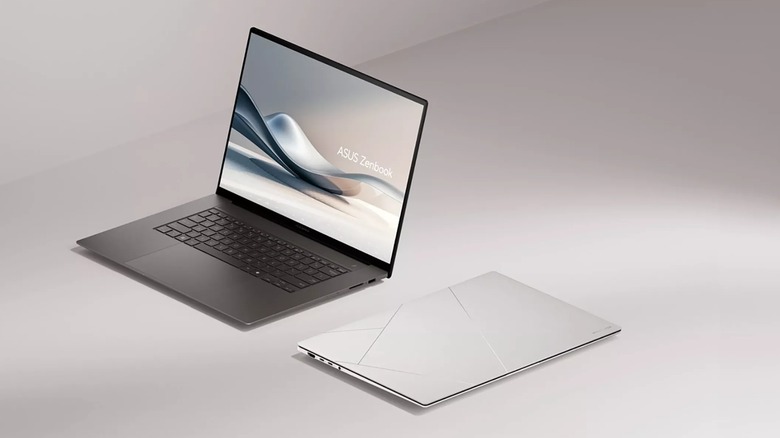
Like all computers, Vivobook and Zenbook prices vary depending on their specs. If you order a Vivobook with the most powerful hardware it can handle, odds are it will cost more than a Zenbook with the most basic components. But just because you can save money, that doesn't necessarily mean sacrificing performance is worth a few extra dollars in your wallet.
Let's compare the Vivobook S16 to the Zenbook S16. The former starts at $1,499.99, while the latter starts at $1,599.99. Both include a one-terabyte SSD, but while the Vivobook's monitor includes 16-inch Full High Definition (FHD) resolution, the Zenbook includes a screen with 3K resolution — not quite Ultra High Definition (UHD), but better than FHD. However, it's the processors that really set the computers apart from each other. While the Vivobook comes standard with an AMD Ryzen AI 7 445, the Zenbook starts off with a Ryzen AI 7 350. That's a definite power advantage for the Zenbook, but this laptop has an extra trick up its sleeve: an AMD Radeon Graphics GPU. The Vivobook S16 doesn't have the option for any graphics cards, so it gets left in the dust by its counterpart when performing just about any task more strenuous than running Microsoft Word.
If you plan on using a computer for general computing such as browsing the internet, data entry, or word processing, the Vivobook S16 — and its lower price — may be the right choice. However, if you want to do any sort of gaming, that extra $100 spent on the Zenbook can make all the difference between frustration and hours of fun.