

Who Owns Dell?
Dell, which started in 1984 out of Michael Dell's dorm room, is a rare company in the tech world today, as it's actually still majority-controlled by Mr. Dell himself. The PC equipment manufacturer went public in 1988, reverted to being private in 2013, and then went public yet again in 2018, with Dell still holding onto 40% of the company's overall stock and being described as the "Company's controlling stockholder" in its proxy statement. Though it's important to note that the Dell brand is technically owned by parent company Dell Technologies.
Those invested in Dell include the usual suspects. BlackRock — one of the companies that have massive stakes in many other tech giants – also holds 24.09 million shares in Dell, followed by Vanguard with 19.44 million shares. Overall, Dell is on the up and up, with its stock sitting at $468.65 per share as of writing — more than a 250% year-over-year increase. However, at the center stage is Michael Dell, who has overseen his various divisions and companies that Dell has acquired over the years. Thanks to the demand for AI data centers and the hardware Dell provides, Michael Dell's fortunes have exploded in recent years. He is now the fifth-richest person in the world, worth around $246 billion, with reports of his total wealth surging by $80 billion this year – all because of his ownership of Dell.
Michael Dell has fortified Dell

Michael Dell became the world's youngest Fortune 500 CEO in 1992, at age 27. However, he hasn't always been the CEO of his company. In 2004, he resigned and was replaced by Kevin Rollins, who acted as Dell's COO and president. Dell returned just three years later in 2007, after Rollins oversaw a slowdown in Dell's growth and a bad bit of public relations, with a battery recall. It's here that, under Dell's renewed control of the ship, the company began to fortify its enterprise.
In 2010, Dell pivoted away from just being a PC manufacturer and acquired a plethora of enterprise tech companies, including Boomi; KACE; Ocarina Networks; Scalent and Compellent. Most other firms acquired after that are also in cloud operations, data center hardware, or Infrastructure and security solutions. Its biggest acquisition came in 2016, when Dell acquired the enterprise data storage company EMC Corporation for $67 billion, bolstering its enterprise offerings. Dell saw its Infrastructure Solutions Group, which evolved from its EMC merger, grow to $60.8 billion — over 50% of the total revenue for the full-year fiscal results 2026, which tallied $113.5 billion.
In addition to all that growth, according to his wife, Susan Dell, the Michael & Susan Dell Foundation has donated $3 billion to various charities so far. Last December, the New York Times reported that the couple announced donating a total of $6.25 billion to the individual investment accounts known as "Trump accounts" of 25 million children in lower-income areas.
A brief look at Dell's rise and evolution
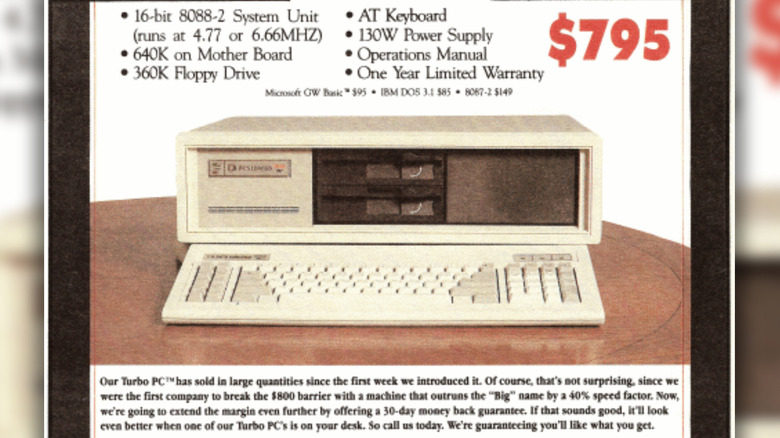
When it started under the name PC Limited, Dell was best known for using off-the-shelf parts to put together prebuilt PCs at reasonable prices. In the early '80s, an IBM PC would cost well over $4,000 once you bought the monitor, printer, and the $1,565 PC itself. Dell was cutthroat with its prices. The first PC produced, the Turbo PC, sold for $795. It would continue this tradition with the follow-up, the PC's Limited AT, beating IBM's equivalent in price, coming in at just over half off at $1,995, compared to IBM's $4,000 price tag. This undercutting in price would cement Dell's foothold in the PC world.
Since then, Dell has acquired the gaming-focused brand Alienware in 2006, as well as continuing to establish its own branded PCs, with popular laptops in the XPS line. Dell's pricing has increased since its cutthroat days, and some of its devices have been impacted by the AI data center-induced price crisis. However, Dell has found huge success in the last couple of years, capitalizing on the AI boom and facilitating data centers across the world with hardware.