

Here's Who Really Owns All Of The Major Tech Brands
Technology has become an integral part of how we live. For work and play, we rely on our smartphones, computers, and other tech-powered devices. Today, many of the world's biggest companies are built around technology. They shape everything for us, from communication to entertainment to how businesses operate.
Major tech brands may appear to be fierce competitors — Apple versus Samsung, Google versus Meta, and so on — but behind the scenes, the reality is far more interconnected. Many of the biggest tech brands are not independent. Most of them, in fact, are controlled by the same handful of powerful companies and stakeholders. The truth behind who owns the biggest tech brands in the world isn't just trivia. It reveals a lot about the brands and what they sell. From social media giants to gaming and cloud platforms, we'll take a closer look at who really owns the brands whose products we use every day.
NVIDIA
Since its founding in 1993, NVIDIA has become one of the biggest tech companies, with a market capitalization of $4.48 trillion as of January 2026. It's the first company to hit that exorbitant milestone, and today, it's regarded as the backbone of the AI revolution. It essentially controls the discrete graphics processing unit (GPU) market, and it runs the world's most advanced AI systems and data centers. NVIDIA chips power everything from ChatGPT to self-driving cars, making it one of the world's most valuable tech companies.
NVIDIA isn't owned by a single person or company. It's a publicly traded firm, with majority ownership split among institutional investors like The Vanguard Group and BlackRock, as well as individual stakeholders. Vanguard is owned by its member funds, which are held by their investors. This means shareholders are the actual owners. Nearly 75% of BlackRock is owned by large investment firms like Vanguard, State Street, and Capital Group. CEO Larry Link owns a small personal stake of 0.5%. The remaining 24.5% is with public shareholders.
The co-founder and CEO of NVIDIA, Jen-Hsun (Jensen) Huang, is its largest individual shareholder. Huang owns more than 922 million shares, which means about 4% of NVIDIA. This gives him a net worth of roughly $145 billion as of March 2026.
Founded in 1998, Google is one of the most powerful tech brands in the world. Its core product holds around 90% of the global search engine market as of 2026. Google also offers services like Maps, Gmail, and Android, and the brand develops consumer electronics like Pixel smartphones, Fitbit wearables, and Nest smart home devices. More recently, Google has branched out into artificial intelligence with its Gemini AI models.
In regard to its corporate structure, Google is owned by Alphabet, Inc., a holding company that co-founders Larry Page and Sergey Brin created in 2015 to restructure Google. Alphabet's ownership follows a three-class share structure: Class A, Class B, and Class C. Class A shares are publicly traded and mainly owned by institutional investors. This mainly includes Vanguard Group, BlackRock, and FMR, which jointly own around 20% of Class A shares and around 16% of Class C shares.
Class B shares are not available for public trading. They are private, non-traded stock primarily controlled by co-founders Larry Page (45%) and Sergey Brin (42%). Investor and venture capitalist L. John Doerr also owns about 2.6% of the outstanding shares.
YouTube
YouTube operates as a wholly owned subsidiary of Google's parent company, Alphabet, Inc. In November 2006, Google bought YouTube for $1.65 billion. The deal raised eyebrows at the time, but today, it's known as one of the most successful acquisitions ever. YouTube has since evolved into the world's dominant video platform and a key advertising engine. It reaches about 2.7 billion users each month, which makes it one of the most influential media platforms of all time. It also happens to be one of Alphabet's biggest revenue drivers.
In 2025, YouTube generated $60 billion, far surpassing its biggest streaming rival, Netflix (which made $45 billion). YouTube generates money mainly from advertising and YouTube Premium subscriptions, and it's a strong pillar of the creator economy. While it started as a simple video-sharing site, YouTube has established itself as a global media giant that competes with TV networks, streaming services, and social media — to ultimately grow the net worth of Alphabet's stakeholders.
Instagram is owned by Meta Platforms (formerly known as Facebook), a publicly traded company listed on the Nasdaq exchange. Meta acquired Instagram in 2012 for approximately $1 billion — a deal that's regarded as one of the best tech acquisitions in history. Under Meta, Instagram has grown from a basic photo-sharing app into a global creator and advertising powerhouse. With over 2 billion monthly active users, it's the third most popular social network after Facebook and WhatsApp.
Instagram is all about short-form video (Reels), Stories, and the influencer-driven content popular among younger generations. This plays a central role in Meta's growth strategy. In fact, Instagram is one of Meta's biggest advertising engines. With its interactive visual format and deep integration with shopping features, Instagram has become a key platform for brands, influencers, and businesses looking to reach global audiences.
Mark Zuckerberg, the founder and original developer of Facebook, owns about 15.7% of Meta. Large institutional investors like Vanguard, BlackRock, and State Street hold more than 75% ownership.
Here's a big tech brand that needs no introduction. We've all been using Facebook for years, and we know that it's the flagship product of Meta Platforms, Inc. In 2004, Mark Zuckerberg launched Facebook so Harvard students could share profiles, photos, and class schedules. And at present, with over 3 billion active users, Facebook is the largest social network globally. Even though it may no longer be the trendiest app, many still rely on it to connect with friends and family — and Facebook still drives the majority of Meta's advertising revenue despite growing competition from other social platforms. The founder, Mark Zuckerberg, owns about 15.7% of Meta. Meanwhile, asset managers like Vanguard, BlackRock, and State Street hold over 75% of the company.
Beyond social networking, Facebook has expanded to feature groups, marketplaces, events, and video content. This means that it's more of a multipurpose platform than a traditional social media app. In 2024, Facebook earned $164.5 billion in revenue, with approximately $91 billion coming from the Facebook app. A large chunk of that revenue comes from advertising, giving Facebook a market share that rivals Google's and Amazon's.
Amazon
In 1994, Jeff Bezos founded Amazon as an online bookstore. Today, Amazon dominates global e-commerce and cloud computing. Over time, the company has expanded into cloud computing and entertainment, and Amazon Web Services (AWS) is now the most comprehensive and broadly adopted cloud platform across the globe. With multiple successful business segments, Amazon is among the most recognizable tech brands in the world. In 2025, it generated $717 billion in revenue, making it the largest company in the world by revenue. And around 18% of that revenue was driven by AWS.
Prime Video, meanwhile, is a strong contender in the streaming space; there are over 250 million Prime members in 27 countries. Amazon also owns Zoox, an autonomous technology company that makes self-driving vehicles. It seems the company has no plans to slow its growth.
Bezos took Amazon public in 1997, but he still remains the largest individual shareholder with approximately 8.8% of shares valued at more than $200 billion. Like most big tech companies, Amazon is heavily owned by major institutional investors as well. BlackRock, Vanguard Group, and State Street own an estimated 18% to 20% of Amazon. These firms aren't the sole controlling owners. Rather, they invest on behalf of millions of clients worldwide.
Tesla
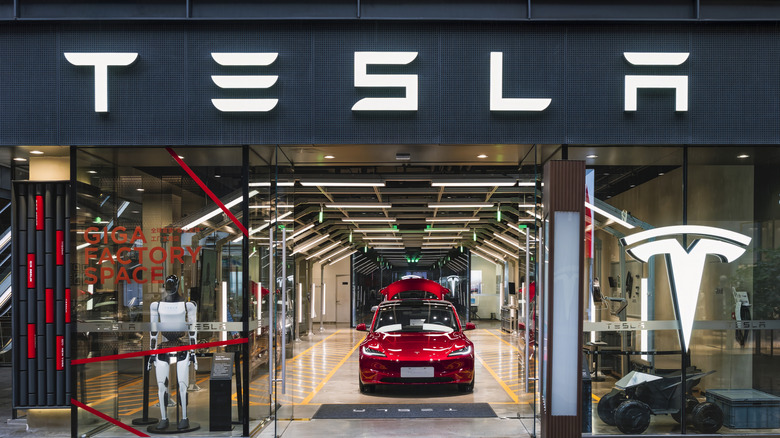
Known as a top-tier manufacturer of electric cars, Tesla makes a number of vehicles that feature Full Self-Driving (FSD) and autopilot assistance technologies. These vehicles can steer, accelerate, and brake automatically, requiring fewer user inputs on the road. Bestselling high-performance electric vehicles like Tesla's Model 3 and Model Y make it the most satisfying EV brand to drive. Tesla also manufactures industrial batteries and solar products to store clean energy.
Tesla is a publicly traded company listed on the Nasdaq Global Select Market. Co-founder and CEO Elon Musk is Tesla's largest shareholder and also its most influential figure. Musk's decisions and public persona have a direct impact on Tesla's stock and strategy. And with more than 500 million shares, he owns around 15% of the company. This makes Musk the richest man on Earth with a net worth of $785.5 billion at the time of this writing. Vanguard, BlackRock, and State Street are all among the largest asset managers with stakes in Tesla, Inc.
TikTok
TikTok, founded by ByteDance, is a popular social media platform where users can create, share, and discover short-form videos. It was initially released in September 2016 in China as Douyin, but in 2017, it was launched in international markets as TikTok. The platform gained popularity in 2018 and 2019 after it collaborated with Musical.ly, and then it achieved global dominance during the COVID-19 pandemic in 2020. To say that TikTok disrupted YouTube and Instagram with its algorithm would be an understatement. Today, TikTok is one of the most popular and fastest-growing social platforms, with around 1.99 billion monthly active users worldwide.
ByteDance is still a privately held company based in China, but it doesn't currently own TikTok in the U.S. As of 2026, the American version of TikTok is owned by the newly formed TikTok USDS Joint Venture LLC, which is mostly backed by U.S. investors. More than 80% of the company is owned by American and global entities. This includes Oracle Corporation, a trusted security partner for storing all U.S. user data in the cloud; Silver Lake, a technology-focused private equity firm; and MGX, an Abu Dhabi state-owned investment group. The Chinese parent company ByteDance still has a 19.9% stake in it.
Twitch
In 2011, Twitch started as a spin-off of a 24/7 reality television show by Justin.tv, Inc. In August 2014, Amazon acquired it for nearly $970 million. At that point, Twitch was a niche platform focusing only on video games. But under Amazon's leadership, it has grown to become a leading live-streaming platform that features gaming, music, electronic sports, talk shows, and even real-time lifestyle streaming. As of early 2025, Twitch had over 240 million active users. The tech brand earned $1.8 billion in revenue in 2024 and hosted more than 7.1 million active streaming channels in 2025.
Twitch is also an important part of its parent company's broader media strategy. It offers several benefits as hidden perks for Amazon Prime members, who can claim a free monthly subscription to a channel on Twitch. Members are also entitled to free in-game content like virtual currency and characters for popular games like FIFA. These cross-platform benefits help Twitch retain users and creators within its ecosystem despite growing competition from YouTube and Kick. Amazon is a publicly traded company listed on the Nasdaq. It is also owned by a mix of individual insiders and institutional investors.
TSMC
Most people might not be familiar with Taiwan Semiconductor Manufacturing Company (TSMC), but it is one of the biggest semiconductor companies in 2026. TSMC is the world's largest and most important pure-play foundry, and it single-handedly makes Taiwan the country that produces the most computer chips for companies like Apple, NVIDIA, and AMD. TSMC is a key player in the global AI and technology supply chain, as it holds around 60% to 70% of the global market share. In 2025, TSMC grew almost four times faster than its rivals. And with a market cap of about $2 trillion, TSMC is the second-largest semiconductor company and the sixth most valuable company by market cap.
Like many global corporations, TSMC is publicly traded, and its ownership is spread across investors. The Taiwanese government is the largest individual shareholder; it owns roughly 6.38% of the company. Foreign institutional investors hold around 70% to 75% of the shares, primarily consisting of global asset managers, sovereign wealth funds, banks, mutual funds, and index funds from the U.S. and Europe. Other shareholders include domestic Taiwanese institutional investors and retail investors.
Apple
Founded in 1976, Apple is the second-largest company by market valuation today. It stands right after NVIDIA, and beats other tech giants like Google and Microsoft. The Cupertino, California-based brand originally started with the Apple I, a hand-assembled computer — but it's now known for products like the iPhone, iPad, Mac, and Apple Watch. Apple's services businesses, meanwhile, include iCloud, Apple Arcade, Apple Music, and Apple TV+.
In 2018, Apple became the world's first company to reach a market value of $3 trillion. As of 2026, Apple has a net worth of around $4 trillion. The iPhone is Apple's most popular product and its primary revenue driver. In 2025, Apple made $416 billion in revenue, and half of it came directly from iPhones.
Initially, Steve Jobs held about 11% of Apple, but he later sold most of his shares after leaving the company. Today, CEO Tim Cook owns less than 1% of Apple. Most shares are held by major institutional investors like Vanguard Group, State Street Corporation, Berkshire Hathaway, and BlackRock. Berkshire Hathaway is a publicly traded company formerly led by the American philanthropist Warren Buffett. He holds a significant voting control through the share structure.
IBM
IBM came into existence in 1911, which makes it one of the oldest names in the tech industry. The company has continuously reinvented itself to stay relevant all these years. Initially, it started with business-based systems like punch-card tabulating machines. During the 1960s and '70s, IBM was the unrivaled leader in computing, producing roughly 70% of the world's computers.
IBM is best known for its powerful mainframes, which you can still find in banks, governments, and large enterprises. But IBM has shifted its focus to enterprise software and consulting business. In recent years, it has also entered other markets like hybrid cloud computing, robotics, research, and artificial intelligence.
When it comes to revenue, IBM doesn't compete with the rest of Big Tech. The company brought in around $67 billion in 2025. Current chairman and CEO, Arvind Krishna, owns 371,894 shares — but this gives him only a tiny 0.04% stake in IBM. The majority of IBM shares (around 64%) are owned by big asset managers like Vanguard, BlackRock, and State Street.
WhatsApp is owned by Meta Platforms as a privately held subsidiary and does not trade independently on the Nasdaq as its parent company does. Meta acquired the messaging platform in 2014 for about $19 billion in cash and stock. This surpassed Google's $3.2 billion purchase of Nest Labs, and also Apple's $3 billion deal with Beats Electronics, to become one of the biggest tech buys ever. Today, WhatsApp is one of Meta's most valuable assets.
Initially, WhatsApp was designed as a simple, ad-free messaging service. Unlike Facebook and Instagram, WhatsApp is focused on private, end-to-end encrypted communication. WhatsApp is a cross-platform messaging service that allows you to send messages, make calls, and share media between Android, iOS, Windows, and Mac devices. As of now, WhatsApp has nearly 3 billion active monthly users across the globe. On average, 100 billion messages and 7 billion voice notes are shared on WhatsApp every day. It has become the default messaging app in many parts of the world, and Meta has gradually begun to monetize it via business tools, customer communication features, and payment integrations.
Intel
Founded in 1968, Intel was an early pioneer of the semiconductor industry. We now know Intel for making central processing units (CPUs) for personal computers, enterprise systems, and servers. It also makes motherboard chipsets, flash memory, solid state drives (SSDs), and network interface controllers.
For decades, Intel dominated the semiconductor industry, especially when it came to PCs. In recent years, though, it has faced intense competition from TSMC, AMD, and NVIDIA. To remain competitive in today's market, Intel has followed a transformational strategy called IDM 2.0, which shifts it from a chipmaker to a systems foundry that can also produce chips for other companies like NVIDIA and AMD. Today, Intel is also actively making neural processing units (NPUs) for AI tasks.
Intel is a publicly traded company that's predominantly owned by large investment companies (47%) and individual shareholders (around 50%). The Vanguard Group holds the largest stake with 8.8%, and BlackRock holds roughly 6%. In August 2025, the U.S. government completed a deal to acquire a roughly 10% stake in Intel.
Xbox
Microsoft owns Xbox, a premium video game brand that features hardware consoles (Series X, S, One), Game Pass subscriptions, and cloud gaming. Consumers can play, buy, and stream games across consoles, PCs, and even their mobile phones. While Xbox is not separately listed on the Nasdaq, its parent company, Microsoft, is a publicly traded company. Xbox was Microsoft's first step into the world of console gaming, and the brand has now expanded beyond traditional consoles. In October 2023, Microsoft finalized a $69 billion deal with Activision Blizzard, and this has played a big role in Xbox's success. Blockbuster titles like "Call of Duty" and "Candy Crush" brought a surge of 49% in Xbox revenue.
In 2025, Microsoft generated a record revenue of $281.7 billion. Co-founder Bill Gates is still a shareholder in Microsoft, but his stake has dropped to around 1.5%. Currently, institutional investors own approximately 72% of outstanding shares: Vanguard has 9.1%, BlackRock has 7.5%, and State Street has 4.2%. CEO Satya Nadella and Vice President Bradford L. Smith together hold less than 1% of the company.

WeChat is owned and developed by Tencent Holdings Company, a Chinese technology conglomerate. It was initially started as a simple messaging app for China — basically the Chinese equivalent of WhatsApp. But through strategic development, Tencent has transformed WeChat from a simple messenger app into a super app for China.
WeChat now works as an all-in-one platform for messaging, social networking, payments, and services. Essentially, it offers everything users need in their everyday life: They can shop, book flights, rent bikes, and play games via mini-programs that work like built-in apps and don't require additional downloads. WeChat has over 1.4 billion monthly users and, between January and July 2025, the company made $81.19 million from in-app purchases.
The Dutch investment group Prosus N.V. is Tencent's largest shareholder with approximately 23% of the company. Prosus is owned by Naspers, which originally invested $32 million in Tencent in 2001. Tencent's co-founder and CEO, Ma Huateng, holds roughly 8% to 9% of shares. And 56% is owned by various institutional and retail investors like Vanguard and HSBC Custody.
Samsung
Samsung is a global leader in consumer electronics and semiconductor manufacturing. It is best known for making smartphones, TVs, and display technology, which its customers use worldwide. According to reported customer satisfaction, Samsung is one of the best smart TV brands. The South Korean giant also supplies key components to rival tech brands like Apple and Xiaomi. In Q4 of 2025, Samsung hit a record-high revenue of KRW 93.8 trillion (which is equal to approximately $63.38 billion).
When it comes to its ownership, Samsung is very different from most Western tech companies. Samsung is part of a South Korean chaebol, a type of family-controlled conglomerate. Samsung is owned by the Lee family, originally led by Lee Byung-chul and later Lee Kun-hee.
Although Samsung Electronics is publicly traded, the founding Lee family still maintains control through complex cross-shareholdings. Basically, Samsung works like both a tech giant and a family-run empire. Institutional investors such as the National Pension Service of Korea (one of the largest public pension funds) and BlackRock also have key stakes in Samsung.