

This Solar-Powered BMW EV Prototype Produces More Energy Than It Needs
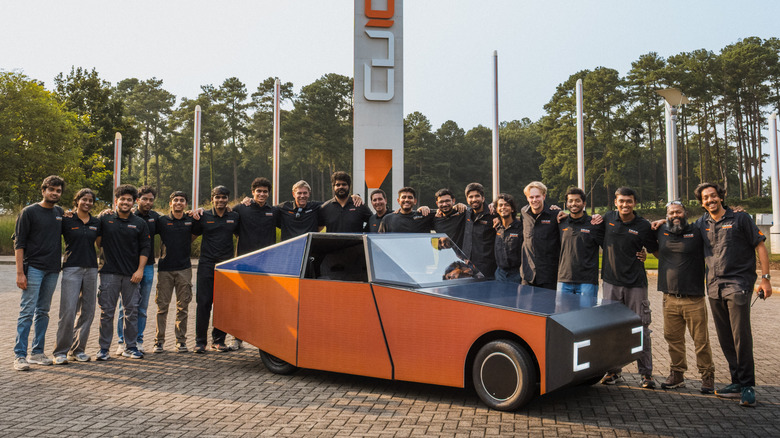
Solar panels are extremely expensive, which is why you don't often see this technology used on automobiles. Some cars have incorporated small solar panels onto the body panels, but large-scale use is cost prohibitive. Lightyear's solar car with 300-mile range didn't survive because production cost more than funding, and Sono Motors ran into the same issue. Looking to overcome cost, a team of automotive engineering grad students from Clemson University may have come up with a solar-powered car that's actually profitable. Partnered with BMW, the Clemson University International Center for Automotive Research (CU-ICAR) created its Deep Orange 17 solar car prototype, designed to collect more solar energy than it consumes during a standard commuting day.
Clemson's students first considered how a car is used in urban settings, factoring in sunlight conditions and commuting routines in cities such as Madrid, Mumbai, Frankfurt, and Greenville, South Carolina (where CU-ICAR is located). Nicknamed Luminetta, this prototype is able to collect 5.7kWh of energy in a single day, while the average 12-mile commute expends just 1.6 kWh. Under those modeled conditions, the car can produce enough surplus energy for an extra 31 miles of travel.
The Deep Orange 17 prototype is expected to be on display at the 2027 Consumer Electronics Show (CES), and it will also be used as a research test bed at Clemson's CU-ICAR campus where future automotive engineering students will use it as a platform for new ideas. They may want to start with the windshield, because thanks to a new breakthrough, your windows could soon generate electricity.
How BMW's solar EV turns its body into a power source
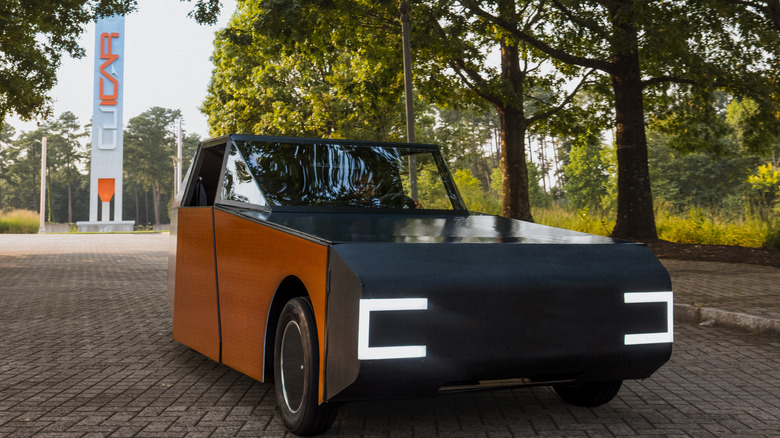
The Luminetta is essentially a driving solar panel with an exterior that integrates 1,781 photovoltaic cells. German research institute Fraunhofer ISE helped develop the ingenious shingled solar system. It arranges small solar-cell strips into a shingled matrix. The strips overlap like roof shingles. They're covered with a durable outer film that conforms to curved surfaces. It can keep collecting sun when portions of the car are shaded because the matrix lets current flow around those areas. Even the vehicle's orange-bronze color is high-tech. Fraunhofer's MorphoColor paint is structured to allow 95% of usable light to reach the panels. In that way, the paint is different from Mercedes' solar paint that could lead to nearly unlimited EV range.
To produce the kind of results the Clemson team saw, they had to look beyond solar panels. Luminetta weighs 1,212 pounds. Compare that to Lightyear's solar car, which weighed more than 3,400 pounds. The chassis mixes steel, aluminum, carbon fiber, and 3D-printed metal joints to cut weight while preserving strength. Using the boxfish as an inspiration, the team created a vehicle that looks like a pixelated video game car come to life, but it actually reduces drag. Internal upgrades included regenerative braking, intelligent torque distribution, and tightly managed drivetrain controls.