

Thunderbolt 4 Vs. 5: What's The Difference Between These USB-C Interfaces?
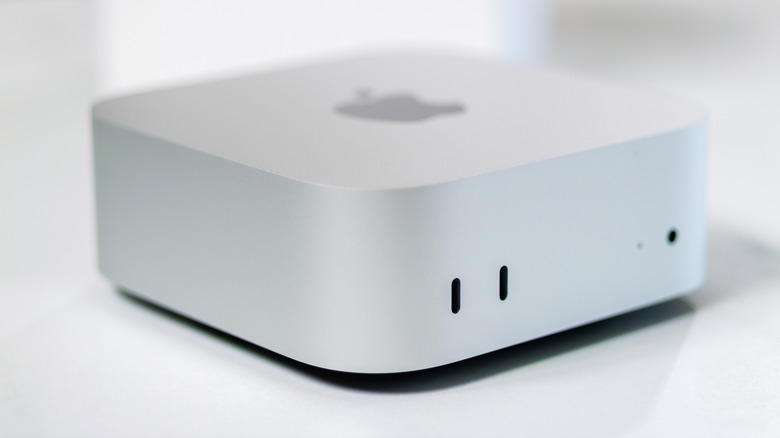
Thunderbolt is the pick-up truck of data transfer protocols. The latest versions of the Intel-controlled standard deliver many gigabits of throughput every second and massive DisplayPort and PCIe functionality over the same friendly USB-C connector that you use to plug into your phone or laptop. That said, the jump from 2020's Thunderbolt 4 spec to 2023's Thunderbolt 5 raises the ceiling on just how far a cable can go.
For starters, what's commonly abbreviated as TBT5 has a maximum bidirectional transfer rate of 80Gbps, double that of TBT4. The higher cap allows for an updated DisplayPort implementation going from version 1.4 to 2.1: whereas with TBT4 you could run two 4K monitors at once, you can now do three 4K monitors or two 8K monitors with TBT5. People with external PCIe accessories can also take advantage of a boost from gen-three speeds to gen-four speeds (though eGPUs aren't worth the money).
Plus, through updated USB Power Delivery compatibility, those TBT4 setups that can push 100 watts can be updated to TBT5 and max out at 240 watts. Thunderbolt 5 already has plenty of upgrades over Thunderbolt 4. But there's one particular trick it can do that requires a special cable to unlock even more gains, especially if you're working in the visual arts.
What is Thunderbolt 5's Bandwidth Boost
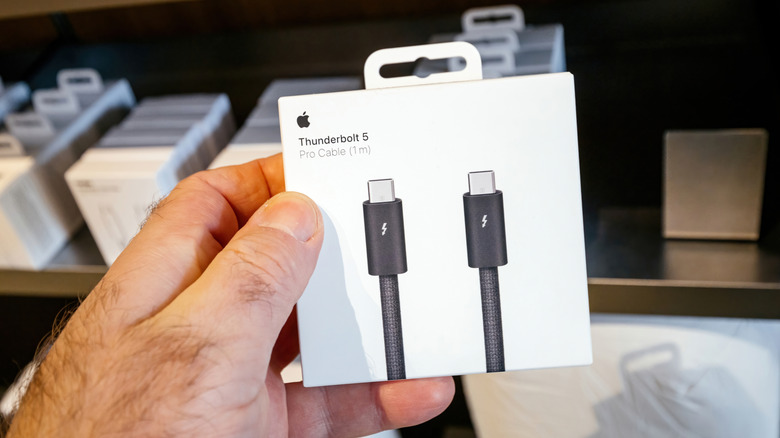
Thunderbolt 5 features Bandwidth Boost, which can shift those symmetrical 80Gbps bandwidths into a 40Gbps upstream and a 120Gbps downstream. This mode activates on demand and is used to make those high-spec video outputs previously mentioned just now possible. Bandwidth Boost requires users to acquire a TBT5-supporting active cable — the term 'active' refers to cables with embedded chips and circuits, which have existed with prior TBT versions to boost signal reach and quality at longer lengths.
To achieve 120Gbps, TBT5 (and its underlying USB 4 version 2 spec) adopts a new encoding method called PAM-3. PAM, which stands for pulse amplitude modulation, transmits data with pulses of voltage at certain levels. Older versions of Thunderbolt used two levels to register binary data — you'll often hear PAM-2 referred to as 'non-return-to-zero' modulation or NRZ. PAM-3 adds an extra level to enable more data to be transmitted at once, though it requires ternary-to-binary reconciliation along the way.
Still, while not as efficient as PAM-4 encoding, which would produce a clean two bits per pulse, PAM-3 does make faster throughput possible while maintaining good connection quality. TBT5 is backwards-compatible with TBT4, USB4 v2, DisplayPort 2.1, and PCIe gen-four gear, as well as others on earlier versions of those standards — just know that those capabilities will be capped by the standard your older gear supports. Just make sure you're plugging those accessories into the right USB-C ports.