

Which AMD GPU Is The Closest Equivalent To The Nvidia RTX 5080?
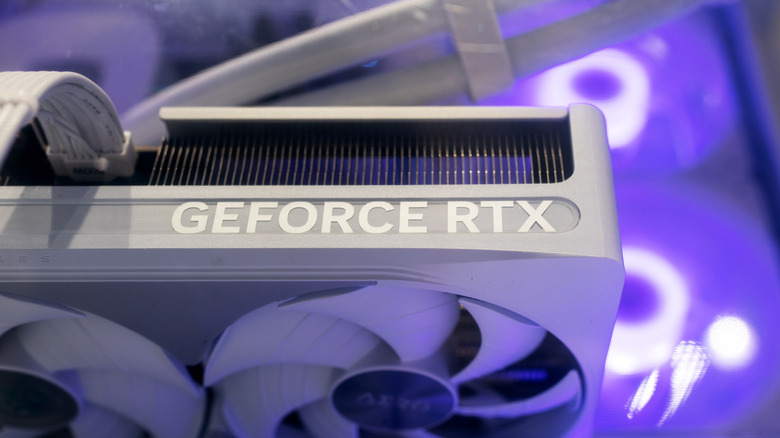
While some more affordable GPUs can compete with the newer Nvidia RTX 50 series cards, what if you want to splurge a bit? After all, something like the RTX 5080 will allow you to squeeze out massive amounts of frames in all the latest titles and help you future-proof your setup. However, the memory crisis has pushed the RTX 5080 close to $2,000, and there's no indication that the prices will reverse any time soon. Thus, it may be more economically viable to get the AMD GPU equivalent to the RTX 5080.
When you put the RTX 5080 specs on paper, you've got 16GB of GDDR7 RAM with a 2,790 megahertz GPU clock speed. Approximate AMD models include something like the RX 7900 XTX, though the RX 9070-XT is as another viable, cost-effective alternative. The former sports 24GB of GDDR6 memory with a 2,615 megahertz GPU clock speed and costs around $1,300, which makes it an attractive choice. An AMD RX 9070-XT, on the other hand, is a wallet-friendlier option with a price point of around $800, packing 16GB of GDDR6 RAM and a 2,520 megahertz clock speed.
Both of these cards will serve you well. Even the cheaper one will allow you to get 60 FPS when running a game like "Alan Wake 2" on Ultra settings with FSR Balanced enabled. Yet, neither holds a candle to the RTX 5080. The RX 7900 XTX is around 10% slower than the Nvidia card. The extra VRAM certainly helps, but it all falls apart when you flip on the ray tracing. For instance, RX 9070-XT dips to around 40 FPS with minimum ray tracing on "Alan Wake 2," just like the more expensive AMD card. Ray tracing is its kryptonite.
How does AMD RX 7900 XTX perform in the real world?
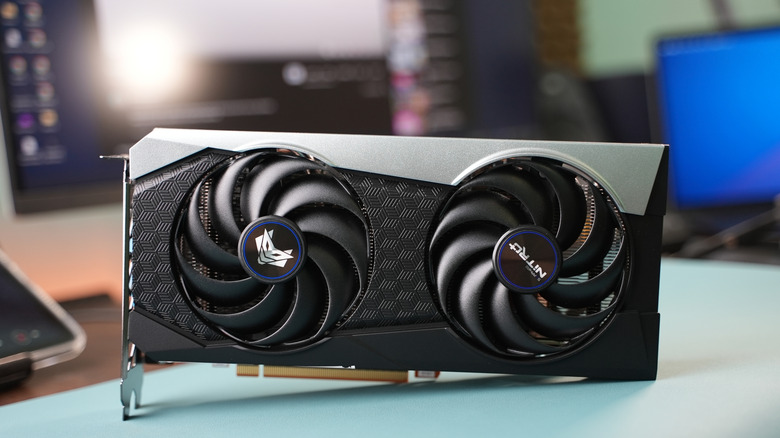
Nvidia RTX 5080 is a flagship card, edging the powerful AMD RX 7900 XTX on all fronts, from applications and on-chip AI performance to gaming. For clear benchmarks, the RTX 5080 is capable of delivering over 200 FPS in "Cyberpunk 2077," all settings on maximum (including ray tracing), with DLSS and frame generation on. For something newer, you can look at "Resident Evil 9 Requiem" comparisons. With normal ray tracing, max settings, and DLSS Quality mode, it pushes out an easy 100 FPS.
The RX 7900 XTX with FSR 3 enabled and ray tracing on Ultra offers from 70 to 80 FPS. It certainly isn't rusty, but it pales in comparison to Nvidia. Similarly, with "Resident Evil 9," you can flip on ray tracing, but get used to running the game around 50 FPS to 60 FPS.
Generally speaking, the biggest disadvantage of switching to AMD GPUs is the slightly weaker technology, so this performance drop isn't at all surprising. If you're stripped for cash, though, you can get an RX 7900 XTX to run all the latest games, as long as you don't expect amazing ray tracing performance. Considering that developers are using this technology more and more, it's no longer an extra feature. Take "Resident Evil 9" as an example: without ray tracing, the game is borderline ugly and flat. Since this technology will likely become even more widespread, smart money is buying the Nvidia RTX 5070 Ti, as it's roughly the same price as the RX 7900 XTX. Is it a better option? Your wallet and your target frame rate will have to decide.