

The James Webb Space Telescope Discovered This Little Red Dot Is Actually An Ancient Black Hole
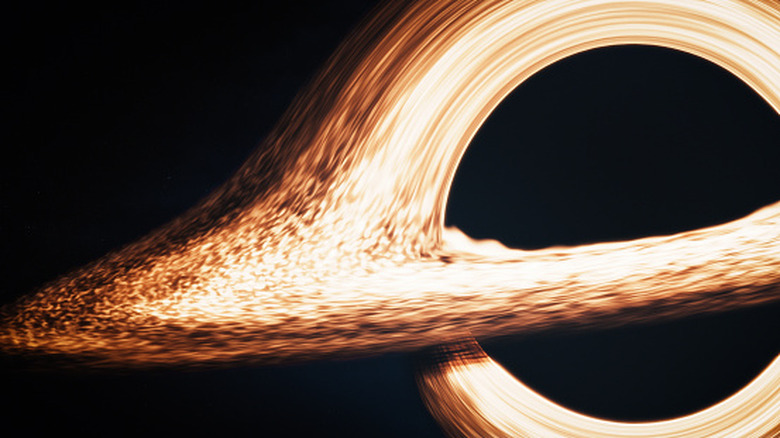
Thanks to the James Webb Space Telescope and its ability to spot the oldest black holes, people have been able to observe more of the universe than ever before. Ever since Webb started sending pictures back, numerous little red dots in its images have been puzzling astronomers. But thanks to a chance image, astronomers are closer to understanding at least one of them. Known as GLIMPSE-17775, astronomers have been able to confirm it is a supermassive black hole and likely an active galactic nucleus. More than that, it's very likely a black hole star, a phenomenon where a black hole's accretion disc illuminates a cocoon of gas enshrouding the singularity, giving it many of the same spectral qualities of a star.
The gases cocooning this black hole are composed of hydrogen, oxygen, helium, iron, and sulfur. Scientists found GLIMPSE-17775 in Webb's imagery while looking for what they refer to as Population III stars — the first stars to emerge as a result of the Big Bang. While the images of GLIMPSE-17775 aren't as groundbreaking as the image of two black holes orbiting each other, the evidence gathered could lead to a better understanding of black hole growth and galactic evolution.
The evidence that GLIMPSE-17775 is a black hole star
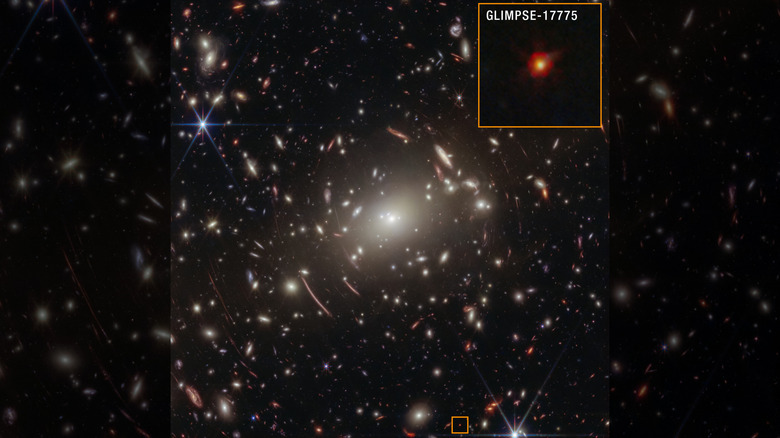
Based on GLIMPSE-17775's cosmological redshift, this black hole formed about 1.8 billion years after the Big Bang. Redshift is a way for astronomers to determine the age of celestial bodies. Since the universe is rapidly expanding, light stretches, and the longest visible wavelength is red. The light continues stretching beyond red to longer wavelengths that humans can't see, so the redder a wavelength, the older the object.
The astronomers observing GLIMPSE-17775 published their findings in The Astrophysical Journal, noting more than 40 spectral lines – "light emitted or absorbed at a specific frequency by an atom or molecule," according to NASA — which is the most detail researchers have gotten from any little red dot. And since these spectral lines contained strong ratios of hydrogen, oxygen, helium, iron, and sulfur, it couldn't simply be a rotating gas cloud.
The only feature missing is a pronounced Balmer break, which is a break in the visual spectrum that's typically seen in little red dots (it's also a characteristic of many regular stars). The scientists pulled data from both the James Webb Space Telescope and the Hubble telescope to determine the reason for a weaker Balmer break, and it appears that there is a host galaxy surrounding the black hole star, which isn't unheard of, but it isn't common for a little red dot.