

What's The Maximum Coverage Range For Mesh Wi-Fi?
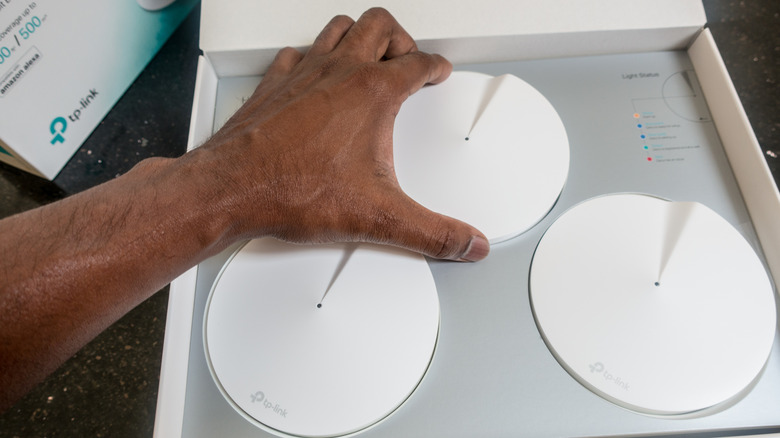
Many consider Mesh Wi-Fi systems to be better than regular routers thanks to their wide coverage and more reliable connection speeds. That's because they combine a modem and main router with additional nodes that you can place throughout the house to extend your network's range. If you're looking for maximum coverage, that will depend on which router you buy and, of course, your home setup.
According to Netgear, mesh Wi-Fi networks typically cover between 2,000 and 10,000 square feet, with 10,000 square feet appearing to be the practical maximum. The company's own Orbi 970 was the only mesh system we could find that hit that upper limit, though the TP-Link Deco 7 Elite gets close, at an advertised 9,600 square feet. To put that amount of space into perspective, a modern home is generally considered a mansion when it's over 8,000 sq ft, while historical mansions start at around 5,000 sq ft.
While a mesh system comes with higher upfront costs than traditional Wi-Fi, it can be worth it for the improved range and speed. And, if you're outfitting 10,000 square feet with equipment, $800 for a single router or $2,000 for a pack of three may not seem that out of line — especially when you consider that a single traditional router will likely leave most of that space unconnected.
Why mesh Wi-Fi systems can cover more space
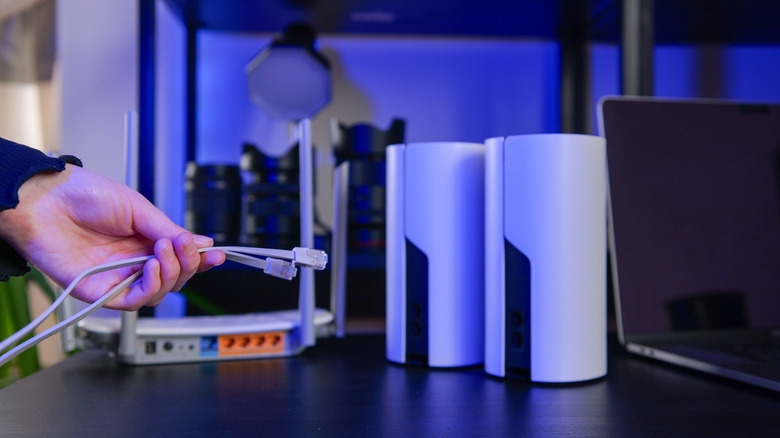
Mesh Wi-Fi systems differ in range for the same reasons that regular routers do. Higher quality models have faster processors and use newer Wi-Fi standards that allow them to deliver a stronger signal. Adding more nodes means you can cover more ground and get a stronger signal than you would using a traditional router and range extender.
Another key advantage of mesh Wi-Fi is that it's flexible and scalable, as extending or improving your coverage is as simple as adding or moving nodes (at least up to the overall capacity of the system). There are even weatherproof nodes that can extend your connection to the outdoors, which is especially enticing if you have a patio or another outdoor space that you use frequently.
It's important to keep in mind that your signal will still get slower as you get farther from the main node. As an RTINGS test demonstrates, all Wi-Fi systems lose speed with distance, and mesh nodes simply reduce that loss rather than eliminating it. That's why it's important to keep your main router in a central part of your house so that the other nodes aren't too far away. Mesh systems are also vulnerable to the same disruptions as normal routers, so they aren't going to save you from outages. Node placement is also important to consider since thick walls, certain appliances, and other large or thick objects can obstruct your signal.