

Astronomers Believe The Solar System Once Had Nine Planets - And The Sun Ate One Of Them
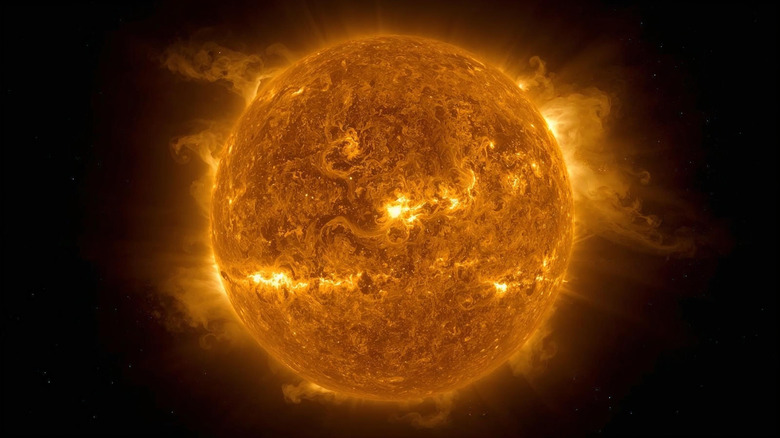
Several decades ago, we thought the solar system had nine planets. Then Pluto was reclassified as a dwarf planet. And then astronomers realized the solar system is full of dwarf planets. Recent studies have redefined how we think planets and stars grow, and a new one suggests that the star we rely on might have developed by cannibalizing a baby planet.
Earlier this month, Mutlu Yildiz, a professor at Ege University in Turkey, claims that his team of researchers might have found evidence that a planet fell into the sun early in the solar system's life. His research was published in Monthly Notices of the Royal Astronomical Society and lays out the evidence for a hypothetical "super-Earth," likely formed when the solar system was young and was drawn towards the sun by its gravitational pull. Unlike the "Super Earth" of "Helldivers" — which is just plain-old Earth with a fancy name — this theoretical body would have had anywhere between five to 10 times the mass of our planet and would have been our solar system's ninth true planet.
Now, you probably don't need to look at the closest photos ever taken of the sun to know it's a fiery hellscape of plasma, so how would anyone know that a planet was swallowed by the sun billions of years ago? Believe it or not, a planet passing through the outer layers of the sun would leave "detectable fingerprints," which Professor Yildiz believes he found. Once the planet passed the outermost layers, then it would fully dissolve.
Models make the sun go round
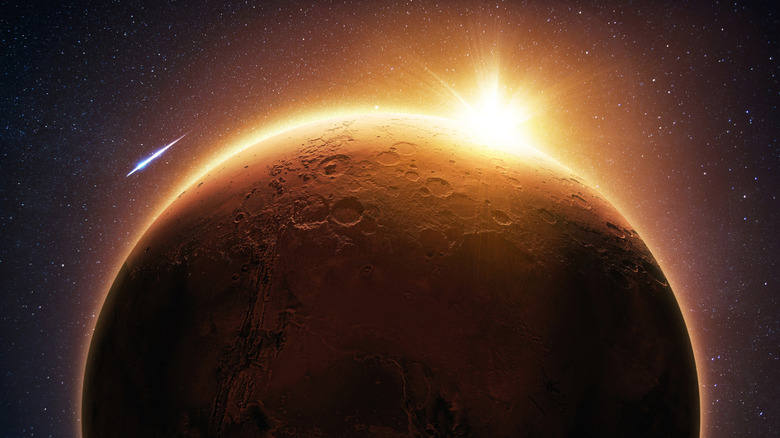
Much of what we know about the universe outside of Earth is based on models. We don't exactly know Jupiter's true size and mass, we just make models that predict this information. And when new studies disprove some of these assumptions, we update the models (and what we think we know about Jupiter). The same is true for the sun.
According to Professor Yildiz, much of his claims are based on discrepancies between existing solar evolution models and current investigations of the sun. Two of the largest clues lay in "subtle changes in the sun's internal structure and its depleted lithium abundance." Specifically, the sun is missing more lithium than it should. Since the information didn't line up with what we thought we knew about the sun, Professor Yildiz's team evaluated how the growth of outer solar layers could affect the sun. The most promising result stated that our star had eaten a super-Earth, and the resulting impact pushed most of its lithium into deeper layers, where it was destroyed more quickly than it would have been near the surface, thus leaving the surface relatively free of heavy elements.
Assuming the information is correct, Professor Yildiz's findings could finally solve another mystery that has haunted astronomers for years. While we have yet to visit other solar systems, researchers have discovered that super-Earths populate many of these far-away locations. Yet we don't have one, presumably because our sun gobbled it up. Of course, as this is only a model, the findings are only theoretical at best. Unless someone invents a time machine that lets us travel billions of years into the past, we may never know if the sun truly ate a super-Earth.