

Not Satellites, Not Telescopes: The Next Big Solar Storm Could Be Predicted By Trees
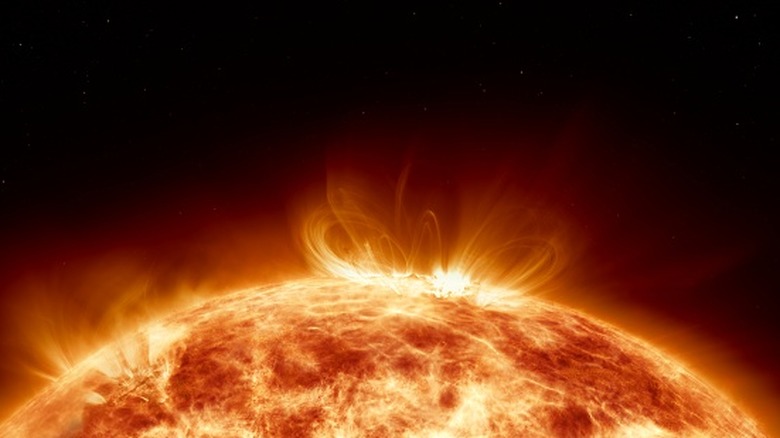
Solar storms happen when the sun unleashes a torrent of energy and charged particles far above its normal output. Occasionally, these solar outbursts are directed towards Earth. And while they are not dangerous to life down on the surface, they can disrupt technology (satellites are particularly vulnerable). Strong solar storms could possibly produce large-scale blackouts and cause problems for airplane travel, which is why scientists are working to better understand them and try to predict when they will happen. To try to learn more about the frequency and size of past solar storms, scientists publishing in Communications Earth & Environment didn't use satellites or telescopes, they used tree rings.
The sun's magnetic activity affects how many cosmic rays reach Earth's atmosphere, and those cosmic rays help create radioactive carbon-14. Because trees absorb that carbon and preserve it in their annual growth rings, scientists can use changes in carbon-14 levels to reconstruct past changes in solar activity. The researchers took measurements from annual tree rings to find out when solar storms happened in the past. Not only did the research team examine new tree rings, but they also compiled data from previous studies to broaden the scope of data they were able to collect.
Measuring the sun's activity via tree rings
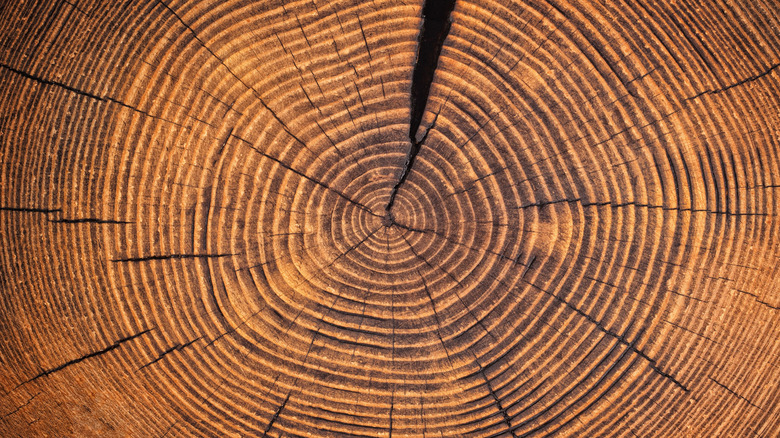
By studying tree rings, scientists have been able to piece together a record of the sun's activity connected to solar storms. Typically, the sun has an 11-year cycle of magnetic activity called a Schwabe cycle, where it gets stronger and weaker. However, it's not on a strict and predictable schedule, certainly not enough for us to be able to reliable predict the next solar storm.
The researchers looked for prolonged periods of low solar activity called grand solar minima (GSM) by using the carbon-14 record in tree rings. They found four periods that qualified as GSM. By analyzing these periods in relation to solar storm tree rings, scientists were able to get an idea of how quickly the sun's magnetic field recovered from such prolonged inactive periods.
The reason why this type of data is valuable is because we have not been able to continuously measure the sun's activity with modern technology for very long. To understand how it behaves in the long-term, and thus get an idea of how often bad solar storms happen, we need to look into thousands of years worth of activity records. Tree rings are essential in giving us this glimpse into the past. Scientists can determine what activity is normal or abnormal based on these records.
Large-scale solar storm events
Not only are tree rings showing patterns for low solar activity, but also for powerful solar storms called Miyake events — named after Fusa Miyake who discovered them during her research. These can be concerning because they are more powerful than standard solar storms and have the potential to cause major technology disruptions. The researchers found four such potential events based on tree ring analysis and noted in the publication that more research would need to be done to determine if the solar storms were truly Miyake events, but enough of the signs were there to consider these dates significant. They found that these events correlated to a spike in carbon-14 followed by a decline over the following years.
The scientists want to use this data to get an idea for how frequently across Earth's history Miyake events have happened, and how often the sun goes quiet. Potentially, this could help us predict the likelihood of the next big solar storm, but for now the data are limited given that there is only so much we can currently glean from tree rings and existing historical archives. In previous research, tree rings have revealed a massive solar storm, one that if it hit today could cause a devastating impact. As research continues, scientists hope to have us better prepared for the future.