

10 Times Software Got Users In Trouble With The US Government

Every once in a while, software manages to land users in hot water. Recently, and most unprecedented, was the case of Sam Tunick, an activist connected to the resistance against "Cop City," a training facility in Atlanta. While being held by American law enforcement, he wiped his phone with Android alternative GrapheneOS' duress security feature, which wipes the phone completely and prevents recovery. It is legally unprecedented, and the U.S. government is now using a federal statute that prohibits the destruction of property to prevent its seizure in an investigation against the operating system's core functionality. The case is ongoing, but it's not the first time the government has had a problem with how people use software.
Parallels can be drawn between the government's stance on GrapheneOS and the massive amount of hacking and cybersecurity attacks targeting businesses and their general user bases, which have risen considerably in the last few years. Cody Kretsinger was sent to prison for a year for hacking Sony Pictures in 2011. On his eponymous website, Kretsinger described it as a "period of arrogance, recklessness, and consequence," which unveiled swaths of passwords and confidential information using a SQL injection.
SQL injections are among the more common cyberattacks. It's a method of manipulating input to a database and forcing it to execute malicious commands. Hackers can use SQL Injection to dump the database or tamper with information. In 2007 and 2009, the Turkish hacker collective "m0sted" breached the U.S. Army's servers and got away with it.
The U.S. government has been looking to backdoor encryption
U.S. government bodies have bungled operations in the cybersecurity world in weird ways. In 2019, two pentesters, I.T. professionals who test for vulnerabilities in various situations, were arrested for performing a "red-team" exercise on the Iowa Judicial Branch. What the branch didn't know was that they'd been given permission to breach the system and were awarded $600,000 in January 2026 for defamation and wrongful arrest.
Security on user devices has been under attack by the U.S. government in general, especially in 2025. As the Electronic Freedom Foundation reported, the STOP CSAM Act threatens to introduce a backdoor into encrypted messaging services, like WhatsApp and Signal, so that information being sent is certified not to contain sexually exploitative content involving children. It is currently pending legislation. The U.S. government has butted heads with Apple in the past over encryption.
In 2016, the FBI wanted Apple to provide software to crack open phones and break through encryption provided by apps and software. It also requested the capability to unlock a phone being held as evidence in a crime, as the iPhone in question would erase all data after 10 failed unlocks. The matter was dropped after the bureau cracked the phone without Apple's assistance (it contained no information about the case).
Private messaging apps have also been used to gather sensitive information. In 2021, the FBI and the Australian government joined forces to lure in criminals with a supposed private messaging app, "ANOM." In reality, it was a way for the FBI to spy on active crimes and led to over 800 arrests.
Going after website owners - deepfakes, drugs, and rock-n-roll (MP3s)
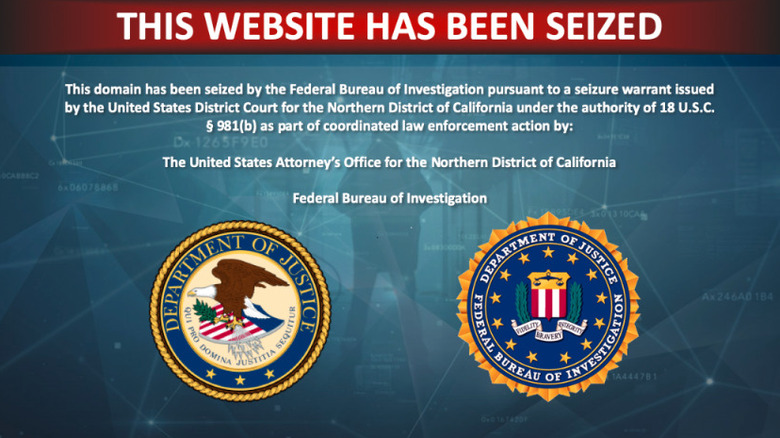
The U.S. government has also intervened in websites and web hosting providers facilitating illegal activity. When a torrent search engine was seized in 2010, the owner told TorrentFreak, "My domain has been seized without any previous complaint or notice from any court!" In 2010 alone, the government shuttered 82 domains related to piracy. In 2015, Rocky P. Ouprasith was sentenced to 36 months in prison for running the "second-largest" music piracy website. More recently, hosts of AI deepfake pornography were hit with seizures, with 12 sites being taken offline.
Famously, the feds used the deep web's more illegal side, often dubbed the "dark web," to track down and arrest the owner of illegal drug-selling site, the Silk Road. Under the name "Dread Pirate Roberts," after the fantasy film "The Princess Bride," Ross Ulbricht utilized the deep web's encryption provided by the Tor network to mask its location. Ulbricht was caught in a San Francisco library, where two FBI agents distracted him as an arguing couple, and a third grabbed the laptop. Despite being sentenced to life in prison for masterminding the drug-selling site and other crimes uncovered from messages extracted from the laptop, Donald Trump pardoned Ulbricht in 2025.
There are plenty of other cases out there, and with artificial intelligence now readily available, it's likely the government will continue to step in — if orders are given, that is. The President recently stated that objectors to the rampant build-out of AI are "traitors."