

Here's How Much Power Wind Turbines Generate
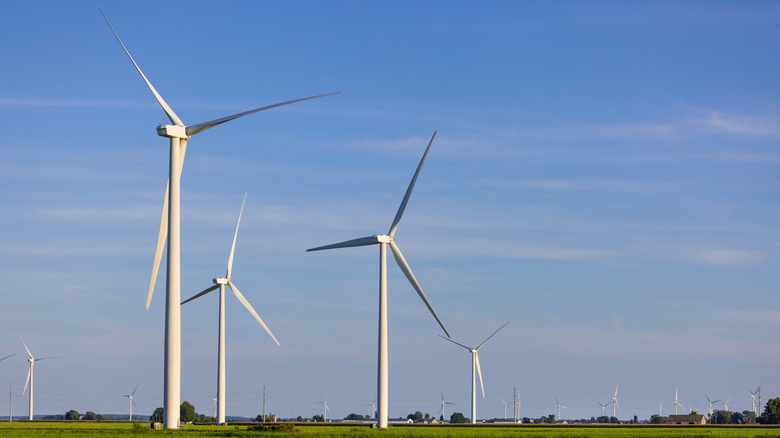
At full power, wind turbines can produce anywhere from a few hundred kilowatts to 20 megawatts of energy, so determining exactly how much electricity a wind turbine generates isn't exactly easy. Another reason for this is because the maximum rating doesn't really tell you how much electricity a turbine will actually produce, since that ultimately depends on where it's built and how much wind it gets over the course of the year.
Lawrence Berkeley National Laboratory's latest wind energy technology update estimates that new land-based turbines installed in the U.S. in 2025 had an average capacity of 3.8 megawatts. The lab's 2025 data isn't complete yet, so that average could still change. It's up from 3.4 MW in 2023, and the Department of Energy says that the 2023 average was already 375% higher than turbines installed in 1998 and 1999. Some offshore turbines are much bigger, too, with one of China's new offshore wind farms already operating a 16 MW floating turbine.
However, that 3.8 MW number is still just the turbine's rated capacity, which means it is the amount of power it can produce under ideal conditions. It isn't how much electricity the turbine sends to the grid at any given time. Wind speeds change a lot, and turbines have to be shut down sometimes for maintenance, when winds get too strong, or when the grid can't take any more power.
How much electricity does an average wind turbine actually generate?
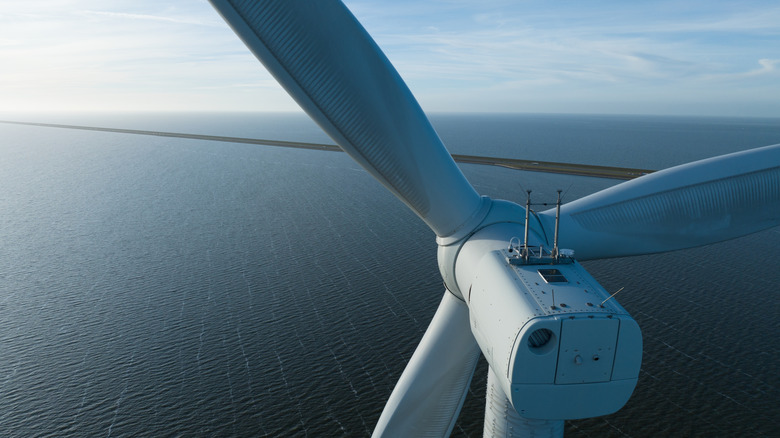
To measure how much electricity a turbine actually produces compared to what it would produce running at full power 24 hours a day, you have to look at something called capacity factor. This is the ratio of energy produced compared to the hypothetical max that a turbine could produce for a given time. And, based on preliminary data from the U.S. Energy Information Administration, the average capacity factor for utility-scale wind in 2025 was 34.2%. That's an average across all utility-scale wind in the country, though, and newer turbines may do a little better.
For example, Berkeley Lab found that wind projects built in 2024 had an average capacity factor of 37.1% in 2025. The U.S. Geological Survey also ran the numbers. Using a 2.75 MW turbine with a 42% capacity factor, the agency calculated that it could produce more than 843,000 kWh of electricity each month. That's enough to power more than 940 average U.S. homes. The USGS used turbines that came online in 2020 for the estimate, and 42% was the average capacity factor for new turbines at the time. That's a lot higher than the 34.2% EIA reported for all utility-scale wind in 2025, which includes plenty of older turbines in its lineup.
Berkeley Lab also tracks a turbine's specific power, which is its rated capacity divided by the area its rotor sweeps. Based on the lab's findings, turbines with lower specific power (bigger rotors for the power they're rated for) usually have higher capacity factors. That's part of why companies keep investing in bigger turbines, even though a single commercial wind turbine can take up to a decade to pay off.
Newer turbines are changing things up
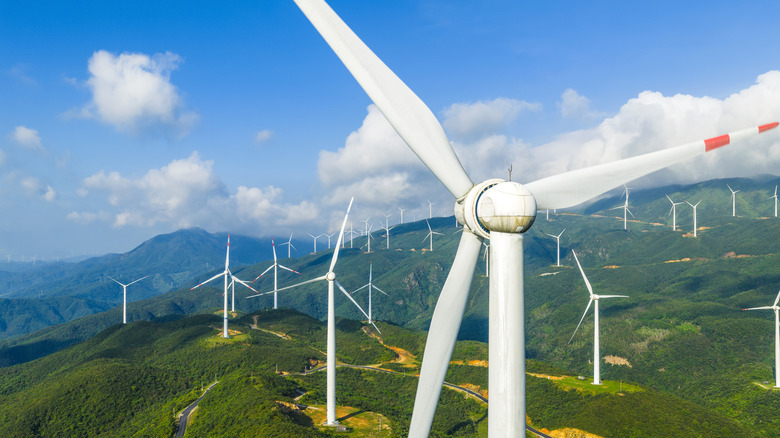
Comparing older wind turbines to new ones is a good way to see how much the technology has evolved. For example, the older Vestas V27, which is rated for only 225 kW, uses a 27-meter rotor and needs winds of around 3.5 meters per second before it starts generating power. In 2004, the Isle of Gigha in Scotland purchased three used V27 turbines from a wind farm in Cumbria and installed them as part of Scotland's first community-owned and grid-connected wind farm.
On the other end of the spectrum, you have the Goldwind GWH 300 / 20000. It's rated at 20 MW and uses a 300-meter rotor with 147-meter blades. China Three Gorges Corporation and Goldwind installed the world's first 20 MW turbine off the coast of Fujian, China, in January 2026. The turbine is expected to generate over 80 GWh of electricity a year, which it says is enough to cover the yearly electricity needs of about 44,000 households.
By rated capacity alone, that single turbine can produce roughly 89 times as much power as the V27. And if the Fujian turbine hits the 80 GWh a year that China Three Gorges Corporation expects, then it would run at a capacity factor of around 46%. Airloom, a Wyoming startup, is also working on a different approach by trying to create a unique wind turbine system that moves vertical wings around an oval track instead of using massive spinning blades on a tower.