

What Are Those Black And White Squares On Rockets For?
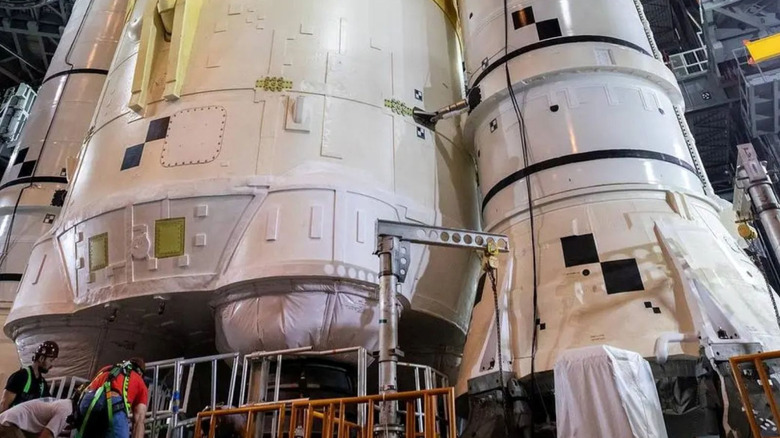
If you've ever viewed a broadcast of NASA's Artemis missions, you would have noticed some strategically placed black-and-white squares on various parts of the SLS moon rocket, which carried the Artemis II crew on a trip around the moon. These squares serve a very important purpose: they help NASA engineers track the movement and shape of the rocket at specific phases of a launch or wet dress rehearsal. The squares are painted on the rocket to assist a post-flight process called photogrammetry, where photo or video frames taken from more than one perspective during launch are used to create a three-dimensional representation of a rocket. Photogrammetry is also used by some apps to measure and duplicate objects for 3D printing.
For example, cameras mounted on a rocket can capture the movement of each square on a booster and help track how it moves during a launch sequence and booster separation. Cameras positioned at remote locations can use the same concept to track a rocket's trajectory and speed.
Data gathered by cameras are compared to computer simulations designed by engineers, and can be used to validate simulation data, or be used to relax certain launch constraints based on data obtained through this method. The reason the squares are black and white is to offer better tracking with sharp edges and high contrast, making them more suited for post-flight analysis.
Why do they paint rockets orange?
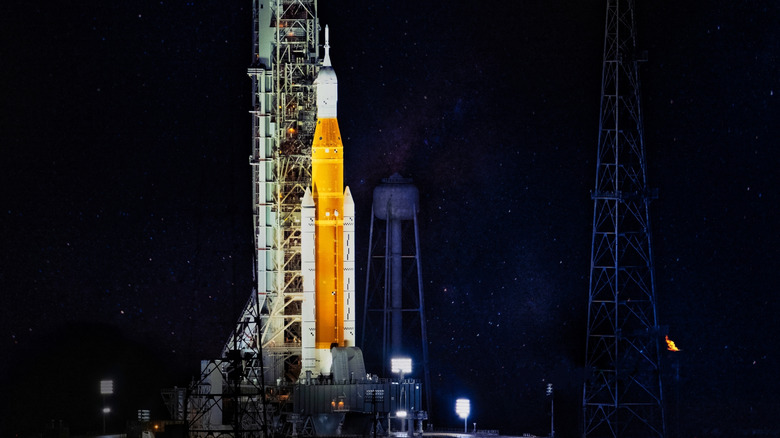
The black-and-white squares are especially apparent on the SLS's fuel tank, which NASA broke as part of the ultimate stress test. Even though it appears to be painted orange, it's not actually painted at all. The orange part of the SLS moon rocket is coated with an insulating layer of spray-on foam that is used to protect the rocket from the extreme heat and cold associated with a launch to space. The foam appears yellow in color, and when exposed to the sun's ultraviolet rays, eventually "tans" and takes on the signature orange color that NASA rockets are known for.
The foam insulation is required to protect the rocket and its fuel from temperatures between minus 423 degrees Fahrenheit to more than 200 degrees Fahrenheit. The insulation is flexible enough to change shape with the rocket, and strong enough to remain intact when exposed to the incredible speed and pressure of launch, moving from a standing start to more than 17,500 miles per hour.
The rocket's fuel requires insulation in order to remain cold enough to stay in liquid form. NASA's SLS rocket has cryogenic fuel made up of liquid hydrogen and liquid oxygen, which have to remain at minus 423 degrees and minus 298 degrees respectively.
The foam used for this insulation is made up of two fluids, which are kept separate until they are sprayed on the rocket. When the fluids mix, a chemical reaction takes place that transforms the fluids into foam.