

How Do Over-The-Air Updates For EVs Work?
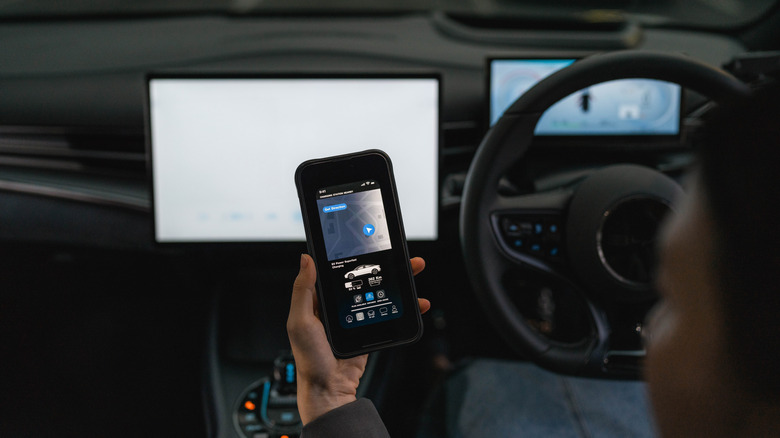
When your smartphone's manufacturer needs to fix the product's operating system, it sends out an update, which can be automatically downloaded and installed. If you own an electric vehicle, you'll also similarly receive notice about software updates designed to improve the vehicle's performance. Buggy software is one of the most common problems with EVs, and these software updates should fix such issues.
One way that some EV manufacturers deliver these software or firmware updates is through over-the-air updates; others may require you to visit the dealership instead. An OTA update occurs wirelessly. Even if you plug in your EV at night to recharge the battery, you don't have to also plug in an Ethernet cable or a USB flash drive to receive OTA upgrades. Each model is a little different, but the typical OTA update occurs through a cellular tower or when you're in range of Wi-Fi.
OTA updates are convenient for EV owners and give manufacturers assurance that owners will be more likely to comply with installing the updates. Most updates are free, especially for those involving a recalled feature on the EV (as mandated at the federal level). However, a few may require a subscription to an upgrade program to receive certain updates OTA. Hyundai, for example, offers free updates for three years after purchase. However, you'd then need to subscribe to its Bluelink service for OTA updates. Without a subscription, you may have to visit a dealer for updates and pay a fee.
Steps required for EV OTA downloads and installations
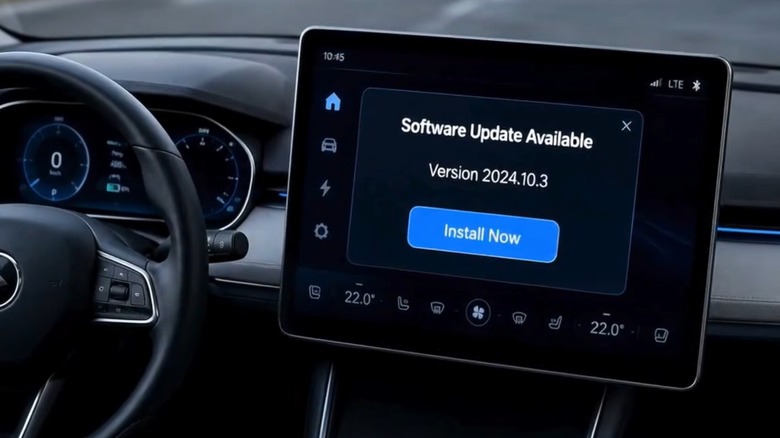
For most electric vehicles, the downloads occur in the background and should not affect your ability to drive. Tesla, for example, will attempt to send updates over Wi-Fi whenever possible, but it may also send updates over cellular connections as necessary. With some manufacturers, such as Volkswagen, you may have to opt in through the app to receive automatic software updates. With a Ford EV, your vehicle will arrive with automatic update downloads enabled, but you can turn it off through the app or infotainment screen and just visit the dealership for updates.
Once the download is finished, you should see a notification of a pending update on the screen inside the car or in the associated app. You usually cannot install the update while driving, as the EV must be parked. However, if an update won't affect the vehicle's driving performance, you may be able to install it while driving. For example, Ford allows some OTA update installations for its SYNC in-car infotainment system while you're driving.
Once you're parked, you can touch the "install" button, and the vehicle will begin implementing the updates. Any other instructions you need to follow to perform the installation will appear on the screen or in the app. You can use your associated app to check the status of the installation. It's not unusual for an update to take 30 minutes to install, but some may take more or less time.
How EV manufacturers are embracing OTA updates
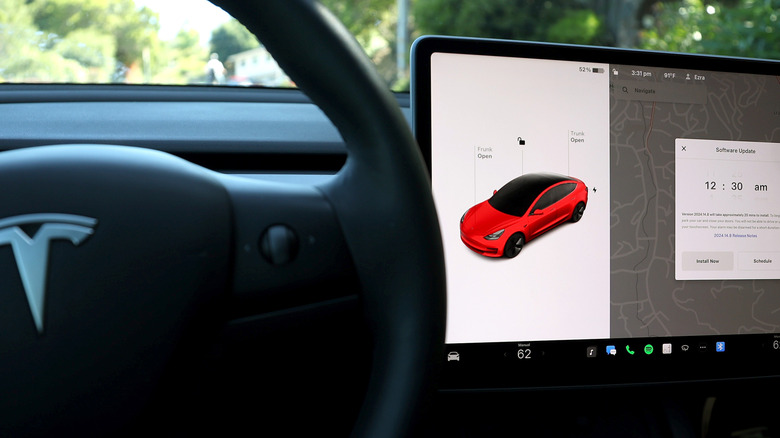
The first OTA updates for electric vehicles occurred with the Tesla Model S in 2012. However, EV manufacturers as a whole have not provided extensive OTA updates in large numbers until the last few years. In a recent report, the International Energy Agency estimates that fewer than five EV models allowed complete OTA updates in 2022, and the agency's estimate for 2027 is that nearly 25 models will allow extensive OTA updates. EV manufacturers may not be rolling out OTA updates as quickly as expected because of concerns over safety. For example, Stellantis pushed a buggy update to Jeep hybrids in 2025 that caused some vehicles to stop working while in motion, leaving drivers stranded on the road.
Once you receive notification of an update, you should install it as soon as you are able. Some people plan for installations to occur overnight so that the updates don't interrupt their normal driving habits. Ignoring software updates on devices like your EV is not a good idea, as you may miss out on important safety fixes or create incompatibilities that affect the car's performance. Some EV manufacturers — such as Ford, General Motors, Lucid, Mercedes-Benz, Porsche, Stellantis, Tesla, and Volvo — have used OTA updates to quickly fix issues that are part of recalls.
One problem with driving an older electric vehicle is that discontinued EVs may no longer get software support through OTA updates, as software support for older EVs is not required in the United States. It's possible that EV manufacturers will simply shut off support for discontinued models, meaning you may lose access to certain features, such as map updates and new safety features.