

A New Dwarf Planet May Be Hiding Beyond Neptune

Surprisingly, our solar system still has a few secrets for us to uncover. For a long time, Pluto was the undisputed king of the outer edge of our cosmic neighborhood. But now it seems it may soon have to share the spotlight. Why? Because astronomers just identified a mysterious object located far beyond Neptune (our outermost planet). The newly discovered body, named 2026 ED138, was spotted using the Vera C. Rubin Observatory in Chile.
It might not sound like much to find a new rock in the sky, but the discovery is a big deal. Scientists estimate this distant world is about 46 astronomical units (au) from the sun, which is farther out than Pluto, at just 40 au; they also noted it could be anywhere from about 370 to 970 miles in diameter, which would make it one of the largest objects ever found in that region. But if it's so big, why did it take so long to find?
Simply put, the answer is galactic camouflage. This object just so happens to orbit a crowded region of the sky near the plane of the Milky Way, where there are thousands of bright stars in the background cluttering the view. Obviously, that'd make spotting a faint, slow-moving sphere fairly tough. Astronomer Matthew Holman of the Harvard-Smithsonian Center for Astrophysics made the discovery using a powerful computer algorithm to sort through the Rubin Observatory's enormous dataset. With it, he finally peered through the camouflage and saw this "new" inhabitant of our solar system.
Waiting for its official status
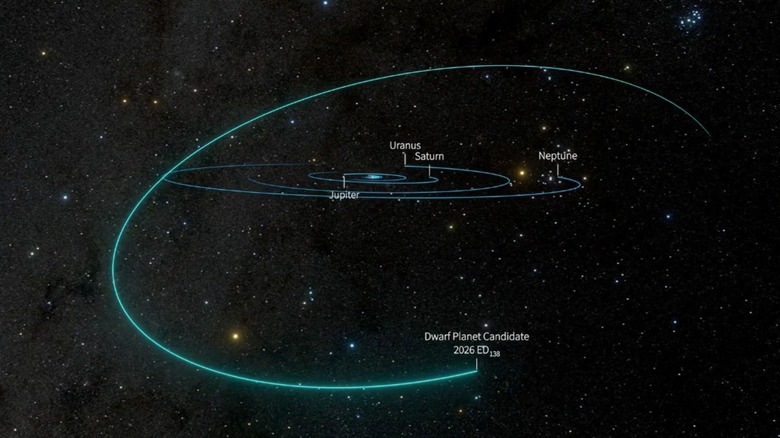
So, does this newly discovered icy giant automatically become the ninth planet in our solar system? Not exactly. Right now, 2026 ED138 is only classified as a dwarf planet candidate. To officially join the dwarf planet ranks of Eris, Haumea, Ceres, Makemake, and Pluto, it needs to prove it's a true dwarf planet; this classification holds the middle ground between full-sized planets and smaller rocks. To gain this status, 2026 ED138 must orbit the sun and have enough mass for its own gravity to crush it into a round-ish shape.
Unlike full size planets, a dwarf planet lacks the necessary gravitational muscle to clear its orbital path of any surrounding debris; this exact rule is what famously knocked Pluto out of the planet club back in 2006. Soon, astronomers may point the James Webb Space Telescope at 2026 ED138 to learn more about it and see if it has a moon. If astronomers do grant it official status, it'll trade its boring number for a permanent name agreed upon by a scientific committee.
Regardless of what 2026 ED138 is finally labeled, though, finding such a large object fundamentally changes how we view the outer edges of our solar system. 2026 ED138's highly tilted orbit suggests that ancient gravitational interactions originally flung it into its strange trajectory. New discoveries like this are exciting for scientists, as they act like a cosmic time capsule, offering fresh clues about the chaotic interactions that shaped our solar system.